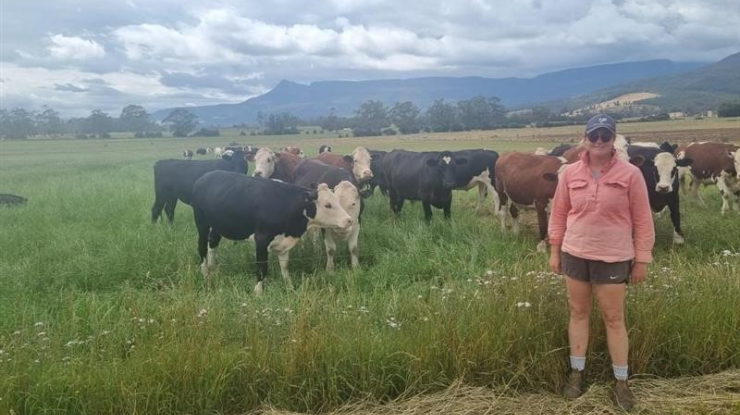
 Zuleika (pictured) and Marcus Crowden view non-replacement calves as an opportunity, not a byproduct, of their dairy business. Image: Zuleika Crowden
Turning dairy calves into profitable beef
For one long-established dairy farming family in Tasmania’s Central North, beef from dairy has never been a sideline – it’s been part of the business for generations.
The current operators, Marcus and Zuleika (Zed) Crowden, are continuing the system Marcus’ father began, using the farm’s large land base to run a profitable, strategically managed dairy beef enterprise alongside milk production.
With 700 cows in milk, the business now draws roughly one-third of its income from beef and two-thirds from milk.
|
FARM SNAPSHOT Name: Marcus and Zuleika Crowden, Central North, Tasmania Area: 1,000ha (with 300ha irrigation) Enterprise: 1,000 dairy (700 milkers, 300 juveniles), 1,300 dairy beef, 200 Angus, fodder, potatoes Pastures: Perennial ryegrass – improved pastures Soils: Red basalt to heavy black clay Rainfall: 1,200mm |
Managing non-replacement calves with clear purpose
The Crowdens view non-replacement calves as an opportunity, not a byproduct.
All non-replacement calves are grown out on-farm, finished to high liveweights and processed directly through Greenham.
Steers reach about 650kg liveweight and heifers approximately 600kg.
The herd, built from medium to large Holstein cows crossed equally to Hereford and Angus sires, produces consistent carcase results.
In the last financial year, 698 head were supplied to Greenham at an average carcase weight of 301kg, reflecting strong growth and reliable market alignment.
Calving is split between autumn (producing animals finished at 26–28 months) and spring (stock finished closer to 30 months of age).
The farm operates grain-free, making late autumn and winter finishing more challenging, but strong pasture growth in spring and summer provides compensatory gains.
From Christmas to August, about 40 head are sold each fortnight – roughly two semi-loads per month – which ensures steady cash flow and well-timed destocking.
Beef from dairy blends values and practicality
For Marcus, dairy beef is both tradition and logic.
“We’ve always done it – with the size of the farm, we either need to grow crops or run beef cattle to utilise the land,” Marcus said.
Strong values underpin the system as well. He opposes bobby calf practices on principle.
“You shouldn’t just mate a cow to then just throw away the income that could be generated from the calf. If you can turn that calf into something profitable, why wouldn’t you?”
Productivity and emissions insights
The dairy enterprise supplies milk to Cadbury and therefore reports its emissions profile annually. The dairy component consistently sits just below average, which in turn makes the dairy beef operation appear extremely low emissions on paper.
While this currently has no effect on the farm gate price, Marcus believes demand for low-emissions beef will grow and sees long-term potential in this space.
Breeding and management strategies
“The bobby calf issue is a real issue and one I’d like to see real change on – the CalfWays project is a step in the right direction,” Marcus said.
“It’s one of the first projects that I can see making a real difference.”
Reproduction is tightly managed to maintain herd replacement levels while supporting beef production. Cows that conceive in the first three weeks to sexed semen produce the 25% of heifers needed annually.
All remaining cows are joined to Angus or Hereford to produce beef calves. The beef enterprise does not negatively affect milk production – the two operations complement one another, particularly through improved pasture utilisation.