 Jock Hughes and Claire Burbury run Cluden Newry Pastoral with their three sons. Image: Pip Williams Photography
Better management powers productivity gains
MLA is the event partner of Tasmania’s Red Meat Updates, which shines the light on the latest innovations in agribusiness, pastures, livestock and more. Each year, the flagship event invites attendees on a ‘virtual farm tour’ (sponsored this year by Pinion Advisory) to see how innovative red meat producers are achieving profitable and sustainable business success.
This year the spotlight was on Tasmanian mixed livestock and irrigated cropping business and Angus stud, Cluden Newry Pastoral, owned and managed by Jock Hughes and Claire Burbury.
The business has been family-owned for close to a century. Under Jock and Claire’s stewardship, the focus has shifted to growth and business development, with their long-term goal to pass on a thriving business to their three young sons. Maintaining a work–life balance to enjoy family time with them is an equally important priority.
They shared how their management strategies have delivered an impressive productivity uplift.
As shown in the virtual tour, the couple have seen stocking rate increase from 9,527 dry sheep equivalent (DSE) managed in 2012–13 at an average annual stocking rate of 12.3 DSE/ha to 27,592 DSE in 2024–25 at an average stocking rate of 19.7 DSE/ha.
Their profit has increased from $338/ha to $933/ha over the same period.
Where it all began
Jock and Claire’s property ‘Jessiefield’ has been in the family since 1927 – it was established as an Angus stud by Jock’s grandfather, Richard Hughes, in 1956.
Today, Jock and Claire target calving ease and high growth with a focus on carcase and eating quality, using fixed-time artificial insemination to achieve their breeding objectives.
Their annual on-site bull sale is a highlight of the year, and the offering is backed by a dedication to data. Bulls are videoed for AuctionsPlus, semen-tested and thoroughly catalogued for the sale.
Investments spark growth
In 2018, Jock and Claire decided to expand their commercial beef enterprise and bought ‘Biddle Creek’ at East Tamar. They invested in irrigation infrastructure to scale the business quickly and provide plenty of grass for weaners.
Cows which are culled from the seedstock herd are moved across into the commercial herd at Biddle Creek.
“They’re still good functional cows even if they’re not good enough to stay in the stud,” Jock said.
“All heifers and cows are joined with yearling bulls at 14–15 months old. The bulls then come home to Jessiefield and are sold through the sale.
“It’s pretty complementary in that respect – we get access to what we think are the best genetics commercially.”
Jock and Claire built their base of commercial breeders by buying heifers from the mainland, where dry conditions had produced fairly lightweight heifers. So it wasn’t a surprise that, at first, conception rates were lower than ideal.
Their investment paid off however, with close to 700 commercial calves born each year.
Around 350 steers are sold each year weighing between 400–500kg to meet feedlot entry weights, an approach Jock says gives him flexibility to sell earlier depending on how the season goes. He joins all heifers and sells them pregnancy tested in calf, or fattened, to Greenham or JBS.
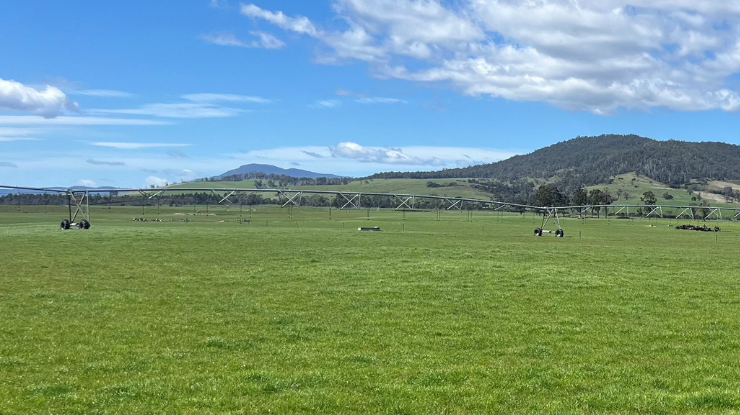
Infrastructure investments in irrigation have driven on-farm productivity. Image: Jock Hughes
Prime lamb
Jessiefield is home to 2,000 ewes which are joined for a winter lambing. This year, 4,000 prime lambs – some of which are trade lambs – will be finished.
“We buy in replacement ewes and join everything to a terminal sire and finish the lambs with an aim for roughly a 23kg carcase,” Jock said.
“This year, however, we didn’t buy in any ewes – we’re weighing up the returns and deciding whether we want to keep running ewes long-term.”
Shifting from a spring to a winter lambing system means they can get as much finishing done as possible without having to rely on irrigation.
“We want the dryland system to stand on its own rather than relying on growing feed under irrigation,” Jock said.
“We prioritise our water for the high-value cash crops we grow including poppies, peas, potatoes and grass seed.”
Infrastructure key to business growth
Investment in irrigation has been a significant driver of productivity at Cluden Newry Pastoral. Jock introduced pivots at Jessiefield in 2005, and this property is now fully developed.
Biddle Creek has also undergone significant improvements and boasts 95ha of irrigation systems – a marked difference from when they bought the ex-plantation property, which had little to no quality pasture or yards.
Their neighbour kindly lent them his yards in those early days with Jock subsequently installing yards of his own.
At their leased property, ‘Glen Ireh’, near the town of Perth, ample shelter belts planted by the owner have been a boon for calf survival rates. Jock has also added paddock drains at this property to manage the wet winters.
Industry involvement
Off farm, Jock maintains an active involvement in industry. His membership of the Southern Australia Livestock Research Council (SALRC) sees him contribute to which research priorities are funded by MLA on behalf of levy payers.
“It’s about sharing regional problems and making sure that MLA is across the producer issues around the country,” Jock said.
Industry connections and access to support and advice from other producers are key benefits Jock has identified from his involvement in a range of producer groups. He said being part of the Longford Red Meat Group has been a key driver of change.
“We’ve been part of two MLA Producer Demonstration Site (PDS) projects – one on rotational grazing versus set-stocking lambs under pivots with clover and ryegrass, and the other on lamb mortality on legume crops which is already providing some useful data and learnings,” Jock said.
Participation in the Australian Wool Innovation-funded Lifetime Wool project, the Rural Industries Skill Training course Lifetime Ewe Management and MLA’s Pasture Principles has added to his grazing management toolkit.
Controlling cost of production
As Jock explains, cost of production is one of the few things that can be controlled in a red meat business.
Benchmarking and collecting data on farm productivity has firmed up Jock and Claire’s understanding of where their business can improve and what is actually driving profitability.
Joining a producer benchmarking group in 2017 has been a valuable opportunity to discuss group members’ businesses and help each other identify where improvements can be made.