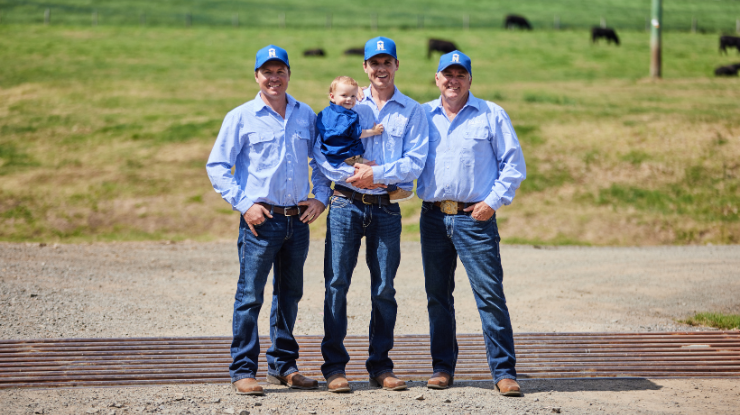
 James, Harry, Jack and Robert Mackenzie
Mixed pastures boost resilience
Robert Mackenzie and his family have taken a proactive approach to building climate resilience into their business.
Across their mixed breeding and seedstock enterprise in NSW, Macka’s Beef, the Mackenzies have made pasture improvement and soil health the focus of their strategy to withstand both the extremes of climate and the demands of a changing market.
Each year, around 400ha are sown to new or renovated legume-rich pastures selected for complementary root structures – from shallow clovers to deep-tap-rooted chicory and lucerne – to boost carbon sequestration and moisture retention.
“By mixing species with different root zones and tap roots, we’re sequestering carbon deeper into the soil and holding more moisture,” Robert said.
That focus on soil and feedbase diversity has been central to a decade-long transformation of the business.
“Over the past five or six years, we’ve seen droughts we’d never seen before, as well as floods we’d never seen before,” Robert said.
“Every time we get knocked down, we get back up and think about what we can do differently.”
The answer, he said, has been to make every part of the business more self-reliant. The Mackenzies have expanded water storage and infrastructure across their eight properties to ensure no animal walks more than 800 metres to water. They’ve also built four hay sheds and stored 10,000 tonnes of silage to buffer against drought.
Soil health
Soil health underpins every decision. Each February, the family takes 1,400 soil samples across their 6,500ha to track carbon, biology and fertility. The data guides variable-rate fertiliser application and helps target areas for further pasture improvement.
“We reduced our inputs and our labour by understanding our soils,” Robert said.
“It’s about managing what you can measure.”
A rotational grazing system with small groups of around 120 cattle supports pasture recovery and animal welfare.
“Cattle will stay in a paddock for three to five days, then it’s rested,” Robert said.
“Happy, relaxed animals are more productive.”
Genetics investments
The Mackenzies’ approach combines genetics, management and measurement to improve both productivity and sustainability. The family has invested heavily in high-feed-efficiency Angus genetics, integrated their data through AgriWebb for animal tracking and developed their own mineral lick − combining probiotics and Australian-grown asparagopsis −to improve animal health and reduce methane emissions.
Every aspect of the Mackenzie family’s approach to business decisions is innovative and proactive, so for Robert, sustainability is about ensuring both future viability and succession.
“We’re a multi-generational business,” he said.
“Everything we do now is about setting the next generation up for success, leaving the land and the business in better shape.”
The pasture work sits within a broader focus on carbon neutrality and efficiency. Since undertaking soil carbon sampling and mapping, Macka’s Beef has determined that, through improved pastures and soil management, it sequesters more carbon than it emits each year.
“We’re drought-proofing ourselves and future-proofing the business,” Robert said.
“A 1% gain in soil organic matter, means 160,000 litres more water per hectare, and that’s our insurance in dry years.”
He believes climate resilience starts with measurement and mindset.
“Know your footprint, understand your soils and work with an agronomist who knows your country,” he said.
“And share what works. If we can all rise together, it’s better for the industry and the country.”