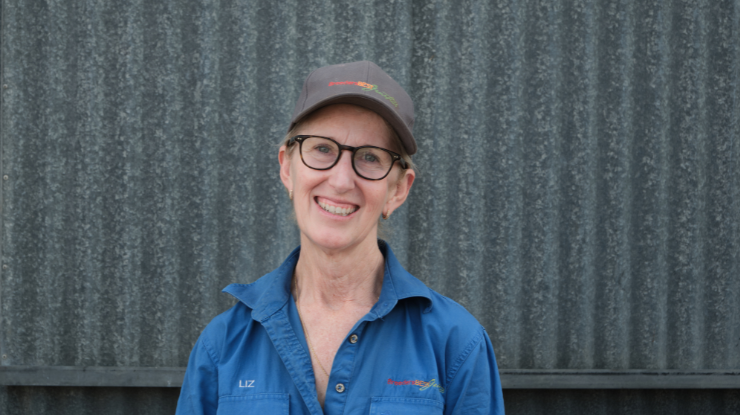
 A producer with many hats, Liz leads both commercial and genetic programs while championing improved medical access for rural families in the wake of her late husband’s death.
Driving change from the paddock up: one woman’s fight for her flock, family and farmers
When Liz Heggaton steps into the lambing paddocks on her family’s WA property, the work feels both familiar and newly weighted.
For nearly 40 years, she and her late husband, Dr Craig Heggaton, built a life around sheep – weaving together veterinary science, reproduction technology and practical stockmanship into a genetics program that now reaches producers across the country.
Now, 18 months after losing Craig to suicide while he was undergoing androgen deprivation therapy (ADT) for prostate cancer, Liz’s resilience, determination and love for the industry have enabled her to continue that work on her own.
Balancing the scales
With a commercial flock, seedstock business and a cropping production, Liz has spent the past year and a half balancing a lot of scales.
She manages two separate flocks across the 14,000ha property – one caters to the Heggatons’ BreedersBEST Genetics and Genstock artificial breeding work (artificial insemination and embryo transplant), while the other operates as a commercial flock supplying to Western Australia Meat Marketing Co-operative (WAMMCO).
“It may seem like a full-on sheep operation, but sheep are only about 15% of what we do,” Liz said.
“It’s our cropping that takes up the majority of our production – spanning 12,000ha.
“However, when Craig and I built each of these businesses, we integrated them into one system that allows each of their day-to-day requirements to fit seamlessly together.
“We were a really good combo,” she said. “Craig was a veterinarian and I come from a family that has a long farming history that stretches back to the 1830s.
“I think it was that foundation we set together that has enabled me to continue even though he is gone.”
Today, it is Liz who runs the sheep from start to finish, while her son James – who now resides on the property with her – manages the cropping enterprise.
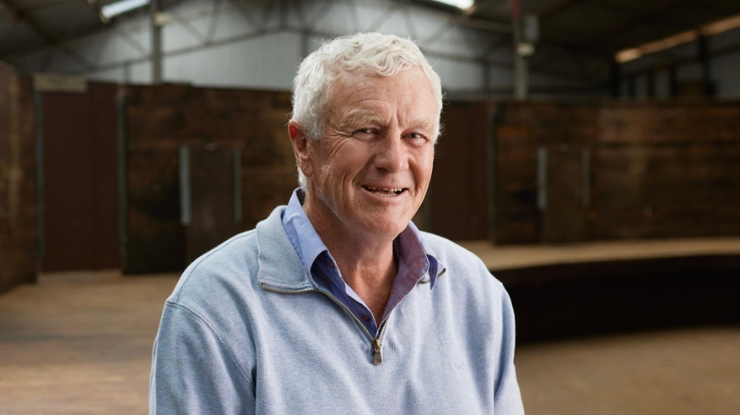
The late Dr Craig Heggaton. Image credit: WAMMCO
Fitting into your good genes
WAMMCO’s customers, ram buyers and semen and embryo importers all have high expectations when it comes to the quality of products from the Heggaton farm, which is why genetics are at the forefront of Liz’s on-farm decision making.
Her clientele has expanded over the past few years, meaning she now has to meet the genetic needs of buyers from throughout WA, up to Darwin, and across to the east coast.
“Data is the driver of our management strategies on farm,” she said. “Every stud lamb – close to 3,000 a year – undergoes genomic testing.
“This provides Australian Sheep Breeding Values (ASBVs) which are used alongside the animal’s on-farm records and physical appearance.”
Targeting growth, muscle, fat and eating quality traits, Liz’s breeding objectives aim to deliver on-farm productivity that translates to off-farm profitability.
“Many of the traits we target aren’t just crucial to ensuring a product fit for market, they’re crucial to animal survivability, productivity and overall health on-farm,” she said.
“Reproduction is also an important trait we’re constantly working to improve.
“Our embryo recipient program has a 70–75% success rate and requires ewes with really good reproductive traits.
“WA is also quite hot and our climate can often be incredibly harsh, so we look to target twin bearing traits rather than triplets – ensuring ewe productivity and lamb survival.”
According to Liz, even with data underpinning her decisions, the reality of WA’s harsh climate – and its effect on the paddocks – is what ultimately sets the timing of her management choices.
With a late autumn break and minimal spring rainfall, Liz works to make the most of a short wet season.
“We preserve fodder in the autumn by confinement feeding all stock up to a couple of weeks prior to lambing,” she said.
“Post lamb marking, we then commence rotational grazing, utilising clover and ryegrass improved pastures – this ensures maximum nutritional needs are met.
“We also maintain separation between our two flocks during this time, with our seedstock flock lambing in May–June and our commercial flock lambing in July.”
“In July, we re-open our rested paddocks that have clover and ryegrass, which last all the way through to weaning in spring.
“Most of our commercial ewes are twin bearing, so we want them lambing in the paddocks with the best nutrition and shelter supply.
“Currently, our commercial twin bearing ewes have a 170–180% weaning rate – which is really great considering we have them lambing during the coldest and wettest time of year.”
Kojonup and up
Liz describes the loss of Craig as both personal and practical – something she has had to navigate across the spectrum over the past year and a half.
“We lost Craig, not only as a husband and father, but as our vet too,” Liz said. “He’s left behind a gap I feel every day, whether it be in our home or in our paddocks.
“As the vet on-farm, Craig shaped a lot of our reproductive work and took the lead in our artificial breeding programs.
“These jobs are now left to me to continue, and while his skillsets were probably better suited, I am not one to throw the towel in. I love the sheep industry – it’s important for me to find a way to keep myself and my businesses going.”
According to Liz, this is where community and industry members come into play.
“James’ integral involvement with our family operations has really enabled me to focus on our seedstock flock,” she said.
“He’s been really supportive in my decision to not only continue the operation of our three sheep enterprises, but the efforts I’ve been making to ensure their continued growth and profitability.”
As part of this, Liz said she has employed the help of sheep consultant Jason Trompf for genetic selection guidance, hosted several client field days, and opened her farm gates to international Australian lamb ambassadors.
“I’ve focused quite heavily on my relationships with others during this time – especially our clients who are so critical to our business’s success.
“Their support and ability to promote our businesses through word-of-mouth is so valuable.
“Last August, I had more than 50 clients attend our field day, and over the last two ram sales, I completely sold out.
“Along with James, I feel really proud of our efforts. It’s been an incredibly hard period for me, but I’ve persevered, I’ve leaned on my support systems, I’ve put myself out there, and despite the challenges, I’ve bettered the profitability of my businesses.”
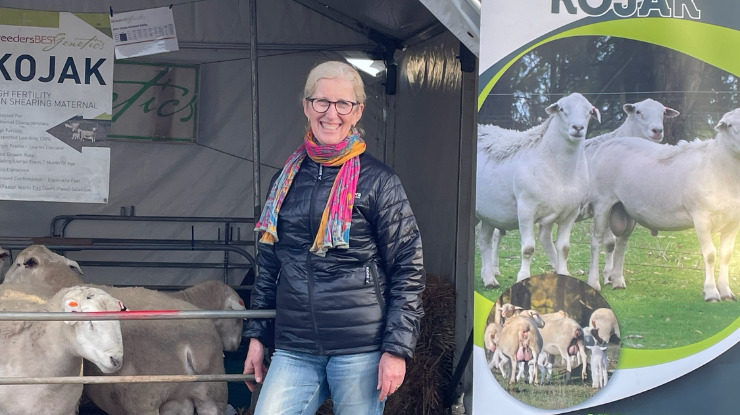
Liz showcasing her Kojak maternal line – one of four breeds in her BreedersBEST genetics program alongside Prolifics, White Suffolks and Poll Dorsets.
Opening the farm gate
Liz has also participated in MLA’s Lambassador program – hosting 16 international chefs, butchers and food influencers on-farm as part of the program’s delegation celebrating 10 years.
“The Lambassador program utilises the skillsets and influence of international food professionals to further promote the consumption of Australian lamb in their home countries,” she said.
“Our commercial flock supplies to international markets via WAMMCO, so when Rob Davidson – the WAMMCO Manager of Supply Development – raised the delegation with me, I felt it was a wonderful initiative I could get behind.
“Hosting them on-farm, I was able to show some of the hard work, passion and care behind the end product.
“It was great to not only showcase my work, but also my husband’s legacy – both things I’m proud to share.”
Bridging the health gap for rural cancer patients
Medical isolation is not an unfamiliar concept to many Australian producers, and since Craig’s passing, it’s something Liz is looking to change.
“When Craig was diagnosed with prostate cancer at 56, he underwent a radical prostatectomy and went on cancer-free for five years,” she said.
“Unfortunately, the cancer then metastasised, so androgen deprivation therapy was the treatment recommended.
“At the time, I had no understanding of the potential mental health impacts of the treatment – or the 70% increased risk of suicide the cancer posed alone.
“It felt like every step of the way we didn’t know until it was too late.
“I became very aware of the isolation we experience living on a property – especially from a medical standpoint – and I felt deeply that what Craig and our family went through is something I’d never want anyone else to experience.”
Liz began serving as an advocate for rural families impacted by prostate cancer six months after Craig’s death.
With the message that ‘early testing ensures early intervention’ driving her actions, Liz began speaking to journalists, members of Federal Parliament, and featured on Australian Story in 2025.
A large part of reducing the likelihood of mental and physical health deterioration and, more importantly, reducing the number of deaths related to prostate cancer is increasing accessibility to medical care for rural and remote communities – something Liz acknowledges that she can’t do alone.
“Rural and remote Australians have poorer survival rates after cancer diagnosis,” she said.
“This is all due to longer, and therefore more costly, travel to access specialised medical care, reduced access to clinical trials, and substantial wait times when accessing a local GP.
“Prostate cancer in particular only receives about half the Federal funding as other major cancers – which could be why so many of the men who are diagnosed have to undergo a treatment with so many negative side effects.
“My hope through this work is to encourage and increase awareness, research funding and accessibility to healthcare services for rural and remote Australians.
“Protecting and ensuring the longevity of Australia’s red meat industry is not just about genetics, pastures and animal management strategies, it’s also about looking after the people behind it,” Liz said.
“Because without them, our industry and its standards simply wouldn’t exist.”