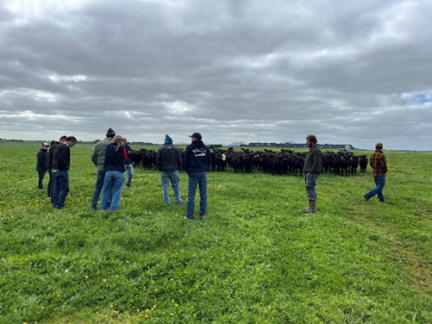
 Early weaning group session at the Mortons’ farm looking at weaned calves on clover.
Early weaning helps tackle tough seasons
Tim and Stacey Morton are part of a large family-run operation near Penshurst, just south of Hamilton, in Victoria’s Western District.
Historically, their business has sat at 70% Corriedale sheep and 30% Angus cattle but recently, the Morton family made significant changes to their business model due to wool market challenges increasing costs of production and lower lambing percentages. Tim and Stacey decided to switch from a 70% sheep to a 70% beef cattle operation to improve profitability but also reduce labour requirements.
One of their main goals is to hand a financially viable farm operation to their children, should their children decide to pursue a career in farming. To ensure the changes became viable and profitable, the Mortons decided to participate in the MacKillop Farm Management Group’s Producer Demonstration Site (PDS) project, ‘Post-weaning management strategies in beef herds’, to improve their weaner cattle management.
Weaning strategies
Previously calving in May/June, the Mortons have found limited flexibility to sell cattle when seasonal conditions are unfavourable, leading to high supplementary feed requirements throughout calving. For this reason, they switched to a mid-July/August calving. They plan to wean in February, with flexibility to bring it forward to January or even December based on seasonal conditions.
In the past, the Mortons would hold weaner calves in the cattle yards overnight before letting them into a holding yard with ad lib hay for one week. After that, calves were processed through the yards to be weighed and receive a 7-in-1 booster vaccination and drench. They then went out to finish any paddock feed available before being supplemented with hay until adequate feed was available after the autumn break.
Weaners typically weighed an average of 330kg for steers and 300kg for heifers and gained around 300g/day between February and April. Depending on the arrival of rain, they would stagnate for six weeks through May as the autumn flush came through before slowly increasing growth rates up to 2kg/day with compensatory growth in September. Whilst the Mortons were weighing calves and getting feed testing done on hay and pasture, they were not utilising this data to inform management decisions.
Throughout the course of the PDS, the Mortons refined their weaning process. Calves are now held in yards for a minimum of three nights, with ad lib silage or vetch hay available as well as pellets. They are handled twice daily during this period, using low-stress handling techniques. Tim and Stacey have been trialling different post-weaning management strategies, including silage and pellets, summer crop, sorghum and early weaning onto clover and ad lib pellets. Results have been varied, with growth rates of around 650g/day on summer crop (Pillar) yet closer to 1kg/day on silage and pellets.
Early weaning as a management tool
In September 2024, the PDS project held an information day discussing intricacies of early weaning as a management tool in tough seasons. Determining the most appropriate time for weaning depends on a variety of factors, including:
- time of calving
- seasonal variations
- feed availability (both pasture and supplementary)
- options for sale
- labour availability.
Weaning early can minimise supplementary feed requirements, which in a tough season can be a significantly beneficial management tool. Furthermore, the cow-calf unit will drink about 50L per day more than the pair if separated, which becomes an important factor to consider in tough seasons when water is less plentiful.
Weaning early can also increase marketing flexibility, allowing the sale of non-productive or cull cows earlier and in better condition. Removing these cows early allows better pasture allocation for calves, or cash flow may facilitate the purchase of higher quality supplementary feed to maximise growth potential of weaners. Maintaining weaning timing flexibility can also help sustain a more optimal body condition in breeding cows.
True early weaning is typically considered a minimum of three months of age and 130kg liveweight. In many southern farming systems, it is not unusual for calves to be weaned at nine months of age or older. Consequently, for the purpose of this case, we are not necessarily describing true ‘early’ weaning but rather utilising an earlier weaning as a tool to help get through a tough season.
In 2024, the Western District of Victoria experienced extraordinarily dry conditions throughout autumn and winter. With their late autumn calving system, Tim and Stacey found themselves calving onto minimal paddock feed. Without an autumn flush of feed coming through, they were heading into winter with cattle in peak lactation and consequently extreme supplementary feed requirements to maintain the condition of their cows with spring forecasts also looking unfavourable. With lush clover in early spring from the little rain they did get, the Mortons decided to wean earlier. This allowed them to prioritise the feed on the ground for calves and maintain condition on their cattle with lower supplementary feed requirements.
Tim and Stacey weaned half of their calves early, at four to five months of age and with an average weaning weight of 150kg. After yard weaning, these calves went onto fresh clover pastures with between 2000–3000kg dry matter (DM) feed on offer (FOO). The calves had access to vetch hay and ad lib pellets in feeders, however, they did not eat significant amounts of either supplementary feed until paddock feed was largely utilised. The calves gained around 500g/day throughout the entire period.
The Mortons were pleased with their decision to wean early given the seasonal conditions. Their cattle maintained excellent condition, joined well and were in great condition (BCS 3.5–4/5) coming into calving in 2025. They did not need to start supplementary feeding mature cattle until mid-April 2025, which is later than would have been expected given the continued dry conditions in the Western District.
The biggest challenge found with early weaning was increased calf losses, at 2.5% as opposed to their normal losses (below 1%). Unfortunately, these losses were random, experienced over an eight-week period and of animals of varying weights, and consequently, no post-mortem examination was undertaken.
Moving forward, Tim and Stacey plan to routinely wean at around six months of age, utilising earlier weaning as a seasonal condition management tool.
Benefits of being involved in the PDS project: Post-weaning management strategies for beef herds
Over the course of this PDS project, participants heard presentations from livestock nutrition advisors to improve knowledge around the nutritional requirements of weaners and the different options for meeting these requirements. Interpreting and utilising feed test results was a key focus. The Mortons have used this information to make informed decisions when planning different post-weaning management strategies. It has allowed them to utilise data they were already collecting to understand potential outcomes and make managerial adjustments for the best chance of success. The benefits of this were most noticeable in the failed autumn of 2024, when the Mortons planned an early weaning to best manage their cattle through the difficult seasonal conditions.
One of the most valuable sessions for the Morton family was the stock handling session held with Dr Lachlan Strohfeldt of Livestock Production Vets. This session focused on minimising stress at weaning through handling and educating livestock during yard weaning. Not only does this have significant animal health and production benefits, it allows for safer handling throughout an animal’s life, resulting in notable work health and safety (WH&S) advantages. While the Mortons have always practiced some low stress stock handling techniques and valued the importance of educating cattle at the time of weaning, this session was found to be a great refresher and encouraged the family to reprioritise time spent with weaner cattle and upskill those who didn’t have the necessary experience.
The Morton family found great value in being involved in the MacKillop Farm Management Group’s ‘Post-weaning management strategies for beef cattle’ PDS, particularly at a time when significant changes are being made and are grateful to have had the opportunity. Tim and Stacey feel they are now doing a better job with both their weaners and their heifers, as well as being better equipped to make management decisions around weaning strategies moving forward.
Key messages1. You don’t know what you don’t measure! Collecting data, keeping good records and taking consistent measurements will be crucial to inform decision-making. 2. Nutrition, nutrition, nutrition! Allocating feed to different classes of livestock will minimise the need for supplementary feeding. This year the Mortons are three to four months ahead of where they were last year, simply by implementing changes in dedicated feed resources. 3. Low stress handling has significant benefits. The benefits of low stress stock handling and weaner education have been emphasised throughout the course of this PDS, including animal health and production and long-term ease and safety of handling. |