Goat grazing trial reduces bushfire risk
The inquiry responding to the widespread devastation of the 2019/20 Black Summer Bushfires recommended implementation of alternative methods to mitigate and reduce potential fuel load in fire prone areas.
One of these methods was controlled grazing using goats.
Since February 2021, ‘Goat Brigades’ have been supporting rural firefighting efforts through deployment into Asset Protection Zones – the areas surrounding built assets such as residential housing, commercial infrastructure, or machinery sheds – and Strategic Fire Advantage Zones or control points near Asset Protection Zones to reduce risk of spread or spot fires.
Through controlled grazing in areas with varying vegetation types, density, and differing topography, goats have been effective in reducing and mitigating fuel loads from fire prone regions.
This initiative has been funded by the NSW Government’s Bushfire Mitigation Program through to the end of June 2026.
Goat Brigade at work
The ‘Goat Brigade’ is made up of vendors verified by the Rural Fire Service (RFS). These vendors have established businesses and associated practices to responsibly hire goats for vegetation clearing.
Depending on the location and size of the project, the size of the mobs hired for grazing are scaled up and down.
Grazing is controlled in a ‘cell’ process, which replicates managed paddock grazing in other livestock industries. Goats are rotated through cells that are set up with temporary electric fences and rotated through the designated area over a series of weeks to complete the fuel load clearing.
Kim Smith, NSW Rural Fire Service Preparedness Lead – Area Operations, said that the impact of the practice has been significant.
“To date, these jobs take place in areas ranging from one to 80 hectares,” she said.
“The average size of the Asset Protection Zones we clear is around 5 hectares, which takes the goats around 8–12 weeks to clear in its entirety.
“The program is often used in areas where traditional methods of Hazard Mitigation – such as burning and mechanical activities – aren’t an option because the resulting smoke, traffic or noise impact on the surrounding community is too great.
“The program is regularly used in visible spaces around hospitals, schools and public recreation areas, so we often hear comments from community members who enjoy seeing the goats doing their job so thoroughly.”
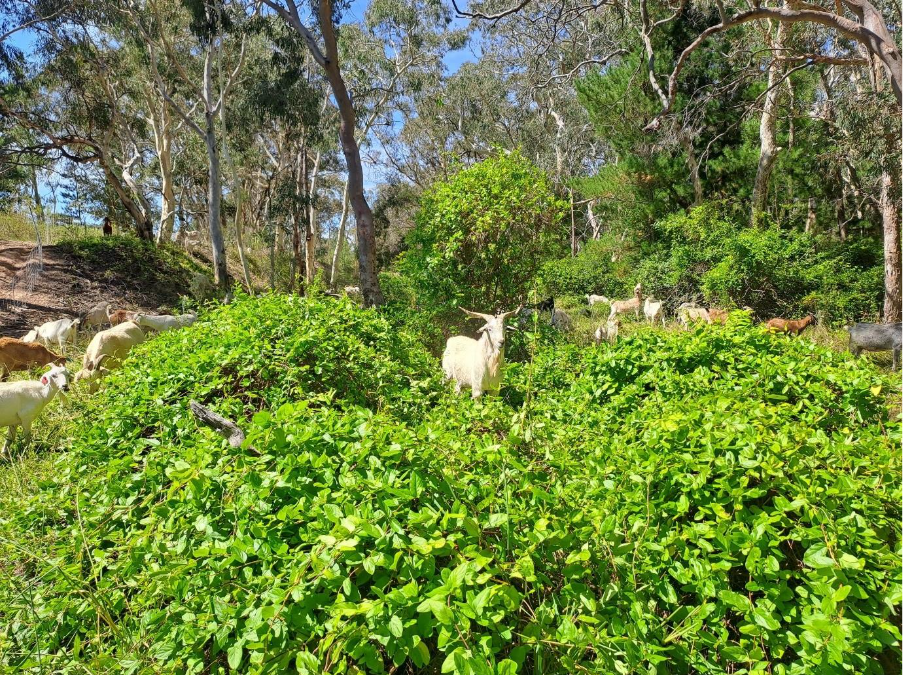
Goats are being used in effectively in controlled grazing in areas to reduce and mitigate fuel loads from fire-prone regions.
The impact so far
Although initially funded for the first 12 months of the program, the continued renewal of the program through subsequent years reflects the impact it’s delivered to the regional Bush Fire Risk Management Plan.
Key benefits of the Goat Brigades include:
- Accessibility: goats are versatile and can access areas that are inaccessible to land clearing machinery.
- Reduced workplace health and safety issues: reduction in human intervention means less risk to workforce during fuel load clearing.
- Unimpeded by weather: grazing isn’t weather dependent and can be completed throughout the year.
- Low maintenance: once established, goats are easily contained and are self-reliant with a reliable vendor.
- Minimal community impact: no interference with the community through smoke, noise, or road closures typically required for safe fuel load clearing.
- Thorough clearing: will mitigate a majority of plant species, including weeds and areas can be repeatedly grazed if necessary.
- Competitive cost: cost is comparable to other methods of mitigation.
- Support other mitigation methods: can be used to reduce fuel loading prior to a prescribed burn.
As the trial comes to an end, the effectiveness of the program is being measured by the University of Melbourne, with results and data to be made available on completion.