KIDS+ progress update: Introduction to the Selection Index
As the Australian goat industry formalises and matures, so too does the need to improve management systems for enhanced herd performance. Identified as a priority investment, the KIDS+ project was funded in 2022 for five years.
At year three of the project, KIDS+ has identified avenues for better herd selection and touch points where individual electronic identification (eID) can be applied for best performance. Integral to the work completed to date has been the development of a Selection Index for replacement does. The producers participating in the program have identified growth rate post-weaning as the predominant factor influencing their selection – the aim being to minimise the number of days to slaughter weight.
This update captures the development of the Index, defined criteria, and tested outcomes, which are forming industry best practice for more robust goat management systems.
What is the Selection Index?
Selection of replacement maiden does within the herd has historically been informed by the weight and size of maidens at the time of weaning. This method has seen varying success, with the weight and health of the goat typically fluctuating post-weaning. Part of the reason for this partial success is that weaning weight is influenced by numerous factors (see Table below), not directly linked to the maiden’s own genetic potential.
The Selection Index is a prediction model that uses inputs from key data collection points (such as weaning, and a weight 2–3 months post weaning) to better identify maidens for herd selection. It takes into account:
|
Timing of the replacement maiden selection |
Weaning weight/size influences |
|
Increasing the selection timeline to at least 2–3 months post-weaning to identify maidens who show high post-weaning growth rates. |
|
The resulting index is calculated on a 270-day average and compares the maidens within their own cohorts.
Why do certain traits matter in herd performance?
The inputs that inform the Selection Index provide detailed and data-informed insights to lead strategic herd selection. By having the availability of the data, producers can implement progressive management of their mob through parities to breed goats that meet the target weight more efficiently.
The prediction model has been informed by datasets of more than 28,000 goats and is illustrated by Figure 1, where 315 maidens were selected.
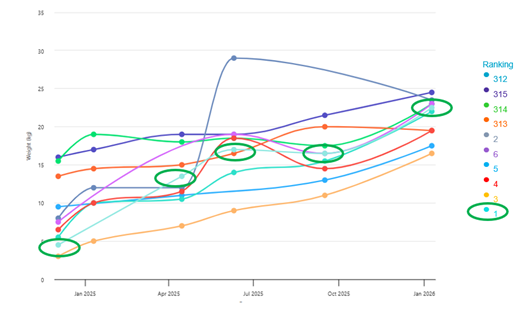
Figure 1: The ranking index of F1 crossed (Rangeland x meaty breeds) maidens and their specific weights on different weighing days. First weight is weaning weight.
Although the top-ranked maiden (1), was not the heaviest, she had a low weaning weight but showed the best daily gain post-weaning; Rank 1 increased her weight by ≈20kg, whilst Rank 315 was heavier at weighing, but only increased her weight by approximately 10kg. If the producer was selecting only on size/weight at weaning, several slow growers would have been selected only because they were heavier at weaning.
Does it work?
Yes. Outcomes to date have been applied in third and fourth parities with increased refinement of the data set.
While KIDS+ continues to grow and develop, sample modelling demonstrates how the Selection Index informs best genetic selection for the next herd.
What’s next for KIDS+
With less than two years remaining on the program, the focus of KIDS+ turns to methods of adoption of the Selection Index, supported by eID implementation and other data insights into practical, accessible means for producers.
At the core of this will be the personalisation of experience, where producers can query and interact with the data in a way that suits their production means. That is, being able to ask questions and receive herd- and production-specific insights such as:
- When will 30% of my weaners (bucks, wethers, does) reach the target weight of x by December?
- Select the best 100 maidens according to their index.
- Select 70 maidens to maintain ideal breeding herd structure (what is the ideal breeding herd structure?).
This capability is being explored with AI integration on the Agview platform, which can transform the industry’s approach to managed herds.
To ensure the success of the KIDS+ program, datasets will continue to be refined. Final outcomes and delivery of KIDS+ is set for the end of 2027.