Northern rainfall impacts prices across eastern states
Key points
- Major sales in the north were cancelled due to heavy rain, cutting national yardings by 17% to 70,538 head.
- The rain was patchy but well-needed in some regions.
- Reduced supply lifted most prices, with Queensland restockers firmer and southern restockers softer.
Heavy rain and localised flooding across northern Australia last weekend disrupted cattle movements, tightened supply through key selling centres, and shifted price signals across the eastern states.
Widespread weekend rain event
A broad rain band moved across the north last weekend, delivering much-needed relief after a dry start to the year in many districts. The Bureau of Meteorology (BOM) reported that January rainfall was below average to very much below average (in the lowest decile since 1900) across most of Victoria, Tasmania, NSW, and SA, as well as southern Queensland. Soil moisture levels were also very much below average for this time of year. In response, producers (particularly in NSW and southern Queensland), have begun to increase turn-off, with higher-than-normal yardings of cows and cow-and-calf units reported as some operations started to offload stock.
A broad rain band moved across the north last weekend, delivering much-needed relief after a dry start to the year in many districts. The Bureau of Meteorology (BOM) reported that January rainfall was below average to very much below average (in the lowest decile since 1900) across most of Victoria, Tasmania, NSW, and SA, as well as southern Queensland. Soil moisture levels were also very much below average for this time of year. In response, producers (particularly in NSW and southern Queensland), have begun to increase turn-off, with higher-than-normal yardings of cows and cow-and-calf units reported as some operations started to offload stock.
The rainfall itself was substantial but uneven. Many northern regions recorded up to 200mm, with heavier totals in parts of north Queensland. While the rain improved feed prospects, it also created immediate logistical constraints: access to saleyards was restricted in some areas, mustering and trucking were delayed, and a portion of northern producers opted to hold sales to take advantage of an improved seasonal outlook and potential liveweight gains.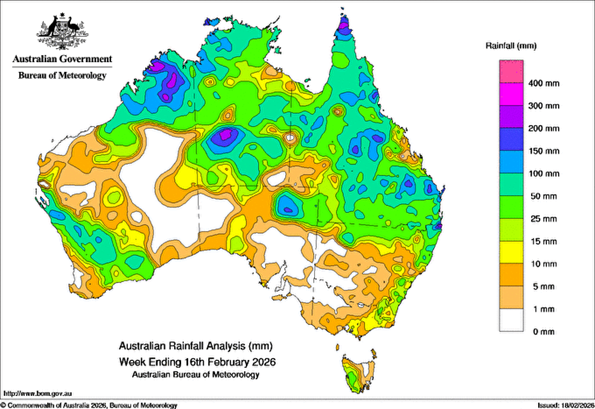
Yardings and market disruption
National cattle yardings fell 17% week-on-week to 70,538 head as widespread rain and flooding forced the cancellation of several major northern and central-western Queensland sales, including Roma, Blackall, and Charters Towers. Queensland absorbed the largest impact, with weekly yardings down 60% to 8,094 head. SA also eased 38%, with weather and freight limitations weighing on throughput. By contrast, southern saleyards were less affected: NSW throughput lifted 6% and Victoria held broadly steady week-on-week.
Price response and restocker behaviour
With northern supply abruptly curtailed, most indicators strengthened as buyers competed over a reduced offering. The Eastern States Young Cattle Indicator lifted 5¢/kg liveweight to 858¢/kg lwt (to 18 February), signalling improved confidence where rainfall was most beneficial. However, the indicator’s movement was uneven. A decline in Victoria weighed on the result, and Queensland’s reduced contribution increased the influence of southern sales on the overall indicator.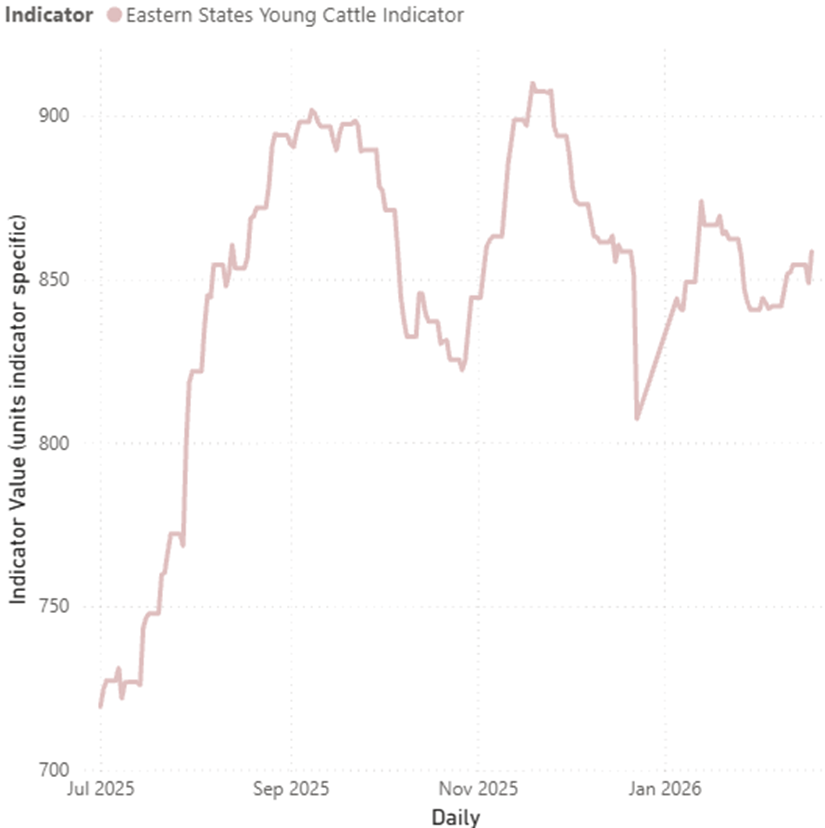
Source: NLRS
Buyer activity remained firm across several centres, with feedlots operating alongside restocking orders. NSW sales attracted buyers from the south and Queensland, with some lighter steers moving south while other lines travelled north toward Roma. Competition was strongest for well-bred stock, with feedlots and restockers bidding heavily for quality lines.
Attribute to: Emiliano Diaz, MLA Senior Market Information Analyst
Information is correct at time of publication on 20 February 2026.