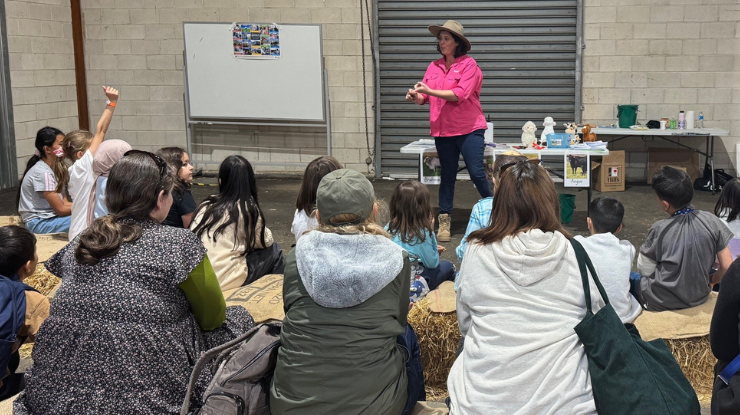
 Producer Deb Gray presenting to students at a farm day
School is in session
When it comes to a viable future for agriculture, the workforce and public perception are two critical pieces of the puzzle. MLA’s Australian Good Meat Education school program underpins both, working to support the growth of quality-based red meat industry education in classrooms nationally – and inspire student interest as a future career pathway.
The program’s hero asset is a suite of more than 100 curriculum-aligned primary and secondary school resources that support all dimensions of the Australian Curriculum and multiple subject area learning outcomes.
MLA Schools and Education Manager Susan Howe, who has spent nearly five years in the role with the goal of enhancing industry education, said there was a growing emphasis on pathways to support confident content delivery.
“We can’t assume that students will gravitate towards an ag career without prior early exposure to it. Similarly, teachers unfamiliar with agriculture usually lack the confidence to introduce this content in the classroom. Everything starts with education,” Susan said.
Step inside the virtual classroom
Meet one of the red meat producers who engages with primary students through ‘virtual classroom’ online education sessions.
Both from her farm near Araluen, NSW, and out and about, Deb Gray is an active participant in the Australian Good Meat Education program.
In her role as an Ambassador for the Red Meat Industry, Deb attends agriculture shows and career days, visits schools, and participates in virtual classrooms.
“It’s such a thrill to show students how everything connects from paddock to plate,” Deb said.
“The students are always amazed to hear about all of the ag-tech that is used and that there are so many jobs beyond being a producer.”
Since being involved with the education program, Deb said the interest from schools has grown and there is more opportunity than ever to interact with students.
“There are some really good agriculture teachers in metro areas too and it’s great to be able to support them with MLA’s school resources where we can.” In her own community, Deb supported the local high school’s agriculture program through donating a steer, U46.
“The students found so much value in having access to that steer. They designed feeding rations, got him to the top of his weight class, and washed and trained him to be led,” Deb said.
“He’s been a great tool for getting the students excited about agriculture.”
Deb recommends any producers interested in supporting red meat education should call their local school’s ag teacher and ask how they can help and refer to MLA’s education resources.
“This industry will keep changing and we need generations of the future to gravitate towards a career in ag to conquer any future challenges.”
“Ag teachers are highly engaged with our resources, yet scope remains for wider adoption, particularly across primary school educators. Insights tell us that educators lack confidence in teaching ag content and those more confident with the subject are seeking to upskill their industry knowledge.”
The education program uses several avenues to drive red meat classroom education, including:
- live-streamed ‘Smart Farming’ virtual
- education sessions for primary schools
- agricultural society school programs
- teacher conferences
- teacher professional development
- digital promotion
- utilising MLA’s Red Meat Ambassadors.
“Our Red Meat Ambassadors play a crucial role in our school education program, helping to share red meat’s story,” Susan said.
“Teachers are the most direct pathway to drive industry education, so our program efforts primarily centre on enabling this audience through impactful opportunities to form stronger industry-to-teacher connections.”
National Schools Food and Fibre Education Strategy
The recently released National Schools Food and Fibre Education Strategy is a collaboration from the 15 Research and Development Corporations (RDCs) to expand the reach and deepen the impact of food and fibre education.
The early years of implementation will focus on cross-RDC collaboration to streamline access and use of classroom resources, opportunities for practical learning and increasing industry-to-school connections.
“We all share the desire to increasingly connect today’s classrooms with Australian agriculture,” Susan said.
“Collaboration and sharing our resources make great sense to reach this goal more efficiently and effectively.”