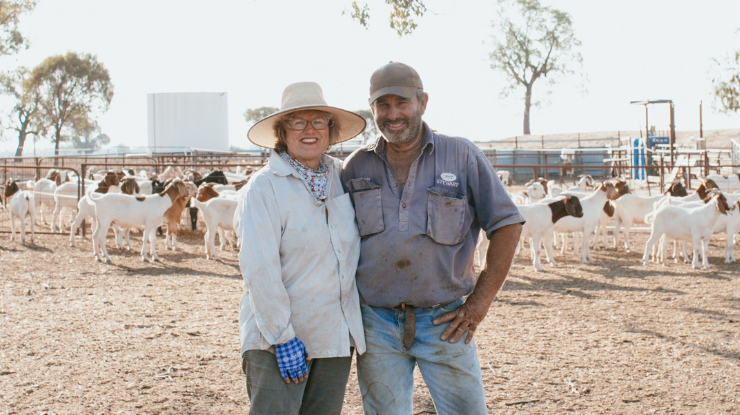
 Goats may be a recent addition to the third‑generation Stewart family operation, but Craig and Jo’s affection for the animals and passion for the industry has quickly become central to life at ‘Inglewood’. Image: Clancy Paine
Smarter carcase use drives new market wins
Could goatmeat redefine Australia’s deli game? Here’s the story behind the 100% goatmeat salami challenging the pork industry.
When producers Craig and Jo Stewart welcomed a single Boer kid onto their Central Western NSW property as a pet for their then 8-year-old daughter, they had no idea they were about to trigger a series of events that would result in the disruption of an entire meat category.
Yet, almost two decades on, the couple behind ‘The Gourmet Goat Lady’ have turned calm stockmanship, tight genetics and relentless logistics into a premium brand – featuring a 100% goatmeat salami that’s giving pork a run for its money on the charcuterie board.
|
FARM SNAPSHOT Name: Craig and Jo Stewart – ‘Inglewood’, Collie, NSW Area: 1,040ha Enterprise: 800 Boer does, 50 Hereford cows and some cropping Pastures: Native pastures, medics and fodder crops Soils: Grey clay loams, red clay and sandy loams Rainfall: 500mm |
For the love of goats
When they originally took over ‘Inglewood’ – the third generation Stewart-owned family farm at Collie, NSW – in the 1990s, Craig and Jo had no intention of reshaping the 100-year-old beef cattle and cropping business.
They eventually added ‘Beuna Vista’ at Gilgandra to the business. In 2008, while visiting a friend and local stud goat breeder near Beuna Vista, Jo and their daughter Abbey were offered ‘Olivia’, a female goat not suitable for production.
“Our daughter was absolutely taken by this goat and, since she wasn’t a stud animal, the breeder was quite happy to let us take her home,” Jo said.
“Olivia was our first experience with a goat. She was sassy and a little bossy, but she was also wonderful and we couldn’t help but fall in love.”
Things spiralled quickly from there – they purchased 10 more Boer does and brought in a buck and by 2009, Jo and Craig had gone from one lonely goat to a herd.
Introducing The Gourmet Goat Lady
Despite having an established herd, the Stewarts did not have a commercial future in mind for their goats.
That changed during a family holiday in 2009, when Jo wandered into a local butcher shop and was stunned to see beef mince selling for A$15/kg.
“At the time, we were heavily focused on cropping and our beef business,” Jo said.
“And standing there in the shop, I thought, ‘someone’s making money here – and it’s not us.’ It made me want to seriously look at developing a branded beef product.”
However, when the pair later sat down with a business advisor to explore the idea, he asked a simple question that changed everything: “What about your goats?”
Curious about whether there was a genuine domestic appetite for farmed goatmeat, the Stewarts commissioned a feasibility study exploring who eats goatmeat, how often and in what contexts.
They learned that goat is the most widely consumed red meat globally, with strong culinary traditions across multiple cultures – yet high quality, farmed goatmeat, particularly Boer, remained scarce in Australia.
With more than 90% of the goatmeat produced in Australia from rangeland goats (sometimes known as wild or feral goats) and the majority of that exported, the Stewarts realised they had a product with potential.
“We ate goatmeat for the first time in 2010,” Jo said.
“We tried rangeland, then Boer – and we knew we had a winner.”
That same year, Jo took part in MLA’s last Paddock to Plate CoMarketing initiative before getting involved with MLA’s Product and Packaging Innovation program. It set her on the path to becoming – as one consumer dubbed her – The Gourmet Goat Lady
Changing tunes on-farm
While Jo took the lead in exploring markets, recipes and product opportunities, Craig quietly reshaped the production system behind the scenes. He has curated a purpose-built on-farm operation grounded in high animal welfare standards and a data-driven breeding program.
From the beginning, Craig recognised that while the fundamentals of good stockmanship carried over from their cattle operation, a change in execution was required.
After spending time observing the behaviours of their herd, his first point of action was to make practical adjustments to their infrastructure. This included:
- upgrading fencing
- installing covered yards
- building wider laneways to improve visibility and reduce stress.
“Those small layout changes quickly translated into calmer stock, smoother processing days and a system that worked with the goats rather than against them,” Craig said.
However, despite the improvements, Craig soon noticed persistent issues affecting kid survivability.
“Pretty quickly, I picked up on issues relating to poor mothering, deformed teats and problem hooves,” he said.
To combat this, Craig turned to insights from sheep producers and began tightening his selection criteria.
“I learned that teat traits are highly heritable through the sire line, so a buck with poor teat structure will often pass those defects to his daughters – which can lead to mismothering, feeding issues and higher kid losses later down the line.
“I also learned that our does were probably a bit too big,” he said.
“We originally ran 100kg does, but we used data collected via eID tags to inform reproductive decisions and now have our does averaging 75kg.”
With an improved production and herd survivability, Craig said a sequential result has been improved eating quality of their goatmeat – something he feels is a great return on investment.
Think Italian
As the Stewarts’ herd grew and demand for their fresh cuts of goatmeat increased, feedback from their butchers and food wholesalers made Jo increasingly aware that some parts of the carcase simply didn’t sell as quickly as others.
“They informed us legs and shoulders were easy to sell, but racks were surprisingly difficult despite being such a prized cut in lambs – it was clear this model wasn’t working for us,” she said.
“Goatmeat is an incredibly hard sell to those who are unfamiliar with it. I kept thinking: ‘there has to be a way to use more of the carcase in a way people want to try’. That’s when salami came up.”
The idea first surfaced after years of watching pork-based salami dominate deli cabinets.
“If pork could carry spices, ferment beautifully and hold its structure, why couldn’t goatmeat? Especially farmed Boer goat, which had the right texture, tenderness and subtle fat profile.”
What started as a curiosity quickly turned into a serious project and Jo began calling smallgoods makers to ask a simple question – would they consider making a pure goat salami?
Most were sceptical as traditional salami relies heavily on pork fat, and goatmeat – especially in Australia – wasn’t commonly explored in fermented products.
Eventually, she found a willing partner: Papandrea Fine Foods, a specialist salami manufacturer open to experimenting.
Together, with the support of MLA, they mapped out what a 100% goat product would require – from adjusting fat ratios to meeting strict safety and fermentation parameters.
“Because no protocol existed for goat-based uncooked, fermented smallgoods in NSW at the time, the product needed to pass a series of additional checks and approvals,” Jo said.
“This included providing farmed goat assurances, batch testing and detailed validation through the NSW Food
Authority. It was a significant undertaking – but one that paid off.
“When we finally held that first batch in our hands, it was a pinch yourself moment.
“It was mild, clean, had great texture and didn’t need a scrap of pork – a gamechanger.”
The first commercial batch sold out almost instantly. Then came the awards season – and the salami took out both a gold medal and best-in-class at the 2025 Melbourne Royal Australian Food Awards, beating traditional pork salamis on their home turf.
“Chefs who tasted it were surprised by its delicate, almost sweet profile and consumers from communities seeking pork-free options immediately recognised its value,” Jo said.
“We’d not only created a product that improved carcase utilisation, but also one that highlighted the quality of goatmeat and opened salami up to an entirely new market of people who don’t consume pork.”
New opportunities
In 2025, Jo and Craig said goodbye to their 400ha block, Buena Vista, as they prepared for semi-retirement at Inglewood. Their downsizing has included farewelling 400 does, 300ha of cropping and some of their beef herd.
But, with a proven 100% goat recipe that appeals to new consumer segments, retirement is not on the cards just yet for Craig and Jo. They’re now looking beyond the Australian border at countries where pork-free products are in demand.
“Craig is looking to further improve our herd quality with the use of estimated breeding values for buck selection and I’m looking at ways to improve our products’ reach,” Jo said.
“But as things progress, what I’d really love is to see goatmeat recognised for what it is – a delicious, high quality protein we can all enjoy.”