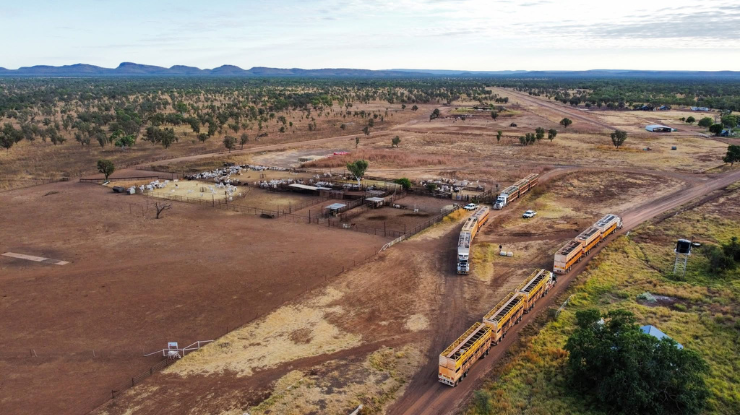
 Birds-eye view of Newry Station.
Fewer cattle, bigger returns
Mike and Kellie Bailey’s management of ‘Newry Station’ in the NT’s Victoria River region is proof that less is sometimes more – at least when it comes to stocking rate.
Over a five-year journey to identify the station’s sweet spot, Mike has landed on a 20% reduction of stocking numbers as the key to increased productivity and profitability.
Results are impressive, with an increase in weaning rates from 54–59% to approximately 80%. This has delivered 1,000 more weaners annually, despite running 2,500 fewer breeders.
A shift in strategy
As station manager, Mike’s focus has been on improving sustainability and grazing productivity in the face of environmental and operational changes.
From 2018–2022, the Victoria River district experienced a run of below-average rainfall which put pressure on pasture availability and herd performance.
“We began seeing high mortality across all classes of cattle,” Mike said.
“We had entered a really tough period and we knew we would have to make some changes if we wanted to see things improve.”
In 2020, the station changed ownership and with that came a fresh perspective.
“The new owners were open to and interested in finding new solutions to reduce mortality and boost productivity – giving us the final push we needed to take action,” Mike said.
Around the same time, Newry Station became involved in the StationSmart project, led by Christie Pearson from the NT Department of Agriculture and Fisheries and funded by the Northern Hub.
The project, which ran from 2019–2021, focused on calf mortality and stocking rate management.
“Christie’s work on calf mortality was a big influence,” Mike said.
“Right after her trial wrapped up, we started implementing changes – using her research to guide our decisions.”
Less stock reduces grazing pressure
The first and most significant shift at Newry Station was a reduction in the breeder herd from 12,000 to 9,500 head over an 18-month period.
“We had more cattle than our land could supply during those drier years, so taking grazing pressure off the land was a key focus,” Mike said.
“We also worked to improve the reliability of existing water points and invested in the development of new ones.
“That gave us more flexibility in dry times and helped spread grazing pressure more evenly across the property – it even opened up areas that hadn’t been grazed much before.”
Targeted supplementation
Despite phosphorus (P) supplementation long being a cornerstone of the station’s productivity gains, Mike decided to better tailor it during the wet season. Taking part in the MLA-funded ‘Easy P’ project led him to triple P supply.
In the first year, they fed out a third of the bags of P they had on-station throughout December to February.
“The cows were very deficient that first year – they were eating it like lollies,” Mike said.
“In the second year, we decided to open all the bags in December.
“However, the cows were significantly less interested in it – their levels were up, and they were just maintaining.”
As a result, Mike said supplementation has become more targeted in recent years.
“We used to feed urea to all our cows just to keep condition on them.
“Now, thanks to our boosted phosphorus program, we only feed urea to cows due to calve from July onwards each year – part of our year-round joining program.”
Tweaks to timing boosts fertility
The final key change implemented at Newry Station was shifting the timing of mustering to earlier in the year. They now muster from the end of April to mid-May, instead of from the end of May to mid-June.
“We try to get our first round done early so cows can put condition back on while there’s still green grass in front of them,” Mike said.
“That’s been huge for fertility – it gives them the best chance to reconceive.”
Less for more
Despite reducing herd numbers, productivity has soared – and profitability hasn’t been far behind.
“We’ve gone from a weaning rate of around 54–59% to approximately 80%,” Mike said.
“That’s a massive jump – and it’s been consistent year-to-year.
“We’re working with 2,500 fewer breeders, yet we’re producing 1,000 more weaners annually.
“That increase in output, combined with lower overheads, has had a significant financial impact.
“We’re handling fewer cattle, which means less mustering, less supplementation and less labour.
“If we sell that extra 1,000, that’s nearly a million dollars more in revenue annually,” Mike said.
The return on investment has been clear.
“We spent quite a bit of money on water infrastructure and on the Easy P program in the first year, but the gains in fertility, calf survival and overall herd performance have paid it back many times over.”
Looking ahead
Currently, Newry Station is continuing to refine its stocking rate using visual assessments and seasonal adjustments as a guide.
While challenges remain – including variable rainfall and diverse soil types – the team is committed to sustainable productivity.
“We’re still working on it,” Mike said.
He looks forward to further refining his grazing management by making use of available tools and calculators – saving time and costs to hit the ideal stocking rate sweet spot.
“We have built a system that can coast us through the dry years and will capitalise on the good ones.”