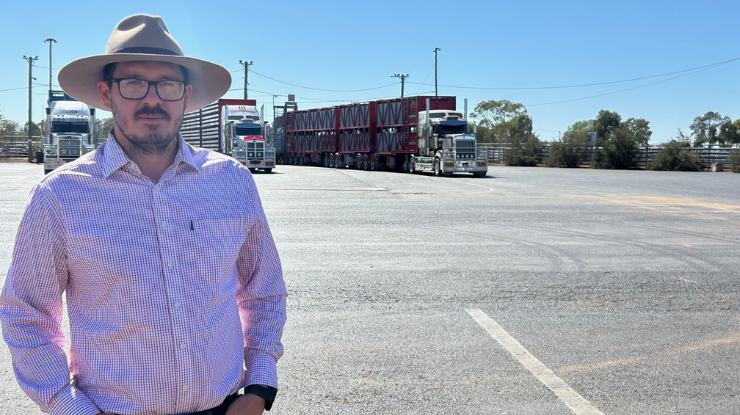
 Dubbo Regional Livestock Market Manager, Harry Brennan
Smarter transport prep boosts returns
With more than 1.2 million sheep and 200,000 cattle moving through the Dubbo Regional Livestock Markets (DRLM) annually, the head of Australia’s third largest saleyard says a few small actions before sending animals can lead to better outcomes.
Manager of DRLM Harry Brennan receives livestock from across Australia at the DRLM facility for sales, processor drop-offs and collections or saleyard transits.
Sound preparation and communication are essential, Harry said. His preference is for cattle travelling long distances to arrive a couple of days before the sale.
“If you send them early, they’re fed, well rested, well hydrated and used to the environment. In the sale environment, they are then more hydrated and walk off the scales in better condition.
“Those who do deliver cattle a few days early realise there’s a commercial benefit and the livestock present better for the agent.”
Hydration and nutrition
To keep animals well hydrated, the DRLM use river water in their troughs. Their research indicates a 3–7% weight increase for the cattle compared to when using chlorinated water.
“They are more likely to drink river water straight away,” Harry said.
Feed at their facility is predominantly straw – tested in line with the National Saleyard Quality Assurance standards – with vulnerable animals provided lucerne hay as required.
For up to $5/head/day to be fed and held at the facility, Harry said there are solid returns from bringing cattle in a couple of days early.
“Dubbo feeder steers are 60¢ higher than the national average,” Harry said.
“If you have 60¢/kg over a 400kg beast, that’s a $240 benefit. Only $10 of that total that went into getting them here two days early.
“If they’re here early and add the extra 3–7% on, instead of $1,800 you might get $2,200.”
Loading densities are key
The commercial and animal welfare benefits of abiding by load density guidelines are also a no-brainer, Harry said.
“Just because it’s a shorter distance, it’s not worth shoving them all on the truck,” he said.
“If you want to sell 70 head but the truck only holds 50, I believe you’re better off splitting it over two weeks, especially for sheep.
“With prime lambs selling for $350/head, if you lose two, you’ve paid the transport twice anyway.”
Dry feed or a feed mix is better than lush green feed ahead of transport to saleyards, Harry said.
“If they come in full of green, they were never going to maintain that weight on the scales – it just ends up on the truck and in the yard.
“Buyers know – they take one look at the floor of the pen and take 5% off the initial offering price.”
Consider the weather
Keeping an eye on forecast weather ahead of sending to saleyards is important, Harry said.
“If you’ve got woolly sheep, do not send them in the rain.
“There’s the risk of suffocation, they get too heavy, they can’t get up, which can cause all sorts of issues.
Extreme heat also needs to be carefully managed, Harry said.
“We had a 40-degree sale day here recently, and some cattle came from way out west at Walgett.
“They were mustered early in the morning, left in the yards with shade and water, were booked in and turned up here at 2am and put into the feed yard on water. They got through that with no stock losses.
“If sheep travelling long distances in extreme heat aren’t managed carefully, you can get up to 5% losses on the truck.”
Ensure they’re fit for the entire journey
Being close to an abattoir and pet food market means DRLM has the added risk of people sending animals that are not fit to load and travel.
Harry and the DRLM team have introduced an app for reporting welfare interactions. This helps them add data and objectivity while working closely with agents to build transparency and an animal welfare culture of trust and honesty.
“Horns in heads was a real issue two years ago. From our stats now, we might have one horn we have to discuss a fortnight or a month.”
Early decision making is critical for the welfare of animals in dry times, Harry said.
“Producers are increasingly making evidence-based decisions earlier. If a cow hasn’t had a calf in two years, she needs to be sold.
“We have an obligation to ensure we are doing the right thing by the animals, but also an obligation to the red meat industry to make sure we’re not dropping the ball.
“Everyone plays a part of the red meat supply chain. One slip-up can cost so much.
“Everyone has to be transparent in their actions. Whether it’s how the animal looked on-farm, how it’s transported, how it’s sold and how it’s transported again, processed or transported overseas.
“The entire supply chain is reliant on someone wanting red meat on their plate.
“If that narrative changes and that demand changes because of our actions, the price drops all the way back. It takes everyone to maintain that.”
|
Harry’s tips for preparing livestock for saleyards:
For more tips on sending livestock through saleyards and guidelines on loading densities, visit the MLA Transport Hub. |