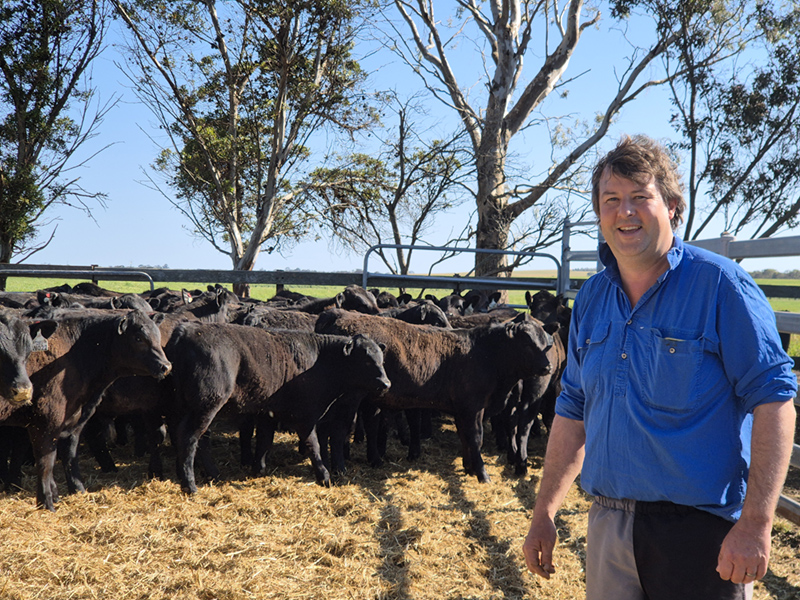
 Nick Ruddenklau, Farm Manager at Epasco Farms, shares his insights on a three-year weaning trial.
Lessons learned from Epasco Farms’ early weaning trial
Nick Ruddenklau is the Farm Manager at Epasco Farms, a 14,500ha mixed farming enterprise in Condingup, east of Esperance, WA. He’s also the lead producer in ASHEEP & BEEF’s ‘Optimising age of weaning cattle’ project, a Producer Demonstration Site (PDS) facilitated by Dr Enoch Bergman from Swans Veterinary Services. As the three-year project enters its final season, Nick shares his learnings so far.
Project background
This PDS is designed to highlight the benefits of early weaning cattle upon feed utilisation, carrying capacity and kilograms per hectare. The concept is that by removing calves earlier from their mothers, less feed is required to meet the nutritional requirements of both cow and calf individually. The PDS aims to demonstrate good comparative weight gain for the earlier weaned calves, along with benefits for the management of cows around feed utilisation, body condition, and future reproductive performance. A basic snapshot of the methodology is that half of the calves from a group of young cows are weaned 60 days earlier than the producer’s typical date. Calf weight gain, cow weight gain, and cow body condition are measured.
The first two years of the PDS (2023 and 2024) were marked by challenging seasons, with early finishes impacting feed at weaning. Most producers found the weight difference between the earlier weaned calves was too pronounced, with the earlier weaned calves being lighter. There were, however, good outcomes for the earlier weaned cows, whose body condition score and weight increased more than their later-weaned counterparts. It was difficult to realise the benefit to the cow program (e.g. conserving feed or saving the best quality feed for calves) because, due to trial design, the earlier-weaned cows continued to run with the later-weaned cows and calves. Heading into the final season, there are four demonstration sites remaining and some will be making adjustments to see if they can refine the early weaning system:
- Nick Ruddenklau (Epasco Farms) will supplement early weaned calves with commercial pellets – see his Q&A below.
- Simon Fowler (Chilwell) will feed a Total Mixed Ration (TMR) as a supplement to early-weaned calves.
- Jonathon Thomas (Sanderson Bros) won’t be changing his program, and is expecting a better outcome this year due to the better season.
- Ryan Willing (Carnigup) intends to identify and remove the mothers of the early-weaned calves from the remaining cows with calves, to allow apportioning of feed resources based on nutritional requirements of the different classes of cows.
Each of these methodologies aims to clarify how to optimise an early weaning system. Results are due later this year.
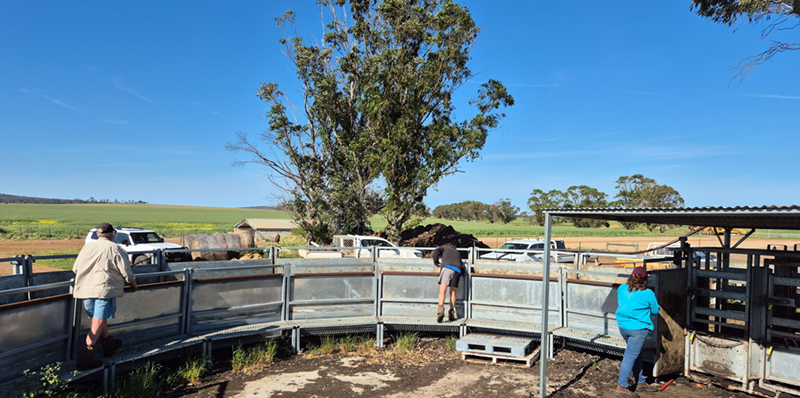
The Epasco team guiding a calf down the race.
Q&A with Nick Ruddenklau
How are things looking on the farm?
We’ve come off two pretty tough seasons, so this year has been great. There’s been a good early start to the season; feed has been growing well and it hasn’t really slowed down. Prices have picked up. Plus, we had a spring for a change, so that’s been positive!
Can you give us an overview of your cattle program?
Breeding objectives are a moderate size cow, keeping a lid on cow size, promoting early growth, with reproduction markers being of high importance.
Traditionally, we’ve targeted the store market for calves, but we’re looking to move into value-adding by feeding a portion of the stock for longer, putting more weight on our steers and working them into a grass finishing window. We’ll essentially keep them from January through to October and try to get them up to grass finishing.
Fodder conservation is an area we’re focusing on. We’ve moved away from growing straight oat hay to more grasses and cereals. We’re seeding earlier and then using those cattle to graze that feed earlier before we shut it up for silage and hay. This shift should help us meet that grass finishing market.
Key dates:
- 20 February - Heifer calving
- 15 May - Cow calving
- 10 June - Bulls in
- August - Preg testing heifers
- End September - Preg testing cows
- End October - Weaning beginning with the heifers and then continuing over 3-4 weeks
- Traditionally we’ve been selling steers in January/February at 9–11 months as stores at 280–320kg. We’re now aiming to keep the top half and sell them as a 500–540kg steer in October.
What were you aiming to gain from the PDS?
We were trying to maintain our cow condition, optimise the growth of our calves, and understand where the point of weaning was to allow our calves to grow to the best of their ability and allow our cows to maintain and prepare for the following calf.
We have learned through the PDS that we were weaning relatively early for our system already (at around 220 days). The PDS has highlighted how much growth those calves put on in that last period of pre-weaning on our farm. We’ve had two pretty tough seasons and understanding the nutritional requirements of calves throughout the year is something we’ve learned.
In the first two years of the PDS, our early-weaned calves did not grow as much as the traditional-weaned cohort. In the first season, there was a 19.5kg difference between the two groups at the time the second group was weaned. There were about 50 calves in each group. The second season the gap was more pronounced.
What we did notice was that those early-weaned cows were putting on weight at a notably higher rate compared to those that still had calves on them. That, to me, highlighted that we were successful in our objective of putting more weight on the cows, but because of the trial design, we weren’t able to apportion our feed resources as well as we wanted (the earlier weaned cows were not separated).
As each season progressed you could see that the early-weaned cows held condition better. The way our system works is that we put condition on the cows in the spring, essentially a haystack on their back, and when the feed availability reduces over the summer, they use that store. We then start supplementary feeding in late summer/early autumn to get them through until the feed comes on again. We rely on that system and I could see that those early-weaned cows held condition better. That was observed at other demonstration sites too. We didn’t notice significant differences in re-pregnancy rates between the two groups, but that’s probably complicated by having had two difficult seasons with generally poor conception rates.
What changes will you make for the final season of the trial?
We’ve identified that if we have a poor spring, it’s likely that earlier-weaned calves will need some form of supplementary feeding to manage their weight gains. This year, we’ve committed to adding some pellets into the diet of the earlier-weaned calves. However, it’s worth noting we’re also going into autumn with much more protein-rich feed available. The paddocks we will be putting the earlier-weaned calves into are a lot, lot better than what they have been in the two seasons past. Identifying when the protein drops out of the pastures and being prepared with supplementary feed is going to be important. In the past, while we’ve known this is happening, we’ve not been as responsive to it.
At this stage, the calves haven’t been introduced to pellets – we’ll do that as the feed drops off with a standard beef grower pellet. They’re going to be yard weaned, as per our typical protocols, which is 5–7 days on hay and water in the yards with daily working and their booster shots. We stage them out of the yards over a couple of days so they learn to understand fences. When the feed drops away, we’ll gradually introduce the pellets though a lick feeder or an adlib feeder. We haven’t done it before, so it’ll be a learning opportunity, but we’re used to the induction process through our sheep program. Because they’ll know hay, we might be able to use that to introduce pellets on top of hay.
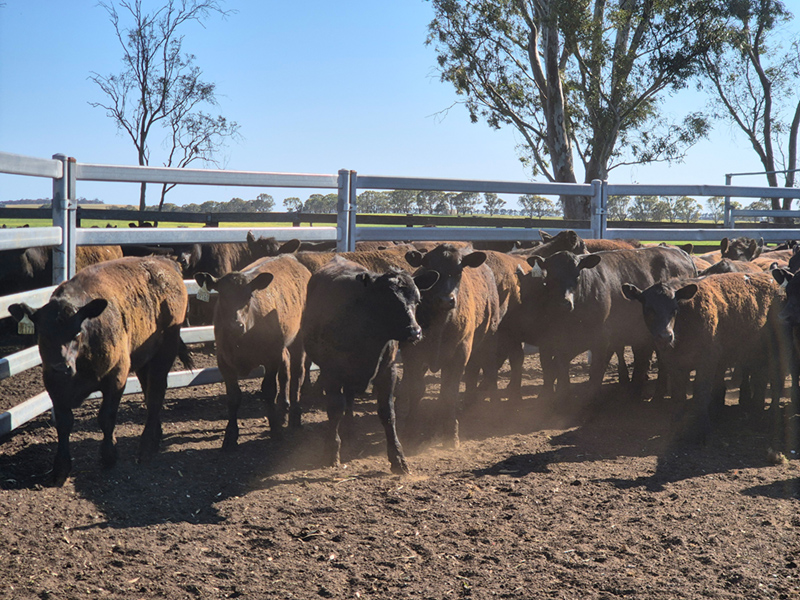
Epasco calves on 3/10/25 at ‘early weaning’.
Once we have a look at the data over the three years, we’ll use what we’ve learned to govern our weaning time. Having this season’s data will be good because it’s a completely different season to the last two. We want to get that early weaning system right – it’s a tool we need in bad seasons. Being able to confidently wean at an earlier time and apportion the feed resources – whether that’s to manage the cows or the calves – will be very beneficial.
We’re not stuck on our weaning date; we’ll use the understanding from the PDS to guide it. The project has been really good for us to critically look at our weaning timing.
Looking at the female calves that we’ve retained for future breeding, as they have grown out we’ve not been able to notice a tail in the mob or a line of heifers that is distinctly different because of some having been weaned earlier.
What have you taken away from this PDS?
There have been some good learnings from the other demonstration sites in the PDS. It’s been really interesting to look at the weaning dates of other producers; we all run different systems. One year a property showed a massive difference in weaned vs unweaned calf weights, while another had very little variation. Learnings around nutrition management have been really useful.
The PDS program is a great system. It hasn’t hit our exact objectives, but it’s still been a good learning opportunity for everyone and a chance to have a good critical look at your business. Time of weaning is a hard thing to put information behind. There’s research out there, but seeing time of weaning differences on your own farm is a really good way to understand where your system is at and finetune it yourself.