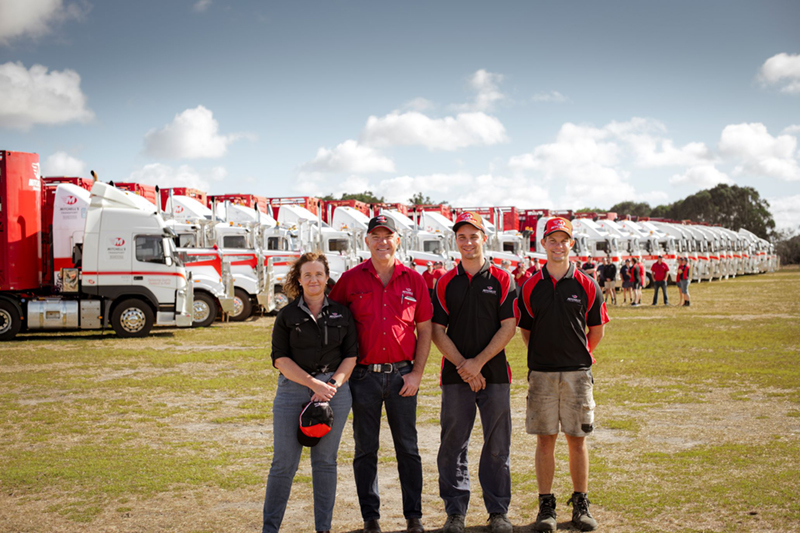
 L-R: Lisa, John, Jarod and Lachlan Mitchell from Mitchell’s Livestock Transport
Beat the heat with safe transport over summer
Mitchell’s Livestock Transport team manage many variables when planning journeys for the 650,000 cattle and 300,000 sheep they move throughout Australia each year. Managing temperature changes in transport is one of them.
Speaking about their company’s experiences transporting in hot weather, Mitchell’s Livestock Transport CEO John Mitchell said forecast temperatures are factored into journeys, particularly for long distance jobs.
“What we have seen when you have extreme change in temperatures, whether it be from normally 10 degrees to 1 degree, or normally 32 degrees to 42 degrees, the sudden change in the animals’ environment can expose them to a lot more risk in terms of them being comfortable on their trip,” John said.
“The further you go with livestock, the more that becomes something you focus on in detail.
“When we are travelling long distances into different areas and regions, we try and keep a look at what weather is coming and try and avoid landing in the middle of the heat anywhere.
“A one-day heat event early in the week can impact animals being transported later in the week,” John said.
“They won’t be as easily prepared for a trip – that could be any trip − it can affect them for the next three or four days while they re-acclimatise.
“You can get cattle that don’t eat as quickly when they go to the next destination. They experience a negative bump in their production.”
In hotter weather, the Mitchell's team encourages clients to schedule loading early in the morning.
“When it’s hot, people think we’ll load late in the day when it’s cooler.
“The truth is, in the morning, the animal has had a night to recover from the heat the day before.
“It’s fresher, it’s got more energy stored, it’s better off being on the road in the middle of the day than standing around in the heat waiting for a truck.
“Transporting out of destinations like saleyards reduces the ability to control the time of loading,” John said.
“At saleyards you’ve got to be able to just move cattle to a spot where they have access to feed and water as quickly as possible and get them off the concrete.”
A number of Mitchell’s feedlot clients monitor and manage cattle heat loads particularly well, John said.
“We’ve got some customers who do a great job with heat loads.
“There’s a formula they use to calculate the heat load the cattle are carrying.
“It keeps your eyes on the job a bit more.
“Hydration and nutrition help sheep and cattle to withstand temperature variations,” John said.
“Feeding cattle good quality hay and water up to time of loading gives them a good setup.
“Having an awareness of forecast weather conditions and focusing on the potential impacts for animal welfare leads to better outcomes,” John said.
“If you’re constantly thinking of that animal and the heat, if you focus on it, you can come up with a better plan.”
MLA Group Manager – Productivity & Animal Wellbeing, David Beatty said where possible, long-distance transport during extreme weather conditions should be minimised or avoided.
“Research has shown that livestock exposed to prolonged periods of heat and humidity will be negatively impacted both from a productivity and welfare perspective,” David said.
Tips for managing livestock transport in hot weather
- Aim to avoid transporting animals in extreme heat.
- If transport is absolutely necessary, plan the journey to minimise the effects of hot weather.
- Transport animals during the cooler hours of the day where possible.
- Reduce stocking densities, where possible, to ensure good air flow between animals.
- Provide access to cool, clean drinking water with enough space for animals to access.
- Provide shade in yards.
- Minimise the duration of stops on vehicles to avoid heat build-up while the vehicle is stationary.