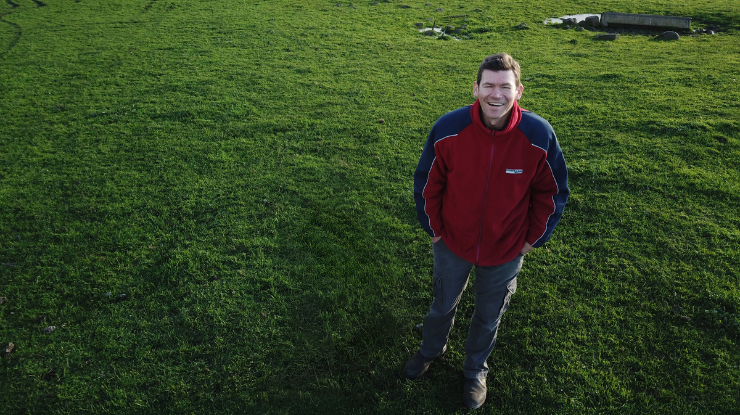
 Victorian producer Jonathan Jenkin uses eID to support strategic decision making.
Data-driven decisions lift lamb performance
For Victorian producer Jonathan Jenkin, electronic identification (eID) in sheep wasn’t a leap into the unknown, but rather a natural extension of the systems already working in his cattle enterprise.
Jonathan and his wife Jo run 450 first-cross beef cattle (turning off 375 yearling steers and heifers to feedlots annually) and a self-replacing composite flock of 2,000 ewes (selling to processors and restockers) at ‘Banemore’, Penshurst.
With 15 years of experience on the property and full ownership since 2020, the couple has steadily built a business focused on precision, performance and sustainability.
Jonathan had already successfully implemented National Livestock Identification System (NLIS) technology with their cattle, so saw immediate potential to apply eID in the lamb operation.
“We already knew the value of individual animal data and had seen how it could drive performance with our cattle,” he said.
“The question was how to use it to make better decisions in the sheep side of the business.”
Taking the first step
Jonathan’s interest in sheep eID technology gained momentum when he joined the ‘Realising benefits from sheep eIDs’ MLA Producer Demonstration Site (PDS), coordinated by Southern Farming Systems.
The project was designed to help producers define the benefits they were seeking from eID and trial practical applications that could improve productivity, labour efficiency and decision making.
“The PDS gave us the structure to test ideas and see what worked,” Jonathan said.
“It wasn’t just about getting the gear, it was about understanding how to use it to make our sheep enterprise more efficient.”
Drawing on his experience with NLIS in cattle and with the added support through the PDS, Jonathan quickly identified several areas in his lamb operation where eID could be applied.
As a result, he determined he would class lambs by weight range and growth rate, identify high-performing self-replacing ewes, manage ewe condition ahead of lambing, and distinguish between single and twin-bearing ewes.
Putting eID to work
Lambing at Banemore occurs over a five-week period, beginning in July.
To establish individual records from the outset, Jonathan decided to tag lambs with eIDs at marking.
From November through to March, he weighs lambs monthly to monitor growth rates.
“The monthly weigh-ins give us a clear picture of how each lamb is tracking, to make decisions about selling, retaining or adjusting feed based on real data – not guesswork.
“The first weigh-in – at weaning in November – is particularly important as it’s when we group our lambs into weight ranges to guide early management decisions.
“Then, at the December weigh-in, the heaviest ewe lambs are selected for retention and are shorn that same month.
“Depending on seasonal conditions and market demand, decisions around shearing or selling older lambs are also informed by growth data.”
Jonathan and Jo use eID tags in combination with a sheep handler, auto-drafter and a tag-reading system.
Data collected includes weaning and post-weaning weights, condition scores, health treatment records and reproductive data – such as the number of ewes joined to terminal sires.
All information is integrated into Mobble, allowing for seamless tracking and informed decision making throughout the season.
Results that matter
Since adopting eID technology, Jonathan has seen measurable improvements in how his lamb enterprise operates.
The ability to class lambs by weight and growth rate has allowed him to target specific markets with greater precision, smoothing out turn-off timing and improving cash flow during summer.
“We’re not just selling when the season tells us to, we’re selling when the lambs are ready and when the market suits.”
Beyond sales, the system has helped Jonathan identify high-performing ewe lambs for retention – strengthening the genetic base of the flock and supporting long-term productivity.
Pre-lambing condition monitoring has become more targeted, with eID data helping Jonathan distinguish between single and twin-bearing ewes.
This has enabled more tailored feeding and care, improving outcomes for both ewes and lambs.
“It helps identify animal nutrition and health needs over this high growth period and alerts you to any issues,” he said.
“This process works and was well worth investing in – it was also easy with everything linking to the one spot.”
Tips for first-time users of eIDJonathan said accuracy and consistency of data collection are key to getting the most out of eID. “You need to be confident in the data to use it for decision-making,” he said. “More importantly, you need to maintain a consistent record of that data to use it for good decision making.” Be clear on what you want to measure “Pick which areas you want to track or improve upon – for example, growth rates in lambs,” Jonathan said. “Collecting data via eID takes time – you want to ensure you’re focusing that time on collecting and analysing traits that you will use and will supply value.” Know how the data downloads and how to manage it Jonathan uses a tag reader, a panel reader and an auto-drafter to collect and store data – with all data integrated into his Mobble account. He emphasises the importance of being able to sort and filter data in spreadsheets, as this enables meaningful analysis and supports confident, evidence-based decision making. Maintain your equipment Jonathan said part of ensuring accurate data collection is keeping the weighing equipment clean, particularly around the weigh bar. “A clean machine also allows you to gain accurate readings by being able to confirm animals are standing correctly during weighing,” he said. Jonathan found the battery systems a limiting factor when it came to accuracy as, even when they showed 100% charge, they didn’t always record consistently. To address this, he recommends using solar power or hard wiring the system. Stick with it “After one season of consistent use, the process becomes second nature and the benefits become clear,” Jonathan said. “If you maintain that consistency long-term, you will see that gradual improvement in your flock’s genetics and gain that return of investment.” |