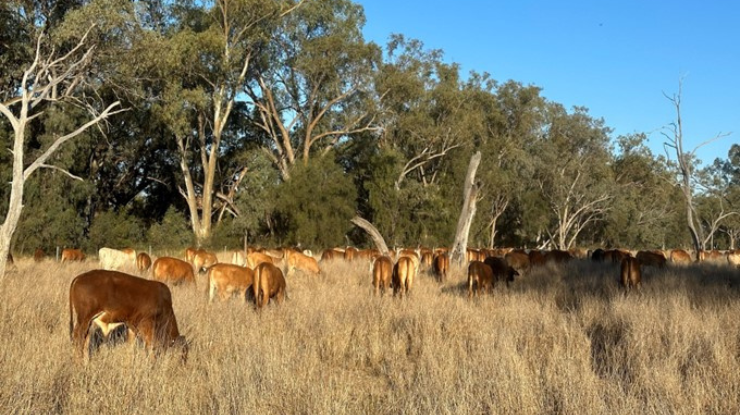
 Herdflow helps inform cattle buying and selling decisions at the Queensland beef property ‘Woodlands’.
Stay ahead of the game with HerdFlow
For Queensland cattle producer John Syme, who manages his family’s property ‘Woodlands’ south of Mitchell, fast and accurate herd data is a fundamental part of running a modern beef operation.
With growing expectations around financial reporting, business performance and the likelihood of future environmental requirements, John is one of many producers turning to HerdFlow – a livestock inventory management system developed by Bush AgriBusiness and cofunded by MLA Donor Company.
Since his early adoption of HerdFlow, John has seen the platform quickly cemented itself into his daily workflow and the way he makes operational decisions.
Speed and efficiency
Before moving to HerdFlow, livestock reporting at Woodlands was a time-consuming end-of-year scramble which required a mix of paddock books, Excel spreadsheets and handwritten notes.
“Previous managers could spend eight to 10 hours at the end of the year just pulling the numbers together,” John said.
“It was a huge job, and it only told you where you’d been, never where you were right now.
“With HerdFlow, I enter things as they happen – a sale, movement, a group of dry cows pulled out. Whatever it is, the system stays live and current, and the visibility is something we just didn’t have before.”
Woodlands has been part of a Bush AgriBusiness benchmarking group for nearly a decade, so when John returned to the family operation 18 months ago, he was encouraged to adopt Herdflow straight away – a shift he said paid off.

‘Woodlands’ manager, John Syme, keeps on top of his herd numbers, sales and stock movements by regularly imputing data into HerdFlow.
Simplicity
It’s a system he finds easy to use, even with the reality of patchy rural connectivity.
“For daily management, it’s very easy,” he said.
“Having two screens helps – stock numbers on one, transactions on the other. That makes things very efficient.”
While the end-of-year reclassification step takes a little more concentration, he expects it will become simpler with practice.
“Because you only do it once a year, it’s the part that can trip you up – but overall, the system is really straightforward.”
Real-time performance
HerdFlow doesn’t just store data, it visualises it. For John, that’s where the platform becomes powerful.
“Being able to compare budgets to actuals halfway through the year is incredibly valuable,” he said.
“This year, prices were so strong that we hit 60–70% of our forecast turnover only six months in.
“Before HerdFlow, I wouldn’t have realised that until long after the fact.”
He said tool is also useful for more than month-to-month oversight. John has begun using HerdFlow to examine patterns across years, which has strengthened his confidence when making selling decisions.
He tracks natural increase, transfers, purchases, deaths and sales in real time, gaining a clearer understanding of growth and decline through the year.
One major benefit is using HerdFlow’s historical data to guide selling decisions.
In December, John needed to decide whether to sell steers that were 30–40kg lighter than ideal.
HerdFlow allowed him to compare those cattle with similar mobs sold earlier in the year.
“I went back through my records – especially July versus December sales – and could see what the market was doing then, what weight differences meant and what I’d achieved in previous years,” he said.
“Even though these steers were lighter, the price-per-kilo premium made it worthwhile to sell now. Having that history gives you confidence.”
He also likes the ability to benchmark against national feeder steer and cow indicators.
“You can see how your sales compare to the national average,” John said.
“And if something falls short, you can drill into it and investigate the ‘why’.”
Budgeting with confidence
HerdFlow is also reshaping how John approaches budgeting.
With reliable historical data and up-to-date herd numbers, he can forecast earlier and with more clarity.
“I already had a rough draft of my 2027 budget done back in August 2025,” he said.
“I like working that far ahead because it gives me a sense of where the business is heading, whether we’ll have surplus capital or whether we need to hold some back.”
Although he’s mindful that markets, weather and seasonal conditions can shift, he says having a baseline plan gives him confidence.
“You can’t predict everything – markets correct, droughts happen – but at least you have a starting point. You know roughly where you stand, and you tweak from there.”
The next steps
Looking ahead, John is excited about HerdFlow’s potential as additional features roll out.
“I genuinely think HerdFlow will become a one-stop shop – not just financial performance, but reproductive metrics, emissions, everything in one place.
“The direction it’s heading is really promising, and I like being part of that growth.”