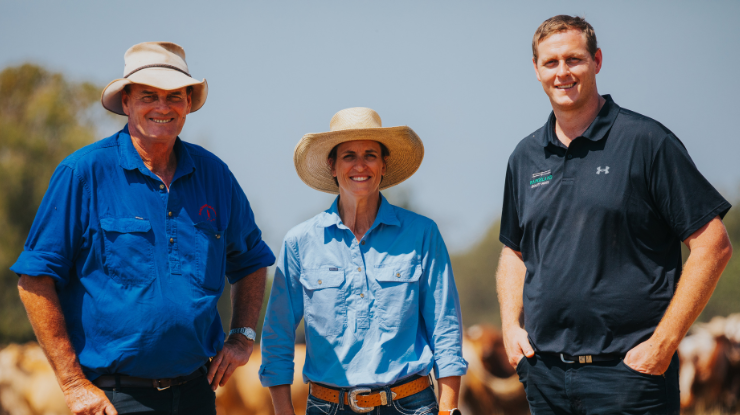
 Philip, Anna and Alister Hughes
Keeping pastures ‘rain ready’
The Hughes family has been on a journey to restore the health of their grazing land for the past 16 years. Introducing rest through rotational grazing, measuring ground cover and implementing techniques to hydrate soils and cycle nutrients are just some of the tools they use to manage grazing.
The Hughes family own and operate a paddock-to-plate vertically integrated branded beef supply chain. Philip, Adele and their daughter-in-law Anna oversee the grazing operations at Dulacca on the Western Downs in southern Queensland, and Alister is in charge of the wholesale beef operation, Rangeland Quality Meats, in Brisbane.
As long-term advocates of regenerative agriculture, they regard soil hydration, nutrient cycling and minimum ground cover thresholds to be critical in managing healthy soils, which in turn support a well-functioning environment and a productive beef business.
A new system
The extended run of dry years in the early 2000s forced the family to rethink their grazing management philosophy.
“This country was quite run down at the time we purchased it,” Philip said.
“We tried a few of the older style methods – we ripped country and seeded it and so on, and it failed. And then we ran into a run of dry years that just compounded the problem.
“Then we sat down as a family and said, ‘we’ve got to do something different’. And that started us on a journey – trying to understand how the system functions and trying to replicate some of that back into our land.”
MLA Challenge
Another key turning point came in 2013 when Anna and her late husband Lachlan Hughes took part in the inaugural MLA Challenge – a 12-month program that saw six producer families make improvements to their businesses with the help of research outcomes, mentors and benchmarking.
Philip said Anna and Lachlan’s participation in the challenge, and their “very organic thinking”, were big drivers in the family’s move to adopting regenerative grazing principles.
“The MLA Challenge played a massive role in the business side of the business, and also the production side,” Anna agreed.
Introducing rest
Philip said removing set stocking and introducing rest through rotational grazing was critical to the family’s changed grazing management regimen.
“That’s the first thing you need to do, which is pretty simple – it’s just removing set stocking out of your system, then you can start building from there.”
Monitor and measure
The family also began measuring landscape changes and pasture status as part of their overall management strategy.
“We’ve done baseline soil testing and seasonal grass sample testing to see energy contents,” Anna said.
“Then we can provide the cattle with a supplement to balance the mineral and vitamin requirements that they’re not accessing in the grass itself.”
Herd health
The family has taken a holistic approach to herd management and have moved away from large herd volumes and an ‘engineered approach’ to cattle management, to one that takes into greater consideration soil and pasture health, and synchronisation of pasture growth with grazing density.
This has involved a switch from a complex breeding system to a predominantly trade cattle operation, the use of probiotics to encourage rumen activity, time socialising the cattle on arrival, and not boxing cattle for at least 14 days prior to slaughter.
“A lot of what we’ve done is on the animal health itself. When we purchase cattle they go through an induction process,” Anna said.
“A lot of that has a focus on gut health of the animal before they are put out into the paddock.”
Retaining moisture in the system
As part of an industry that is “always hanging out for rain”, Philip said the business had to change its approach to conserving moisture on-farm.
“I remember Lach and I used to say if we didn’t get 30mm of rain in an event we might as well not have had it,” Philip said.
“If you go back through your rainfall charts, there’s probably only four or five events of 30mm and over in a really good year, and in a bad year there might only be one.
“It became obvious we needed to keep our country in a rain ready state, so we could take advantage of the smaller 10–15mm falls.
“And that was before we learned about the small water cycle and the critical importance of that.”
Maximising the small water cycle
In simple terms, the small water cycle is the ‘closed circulation’ system of transpiration, evaporation and precipitation that happens within a local environment, and which is heavily reliant on the presence of ground cover to minimise run-off and cool the soil.
“We’ve done a lot of training in rotational grazing, cycling our minerals, cycling our nutrients and our water, and so on,” Philip said.
“We’re doing a lot of work trying to work out what is the minimum amount of grass cover you need to get the maximum result from your small water cycle.
“There is some data saying you should probably only take 50% out, trample 20% and then leave 30% standing in the paddock.
“From a grazing perspective, you have to have discipline around leaving whatever that number is, whether it’s 30% or 40%, in the paddock. On our country we think it’s somewhere around 1,000–1,200kg/ha – that’s what we’re working on now to keep our land resilient and rain ready.
“You have to have cover on your land, because it’s the only way you’ll get your water filtration and microbial activity functioning, and keep your soil cool in the summer and warm in the winter.”
Switching focus from grass to soil
As part of their learning journey, the Hughes family now focuses more on what’s under their grass, as they recognise that functioning healthy soils are essential to water retention, good pasture biomass and animal performance.
“We place so much significance and weight on how much grass we have and how much cover there is,” Anna said.
“I think it’s probably a progression of our thinking that we’re [now] going, ‘okay, so what’s underneath that grass is the soil – how do we help it become a functioning system of its own?’”
Using data for decision making
The Hughes family relies on stock management and pasture biomass software programs to track animal and pasture performance, and inform feed budgets.
Their ag-tech toolbox includes:
- AgriWebb – for stock management
- Cibo Labs’ satellite imaging, to assess dry matter availability
- Farmbot – to monitor water levels in their tanks and to electronically measure rainfall at various sites around the property,
- with all information accessed on the family’s mobile phones
- Black Box – a whole-of-life, individual animal data collection system – to identify the performance of each animal and inform purchasing and marketing decisions
- Figured – a livestock management and budgeting system that links into Xero, their cashbook accounting and financial management system.
Watch the Hughes family share their story
Philip Hughes will present at the MLA Beef Industry Breakfast at the Northern Beef Research Update (NBRUC) conference in Brisbane on 11 March 2026. Visit the NBRUC website to register.
|
The Lachlan Hughes Foundation was created to honour Lachlan. It’s a legacy of his vision and passion to develop regenerative agricultural practices for the grazing lands. Each year, a group of participants are selected for a 12-month program – covering capacity building, personal development, regenerative agriculture training and mentoring. To learn more, visit the Lachlan Hughes Foundation website. |