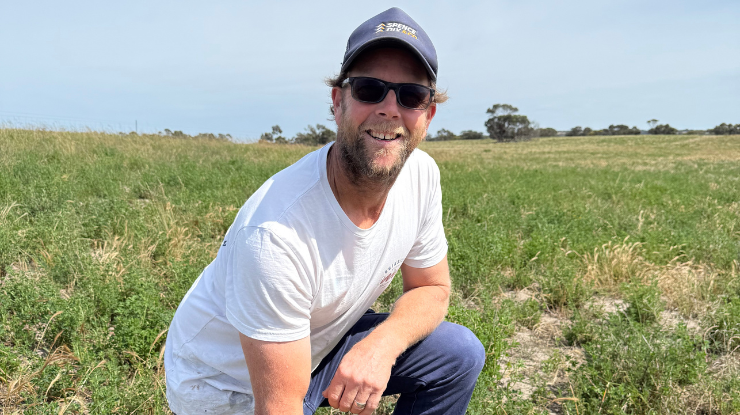
 Site host of the demonstration trial, Nigel Williams.
Sandy soil trial delivers clear results
Producers in SA’s Upper South East are no strangers to the challenges of farming on deep sands – poor water infiltration, low nutrient fertility, and compaction all limit pasture and crop production.
To better understand how to overcome these constraints, a nine-treatment demonstration trial was established in an 18ha paddock on Nigel Williams’s property, ‘Midway’, near Coonalpyn, SA. The trial forms part of the MLA and Coorong-Tatiara Local Action Plan project: Improved Grazing Production on Non-Wetting Sands.
“We wanted to keep learning on our farming journey and make every hectare matter in our grazing business. We were hearing a lot about amelioration across the area, and we thought it’d be good to be involved,” Nigel said.
What was done
In autumn 2022, a range of soil amelioration strategies were tested in 1.6ha strips, including deep ripping with inclusion plates, chisel ploughing with active mixing tines (Bednar Terraland), and surface applications of custom fertiliser and compost. Treatments were compared to an untreated control and monitored through a barley crop in 2022, followed by lucerne sown in winter 2023. Plant establishment, dry matter yield and soil parameters were measured throughout.
|
Matching tillage and amendments to target constraints:
|
What did it show?
Across three years, the Active Mix (chisel plough and mixing) treatment consistently outperformed other tillage types in improving soil structure and supporting plant growth. Assessment of soil strength showed that tillage sufficiently de-compacted the soil to 50cm and increased barley dry matter yield by up to 0.9t/ha above the control in 2022. The ploughed treatments also significantly reduced water repellence and skeleton weed burden.
By 2023, lucerne establishment was highest in the Active Mix plots (up to 35 plants/m²), outperforming both the deep rip and no-tillage plots (31 and 24 plants/m2 respectively). Despite a dry spring limiting growth, testing showed that water repellence was lowest in ploughed treatments, compared with deep rip and control.
In October 2024, Active Mix combined with fertiliser delivered the highest lucerne persistence (average 17 plants/m²) and dry matter yield (527kg/ha; Table 1). No tillage performed weakest overall, with low persistence (9–15.6 plants/m²) and modest yields (0.1–0.23t/ha), all well below the ideal >25 plants/m² target. Deep Rip + Inclusion showed intermediate outcomes, with +Compost and +Fert improving plant numbers and producing similar yields (0.23–0.22t/ha). Field observations showed lucerne growth concentrated along rip lines, indicating limited improvement between them.
|
Table 1. Lucerne plant persistence and yield measured at Midway in October 2024. |
|||
|
Tillage |
Amendment |
Plant persistence #/m2 |
Dry matter t/ha |
|
Deep Rip + Inc |
Compost |
11.7 |
234 |
|
Deep Rip + Inc |
Fert |
9.2 |
218 |
|
Deep Rip + Inc |
Nil |
10.5 |
129 |
|
No tillage |
Compost |
15.6 |
234 |
|
No tillage |
Fert |
10.3 |
208 |
|
No tillage |
Nil |
9.0 |
107 |
|
Active Mix |
Compost |
15.2 |
221 |
|
Active Mix |
Fert |
17.3 |
527 |
|
Active Mix |
Nil |
17.5 |
414 |
Lessons learned
Three seasons of results confirm that mechanical intervention – especially Active Mix tillage – is essential for overcoming physical constraints like compaction and water repellence on deep sandy soils. However, deep ripping alone was less effective and did not consistently improve plant density or yield – despite increasing grain yield in 2022. Organic amendments, such as compost, supported early biomass and persistence but were not enough on their own to improve yield. Fertiliser inputs were consistently more effective than compost, highlighting the role of targeted nutrition on nutrient-poor soils.
Plant establishment remained suboptimal across all treatments, suggesting that additional strategies – such as multiple passes, inversion tillage, or the use of wetting agents – may be needed to establish good lucerne stands on these naturally infertile sands in very dry seasons.
Importantly, skeleton weed pressure was substantially reduced in the ploughed treatments, indicating added weed control benefits from more aggressive tillage.
“If you’re going to do amelioration, you need to be able to pull out if the conditions aren’t right – you can’t just push on because you’ve booked a contractor. It’s a timely job and you want to start with small areas to build your experience and confidence,” said Nigel.
Why does it matter?
Sandy soils are widespread across the southern cropping and grazing zone, and poor productivity limits profitability for many mixed farmers. This trial provides much-needed evidence on how different tillage and amendment strategies perform under real-world paddock conditions.
With rising input costs, making informed decisions about where and how to invest in soil amelioration is critical. The data from Midway show that tillage method and nutrient strategy must be matched carefully to site conditions for cost-effective improvements in plant establishment, yield and weed control.
For Project Manager Dr Melissa Fraser from Soil Function Consulting, the shift in producer awareness and their willingness to consider deep tillage really stood out.
“At the start, there was a lot of hesitancy around using machines like the Plozza plough, which inverts the top and sub-soil layers. But the paddock-scale demonstrations have clearly shown that burying water-repellent sand is a highly effective way to improve long-term plant performance on these soils,” she said.
“In this district especially, producers were reluctant, due to an increased chance of soil erosion after deep tillage, yet we’re seeing attitudes change. These case studies have been crucial in helping producers look past the fear factor and understand the benefits for establishment, productivity and system performance.
“I’m really pleased with the results at this site. They show we’ve made real headway – and also that there’s still room for improvement and that’s okay,” Melissa said.
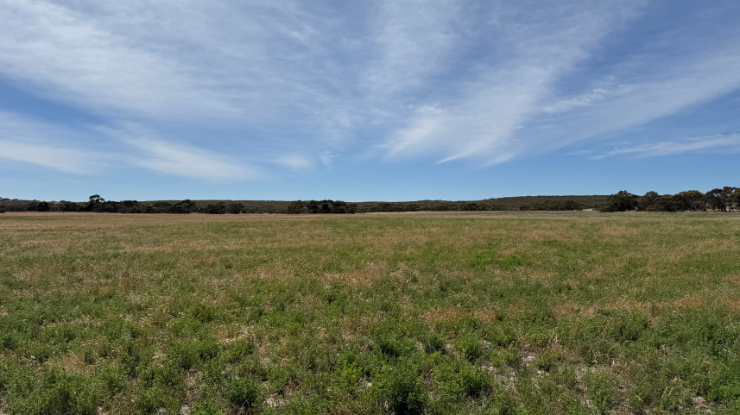
Lucerne stand at Midway trial site
What’s next?
The results from this long-term trial are providing valuable evidence for growers weighing up soil improvement investments on challenging deep sandy soils.
“It all comes back to knowing your numbers – what constraints are you starting with, what production level are you trying to get to and what extra income will you get out of it. You need the payback, otherwise, you might be better off spending the money on something else,” Nigel said.
To learn more about Midway and other sites in the project, visit the project hub online. To explore solutions to sandy soil constraints head to The Soil Hub website.