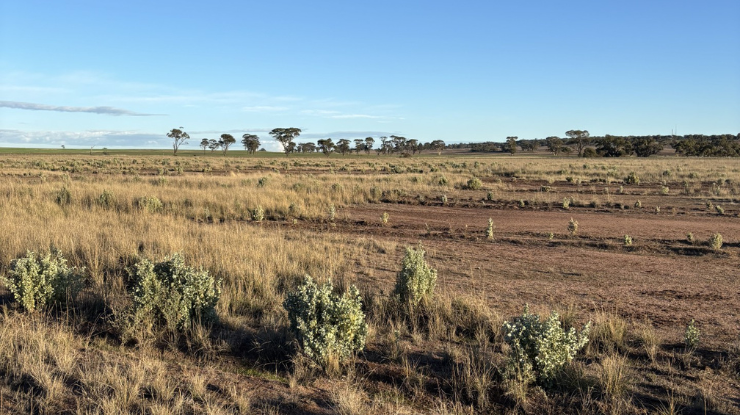
 The Tomlinsons used saltbush to increase their area of grazing land
Saltbush delivers pasture transformation
Sheep producer Chris Tomlinson hates to see farmland wasted, but on his long-term lease property near Cranbrook, WA, salt-affected land has rendered some areas unusable and unproductive.
Joining the ‘Productive saltland pastures for southern WA’ Producer Demonstration Site (PDS) provided the perfect opportunity to trial saltbush and other salt-tolerant pasture species as a solution.
His 2,200 Merino-cross ewes are reaping the rewards of an enhanced feedbase and improved shelter during lambing.
Sown saltbush lifts production
The Tomlinsons decided to trial a new saltbush-based forage system across 13ha in an effort to reinvigorate unproductive land.
“Parts of this farm have saline wet areas, which is flat, waterlogged country that just doesn’t really produce,” Chris said.
“Through the PDS, we’re trying to lift our production levels by introducing shrubs and tall wheat grass.”
In August 2022, the Tomlinsons planted saltbush sown from seed and under-sowed the paddock with tall wheat grass and balansa clovers.
The crop was a long-term investment, with the expectation that any lift in productivity could take years to see.
“We were warned we would need to give it time for the paddock to establish and it did take a couple of years for all of that saltbush to germinate,” Chris said.

WA producer Chris Tomlinson.
Reduced waterlogging
Today, the paddock is a transformed landscape.
“It’s been a game changer. I quite enjoy driving down there now and seeing the difference in the landscape,” Chris said.
“This time of year, you’d usually be looking at waterlogging with no production whatsoever, but the plot has really been turned around.”
Patience is a virtue
Following years of waiting for the salt-tolerant system to establish, Chris has been careful to protect it.
“Now that we have this pasture, we’re a bit reluctant on grazing it too soon because the sheep would graze it off completely and it would take a long time to recover,” he said.
Instead, the paddock was slowly introduced to grazing for six weeks during lambing, in conjunction with other paddocks the sheep had access to.
Chris found that when given the choice of paddocks, the salt-tolerant system was popular.
“Despite having 50ha of pasture beside this 13ha paddock, the sheep liked to graze on the saltbush.”
Combined, the paddocks were grazed by 250 single-lambing ewes at 1.6–3.1 dry sheep equivalent.
“The protection while lambing – particularly from the tall wheat grass – seemed to be just as valuable as the food,” he said.
When the paddock is more established and in rotation, Chris will be able to gauge the impact on the productivity levels of his flock and conduct a cost–benefit analysis of establishing the crop.
Still, Chris is confident enough in the solution that he will implement it further in his operation.
“We’re definitely going to be growing more of it.
“I hate to have land sitting idle, so we’ve got more areas in mind to establish the same pasture system,” he said.
Results for the region
Chris believes the PDS is just the beginning for more salt-tolerant forage systems in the region.
“We’re a heavily stock-orientated area. There are a lot of areas that could be producing a lot more but are saline areas. It’s just about putting the right species in there,” he said.
“I think we’ll start seeing a lot more of this in the area.”