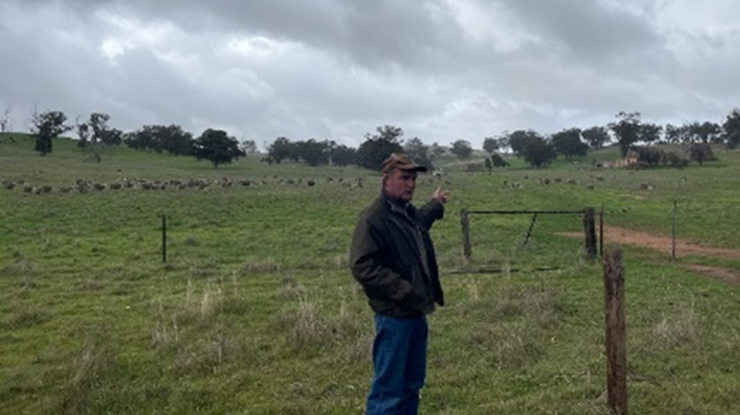
 Upper north SA sheep producer Lachie Smart
Targeted nutrition helps lift lamb survival
Prolonged dry conditions across SA prompted sheep producer Lachie Smart to implement on-farm containment feeding. In this strategic management approach, animals are fed in a designated area to protect pasture, manage nutrition and reduce erosion during adverse conditions, helping to maintain ewe productivity.
Running ewes in smaller mobs based on pregnancy status has enabled Lachie to maximise reproductive efficiency and minimise mortality in his flock – and he puts good lambing results down to having the right nutrition.
Lachie was part of an MLA-funded Producer Demonstration Site (PDS) run by the Upper North Farming Systems (UNFS) group, to build producers’ knowledge on how to successfully run smaller groups of ewes for higher lamb survival.
The PDS looked at on-ground solutions for producers with autumn lambing systems who needed to maximise feed available to lambs and extend feed on offer when faced with shorter springs and extended summer conditions.
Ewe management
Lachie’s 1,600ha Wirrabara mixed farming enterprise, ‘Avonmore’, is characterised by 1,000ha of non-arable hills grazing country.
He has been lambing ewes in containment for seven years to allow the hills’ pastures to establish and recover from spring and summer grazing, without compromising stocking rates.
Lachie drew on information from Lifetime Ewe Management (LTEM) and Grazing for Profit courses to adjust how he manages ewes to lift productivity and profitability.
“We always have a feed deficit each year in this region, so we have two choices: either feed out or reduce numbers. By containment feeding, we’ve been able to increase our stocking rate – but the best part is we’ve been able to let the hills get away,” Lachie said.
Lachie has seen four main benefits to his land and livestock from containment feeding:
- Utilising feed on offer: higher stocking rates better utilises the flush of feed from July–September.
- Protecting hills grazing: containing ewes gives the perennial pastures on his fragile hills time to get away – Lachie has observed improved ground cover, increased grass species and better feed on offer, year after year.
- Better monitoring: containing ewes enables better monitoring to ensure their condition score targets are met and fertility is maintained.
- Improved productivity: since Lachie began supplementary feeding, lambing rates have lifted and ewe wool cuts have improved.
Pregnancy scanning
Lachie completed a UNFS workshop to set breeding objectives and track progress using the Merino Flock Profile tool developed by Sheep Genetics. He uses electronic identification (eID) tags, with a Tepari handler and TruTest weigh scale indicator, to track pregnancy status and condition score.
Pregnancy status is an essential part of Lachie’s flock management.
He has an eight-week joining, beginning in mid-December. He preg-scans in April and drafts ewes three ways: dry, single and multiple-bearing.
Lachie lambs in mid-May when feed can be scarce, especially with a failed seasonal break (as seen in the upper north region during autumn 2024).
Before splitting up single and multiple-bearing ewes, Lachie found he would end up with low condition scores in multiple-bearing ewes which were then hard to get back into condition.
“These were most likely twin-bearing ewes who weren’t fed enough – and I suspect the lambs born and raised by those ewes were likely to be small and potentially less productive,” he said.
“This is where containment feeding has helped maintain ewe condition. If the ewe is in good nick, the lambs are generally in good nick.”
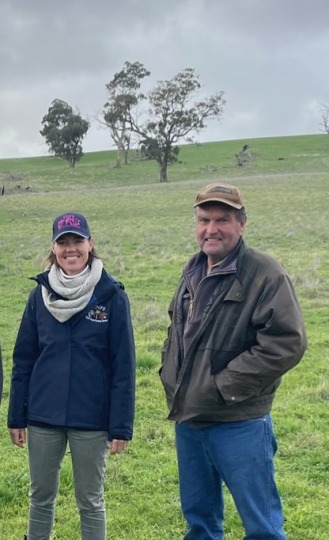
Upper North Farming Systems Project Officer Rachel Trengove and upper north SA sheep producer Lachie Smart.
Containment infrastructure
Lachie’s containment feeding set-up utilises existing small paddocks which had previously been used as small weaning paddocks and to manage sheep during shearing and crutching.
There are eight pens, ranging from 4–12ha, fenced to land class with post and dropper, cyclone and barbed wire fencing. Each has a water point – either a dam or a permanent trough.
After preg-scanning in early April, Lachie condition scores the ewes as they enter the containment area.
Ewes stay in these small paddocks for lambing and receive good quality high protein hay, such as wheaten hay cut right before flowering. Alternatively, Lachie supplements with barley and lupins when prices make that viable.
Ewes return to the main grazing paddocks when ground cover is established – which can be as late as July. At this point, ewes continue to receive a transition ration, giving their rumen time to adjust as they move from supplementary feeding back to pasture.
Targeted nutrition
The containment feeding period for the PDS ran from mid-March to the end of June 2023.
SA-based consultant Deb Scammell of Talking Livestock conducted feed tests on Lachie’s barley, lupins and hay to measure dry matter, protein, energy and neutral detergent fibre (NDF%).
Based on this data, twin-bearing ewes were given the following preferential rations:
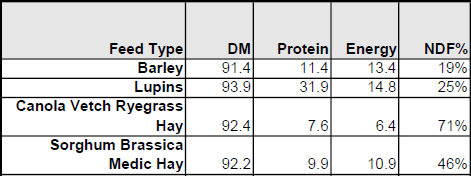
Table 1. 2023 Smart Feedtest results
Twin-bearing ewes:
- lower quality hay ad-lib through pregnancy
- higher quality sorghum hay at day 140 of pregnancy
- 75% barley/25% lupins ration gradually increased from 500g/head/day at day 100 of pregnancy to 1.8kg/head/day by lambing
- high quality sorghum hay ad-lib at lambing, to reduce reliance on grain.
Single-bearing ewes:
- lower quality hay ad-lib through pregnancy
- higher quality sorghum hay introduced at lambing
- barley/lupin ration gradually increased from 500g/head/day at day 100 of pregnancy to 1.2kg/head/day by lambing.
All ewes:
- a high-quality pre-lambing mineral loose lick supplement
- if it was still dry coming into lambing, all ewes received the ration through the whole lambing period.
Hay was fed on the ground using a Hustler bale feeder, and the grain ration was fed using handmade trail feeders.
Lachie used the LTEM app to track condition scores (CS), aiming for CS 3.5 for singles coming into lambing and CS 3.5–4 for twin-bearing ewes.
While he wants to improve survival in larger lambs, lambs which are too large can result in dystocia, so Lachie has set a target birthweight of 5–6kg.
Containment results
Lachie was pleased with the results of lambing in containment paddocks in 2023, which were:
- Twins: 161% at lamb marking
- Singles: 95% at lamb marking
“Since completing the LTEM course, our overall lambing percentage has improved through the use of containment – as has the nutrition and management of our pregnant ewes,” he said.
“This PDS reiterated the importance of keeping your eye on the ball and reinforced the importance of understanding the quality of feed and condition scoring to deliver precision feeding.”
Challenges and opportunities
While Lachie has seen multiple benefits to his business from containment feeding, he acknowledges there are some challenges to consider.
“We already had containment paddocks established, so the cost of a containment set-up was not significant. If you go down the route of fencing smaller paddocks, they do come in handy for other purposes such as shearing,” he said.
“There’s also more labour involved in containment feeding compared to paddock feeding – it added about 2.5 hours a day to our workload and meant we were tied to feeding and monitoring ewes throughout the containment period.”
The cost of grain and hay is also significant, however, in Lachie’s case, he was able to produce this on-farm.
Looking ahead, Lachie plans to focus on condition scoring in December/January to prepare ewes for joining. He would also like to build additional pens, so he can separate twin-bearing ewes with lower condition scores to further target management and improve twin survival.
Another focus will be the nutrition of his hills’ pastures to improve the performance of lambs.