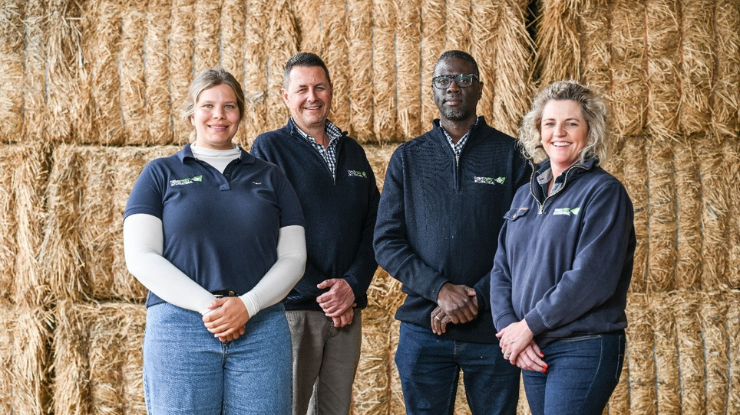
 TFI staff (left to right) Kassidy Coulthard, James Sage, Moses Mpandamabula and Kelly Nankivell proudly represented the company in Adelaide at the MSA Awards. Image: Brenton Edwards
Three strategies backing MSA double win
Thomas Foods International (TFI) has become the first beef producer in Australia to win both grainfed and non-grainfed awards for its outstanding results in achieving Meat Standards Australia (MSA) compliance.
For the fourth consecutive time, TFI’s Southern Cross Feedlot at Tintinara, SA, has won the Grainfed Producer Award for SA/NT in the MSA Excellence in Eating Quality Awards.
However, this 2023–25 period, TFI has also taken home the Larger Non-Grainfed Producer Award for the SA/NT category for the first time.
Over the two-year period, TFI consigned 104,429 grainfed cattle with an average MSA Index of 64.48 and 2,307 non-grainfed cattle with an average index of 62.78 – with both the feedlot and grazing property achieving a compliance of 99%.
Supply chain collaboration
TFI Southern Cross Feedlot General Manager James Sage said an unwavering commitment to animal health and welfare throughout TFI’s supply chain underpins its MSA results.
Their feedlot is European Union (EU) accredited, which requires their purebred Angus cattle to be non-hormonal growth promotant.
To ensure this, TFI works closely with a wide network of vendors, particularly breeders and professional backgrounding operations.
According to James, these partners focus on purchasing high-quality weaners from weaner sales and growing specifically for TFI’s feedlot.
“We also play a role in supplying a lot of our own cattle from our properties at Millicent and Mount Gambier, and Southern Cross Farms located next door to the feedlot,” James said.
“Across our properties and our partners, weaners are backgrounded with the intent to climatise them to yard conditions and socialise them to help manage stress.”
“They’re kept until they reach around 450kgs, before they’re brought into our feedlot.”
The majority of TFI feedlot cattle are fed for 150 days on grain, with half intended for EU markets.
The remaining 15% of cattle are broken up between a 200-day or 270-day feeding for additional export markets.
"Our feeding program comprises a barley-based ration, with a portion of wheat blended in during winter for a bit more energy,” James said.
“We use a winter silage of either barley or oat, with cottonseed and almond hulls for roughage.
“In our starter rations, we include high quality lucerne hay and oaten hay, and the rest of it is a molasses-based supplement with trace elements.”
To ensure year-round comfort for the cattle and minimise any environmental stress, the whole feedlot is under shade and bedding is provided in every pen from Easter through to the end of September.
“We use wheat straw, barley straw and rice straw from the Riverina as well in our bedding,” James said.
“We normally have a 60-day pen cleaning cycle for the whole feedlot, but during the months we provide bedding, we shorten that to a 30 to 40-day pen cleaning cycle.
“Ensuring the comfort of our cattle in all aspects really does play a huge role in obtaining that high-quality result.”

David Packer, MLA’s Meat Standards Australia Program Manager, presented TFI staff representatives with the Feedlot and Band 1 (grassfed business) Most Outstanding MSA Beef Producer Awards.
Low-stress focus
To further ensure animal welfare, James said a focus on low-stress stock handling and having facilities to match undoubtedly helps TFI’s MSA results.
“In both the feedlot and our grazing operations, our stock people are all on horses,” he said.
“Motorbikes can be loud, whereas horses keep things quiet – low level noise on-site plays a huge part in ensuring animals feed calmly.
“We put a lot of effort into staff training as well, and utilise professional stock people to train young and new employees in all aspects of low-stress handling.
“Our trucking and loading facilities, which include a double loading ramp, and using an excellent transport company is another advantage,” James said.
“The other plus we have is the transit period from here to Murray Bridge for processing is only 1.5 hours down the road.”
Seizing grazing opportunities
Sometimes, backgrounded cattle intended for TFI feedlots gain beyond the ideal 450kg and are too big to go into a 150-day grainfed program.
In these cases, James said TFI has seized these as opportunities to further establish their non-grainfed program and move the ‘too big’ steers to continue their growth on improved pastures and forage crops.
“We have about 2,400ha on the feedlot site itself, where we have a lot of improved pastures, veldt grass and lucerne – which grows very well in our lighter sandier soils,” James said.
“We also have the opportunity to grow oat crops, vetch, and legumes under our pivots.
“Our non-grainfed program is very seasonal and we're lucky the season has gone our way over the last couple of years.”
"With our non-grainfed cattle, we aim for a 320–350kg carcase, as opposed to the 420–430kg carcase we seek for our grainfed feedlot cattle.”
“All our non-grainfed cattle go into our Angus Pure Grass Feed Beef brand for the United States (US) market.”
While TFI does supply to the domestic market, targeting the high-end restaurant trade, the majority of TFI’s beef is exported to over 80 countries – with the three main markets being the US, countries in the EU, and Asian markets.
Regardless of the market, all TFI cattle are consigned for MSA grading, with carcase data an important benchmarking tool for the company.
"We analyse MSA carcase data for our own performance and we are starting to benchmark vendors based on that carcase data," James said.
“Everyone goes through different seasons and carcase data gives us the ability to suit cattle from different areas for market access – it’s a great tool to have.”