Western Australian Mutton Indicator tracks national market but trades at a discount
Key points
- The WA Mutton Indicator averaged 711¢/kg cwt in November, 19% below the National Mutton Indicator.
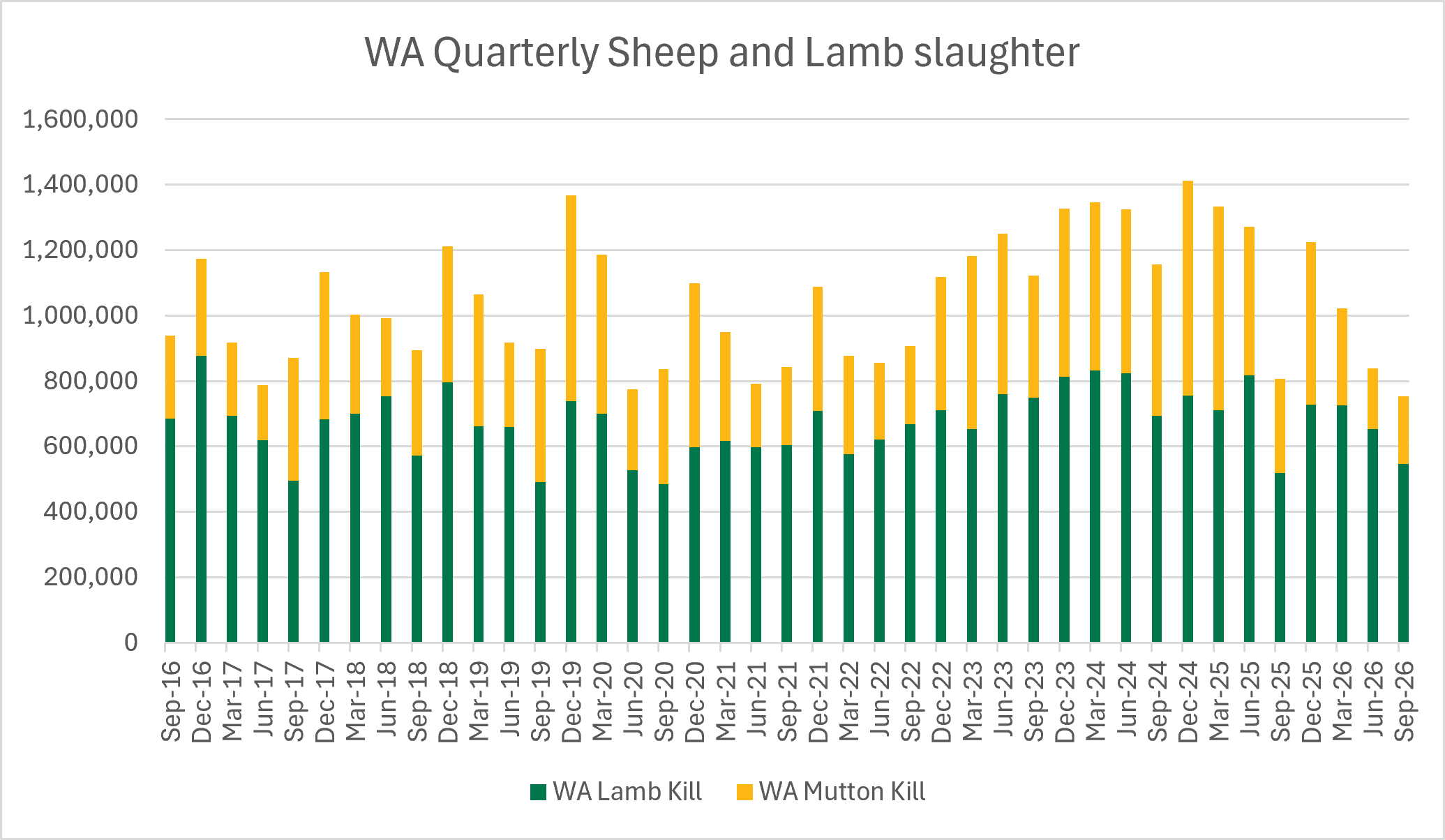
- Western Australia recorded its lowest September-quarter sheep and lamb slaughter in a decade.
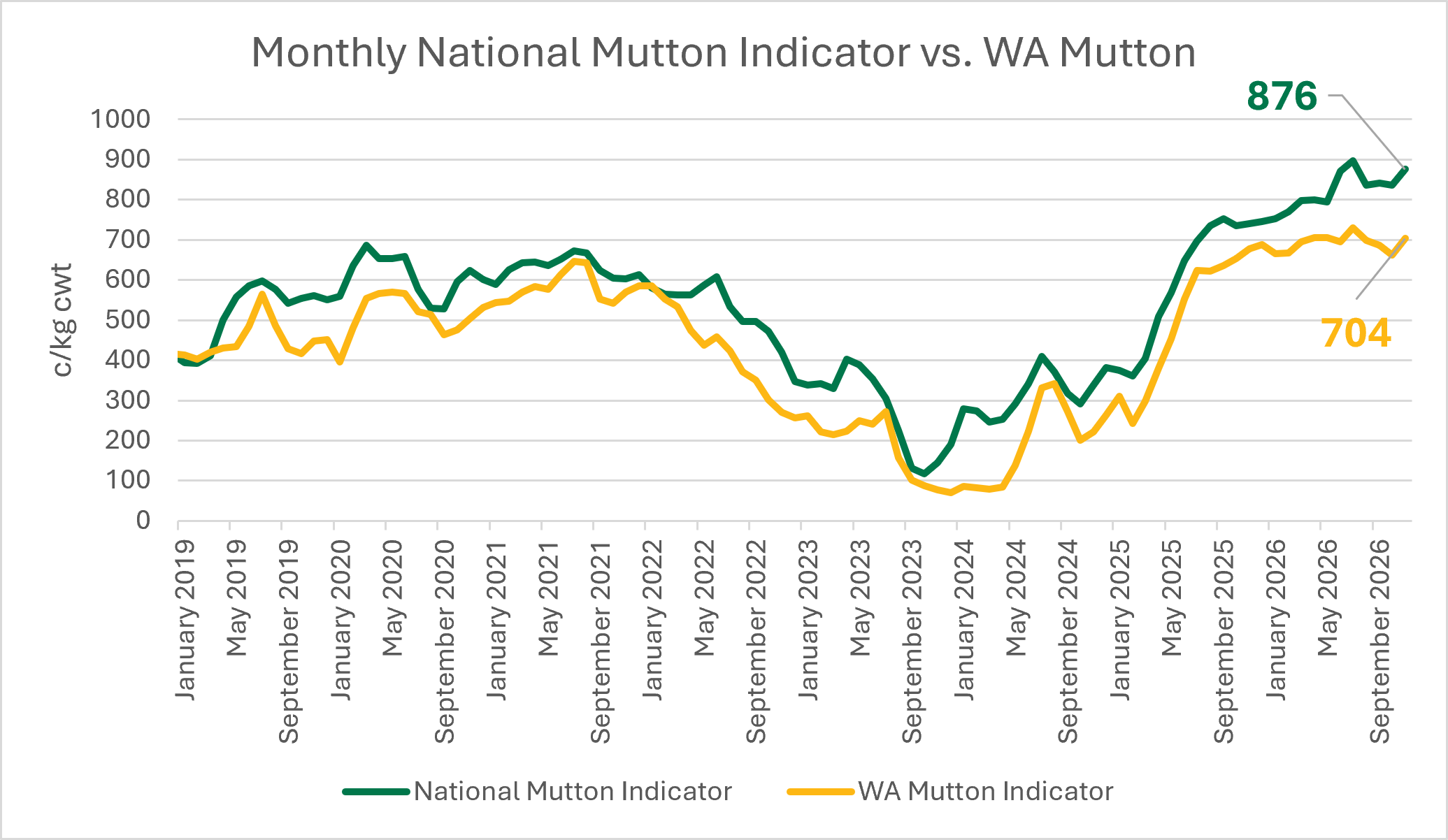
Western Australian mutton is fetching near-record prices, but continues to trade below the national market. In November 2026, the WA Mutton Indicator averaged 711¢/kg carcase weight (cwt), 165¢/kg, or 19% below the National Mutton Indicator of 876¢/kg cwt.
The state's sheep and lamb slaughter has fallen to its lowest quarterly level in a decade as the flock contracts ahead of the legislated phase-out of live sheep exports by sea from 1 May 2028.
WA mutton has traded at a discount for two decades
Between 2000 and 2003, when live export demand provided strong competition for processors, the WA Mutton Indicator traded above the national indicator in 71% of months.
Since 2004, the relationship has reversed. WA mutton has traded below the national price in 89% of months, with an average discount of 16%.
The gap widened sharply in early 2024. In February, the WA indicator fell to 83¢/kg cwt compared with 273¢/kg nationally, a 70% discount.
Both markets have since rallied to record highs, peaking in July 2026 at 898¢/kg nationally and 730¢/kg in WA. However, the gap persists.
The 12-month rolling discount is currently 15%, while the monthly discount has widened to around 20% since June
Source: ABS
Why WA mutton trades below the national price
The discount is structural, driven by several overlapping factors:
- Distance and freight. The national indicator is weighted towards eastern saleyards. When WA has higher levels of supply, its smaller processing capacity creates less competition than in the eastern states, an alternative is to truck them around 2,700 km across the Nullarbor.
- Seasonal turn-off. WA's Mediterranean climate concentrates selling in late spring and early summer as feed dries off. Supply peaks can create the discounts that typically widens between October and January.
Eastern seaboard prices have been supported by a contracting national flock and strong export demand. While WA supply is also tightening, the national benchmark continues to rise, maintaining the price gap.
From record turn-off to a tightening flock
WA's mutton kill hit a 10-year high of 656,100 head in the December 2024 quarter and remained above 620,000 head in the March 2025 quarter, as producers sold down their flocks. Total sheep and lamb slaughter peaked at 1.41 million head.
Slaughter has since fallen sharply, in line with the national trend. In the September 2026 quarter, WA recorded total sheep and lamb slaughter of 752,700 head, including 547,300 lambs and 205,400 sheep. This was the lowest quarterly total in a decade.
Mutton processing as a proportion of total state slaughter declined from 47% in the March 2025 quarter to 27% in the September 2026 quarter, reflecting both ewe retention and fewer sheep available to sell.
Source: ABS
Outlook
Tighter supply should increase competition among WA processors and may help narrow the current 20% discount. However, freight distances to final markets and seasonal turn-off patterns will likely continue to influence the price gap.
Attribute content to Alex Fry, MLA Market Information Analyst.
Information is correct at time of publication on 27 November 2026.