Is your soil ready for the next fertiliser application?
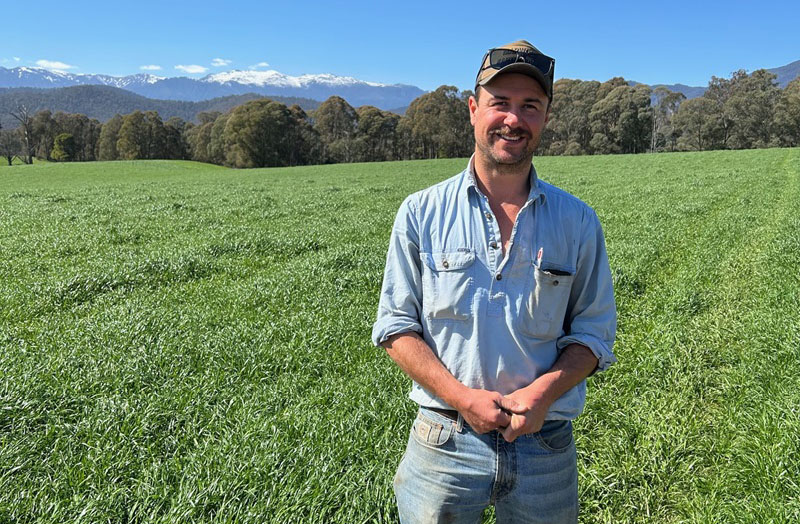
Fertiliser is one of the biggest input costs on George Galbraith’s Upper Murray beef enterprise – here’s how he’s turning soil and weather data into dollars.
Making sure every fertiliser application delivers the greatest possible return has become increasingly important, particularly when seasonal conditions can vary significantly across the region.
Based near Khancoban in NSW, George and his family run a self-replacing Angus herd across a mix of owned and leased country. While rainfall is an important part of the equation, George has discovered that soil temperature can be just as critical in determining when pastures are ready to respond to fertiliser.
Through the Farmers2Founders (F2F) TEKFARM program, George installed a weather station and soil moisture monitoring system to gain access to farm-specific weather and soil data.
TEKFARM connects producers with technology providers and technical support to help overcome barriers to adoption.
George was one of several producers involved in the first Phase of his Upper Murray project delivered by Upper Murray Producers plus (UMP+) and Upper Murray Inc in partnership with the Victorian Department of Energy, Environment and Climate Action (DEECA), Food Agility and Charles Sturt University.
For George, the technology is removing some of the guesswork from key management decisions by providing a better understanding of the conditions driving pasture growth.
Farm snapshot
-
NameGalbraith Pastoral
-
LocationKhancoban, NSW
-
Area in hectares650ha owned plus leased country
-
EnterpriseSelf-replacing Angus (400 breeders)
-
PasturesPerennial ryegrass, phalaris, annual ryegrass and clover-based grazing systems
-
SoilsVariable
-
RainfallApproximately 950mm
Timing matters
Before installing the monitoring system, George relied on weather information from the nearest available weather station at Corryong.
The challenge was that local conditions on his property were often very different.
“Quite often through the winter months we’d be getting frosts and Corryong might be a few degrees warmer,” he said.
“We’re probably another 250–300m higher above sea level.”
Those seemingly small differences influence how quickly soils warm after winter and when pasture begins actively growing. Rather than applying fertiliser as soon as seasonal conditions begin to improve, George now uses soil temperature, rainfall and soil moisture data specific to his farm to help decide when the investment is most likely to deliver a response.
“A lot of people might start spreading urea and the grass seems to get going three weeks or a month earlier in Corryong,” George said.
"You can just look on the app and go, well, it’s not worth spreading fertiliser at present because the soil temperature’s not there.”
George said the technology has not necessarily reduced fertiliser use, but it has increased confidence that applications are being made at the right time.
“What we’re seeing is probably a better result from spreading fertiliser at certain times and waiting until the time is right,” he said.
More confidence, less guesswork
The value of the monitoring system extends beyond fertiliser decisions.
Historical weather and soil data also gives George something to compare against from one season to the next, helping put current conditions into context.
“We can be standing at the shed having a toolbox meeting and go, ‘righto, this time last year we’d only had this much rain and soil temperature was this’,” George said.
As the dataset grows, George expects the information will become an increasingly useful tool for planning grazing management.
“If the season tightens, it will help us work out when we could potentially start pulling cattle off those perennial pastures to preserve them,” he said.
Having objective, farm-specific information gives the business greater confidence that management decisions are being made at the right time rather than relying solely on observation or regional weather information.
Opening the door to ag-tech
For George, the experience has shown that practical technologies don’t need to be complicated to make a difference.
“I nearly 100% would say that we wouldn’t have even looked at a weather station if they didn’t approach us about it,” George said.
“At the time, we didn’t know how it could benefit us.”
As part of the TEKFARM project, participating producers received installation and training support from weather monitoring company METOS.
“It’s very user-friendly – we haven’t had any problems with it at all,” George said.
His advice to other producers is to keep an open mind.
“Don’t be afraid to step outside the box and look at the technology that’s available,” he said.
|
Lessons learned
|