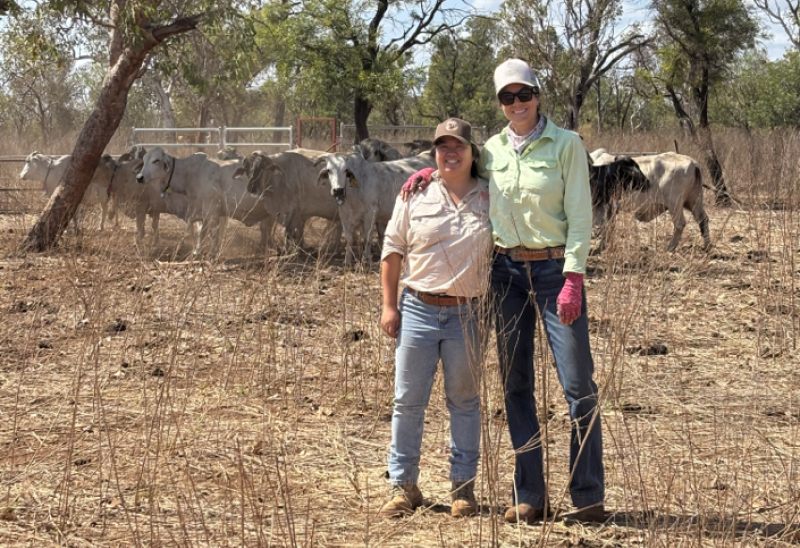
 Anita Chang and Christie Pearson at ‘Manbulloo’. Image supplied.
What cow behaviour could reveal about calf survival
In northern beef systems, factors contributing to calf mortality are often widely misunderstood – especially when it comes to understanding how maternal behavioural patterns influence survivability.
Farm snapshot
-
Name'Manbulloo Station'
Owned by Cross Pacific Investments, leased by NT Department of Agriculture and Fisheries -
LocationKatherine, NT
-
Area in hectares5,180ha
-
Enterprise500 Brahman breeders
-
PasturesTropical tall grasses and mixed perennial grasses
-
SoilsTippera soils
-
Rainfall963mm
To address this challenge, Central Queensland University (CQU) and the Northern Territory Department of Agriculture and Fisheries (NT DAF), with support from MLA, have launched Mooternal – a collaborative research project investigating the impact of maternal investment on calf productivity and survival.
Using a combination of sensors, GPS tracking technology and on-ground observations, the project is uncovering what makes a successful beef cow mother and how those traits contribute to calf productivity and survival in northern Australia.
Team effort
Mooternal is led by Dr Anita Chang, a Senior Postdoctoral Research Fellow with CQU's Precision Livestock Management team.
Anita's fascination with maternal behaviour began during her PhD research with Professor Mark Trotter, where she used sensors to detect calving events.
"During my PhD, I spent hours sitting in paddocks watching cows calve and interact with their calves," Anita said.
"I could see that some cows were incredibly attentive mothers, while others seemed much less invested.
“It made me wonder whether those differences in behaviour were influencing calf outcomes and how we could actually measure that."
Anita discovered her observations were shared by fellow researcher Dr Christie Pearson from NT DAF, with both noting a major knowledge gap in understanding maternal investment in northern beef systems.
In their quest to uncover how maternal behaviour contributes to calf survival, they’ve followed highly protective ‘helicopter mums’ that always kept their calves close, through to groups of cows that would leave their calves together in a crèche-like setting while they went off to graze.
Monitoring mothers-to-be
The team kicked things off at the NT DAF leased and managed ‘Manbulloo’ research station near Katherine in late September 2025. They equipped 100 pregnancy-tested breeders with GPS collars and accelerometer ear tags.
The technology was designed to provide researchers with a detailed picture of what cows are doing before, during and after calving in an extensive northern production system, where monitoring livestock can be challenging.
“The accelerometer ear tags recorded detailed movement data that can be translated into behaviours such as grazing, ruminating and interacting with calves, while GPS tracking revealed how cows utilised resources across the landscape,” Anita said.
“The use of Smart Paddock real-time GPS tracking also meant we had the ability to easily locate our mothers within Manbulloo’s large paddocks.”
The researchers watched for pregnant cows isolating themselves from the rest of the herd and displaying reduced movement.
“This usually indicated she was calving and allowed us to get out to her to confirm the birth.
“We could check that her calf was alive, healthy and vigorous, as well as how protective she was of her calf, before evaluating her udder and teat conformation.
“It also meant that if she lost her calf, we would already have some detailed notes on what could have gone wrong.”
Alongside the sensor technology, the team also recorded a range of physical and maternal traits including body condition score, udder and teat conformation, and maternal defensiveness.
For Anita, one of the most exciting aspects of the project is the ability to collect information that would otherwise be impossible to capture in northern grazing systems.
"A big challenge in the north is understanding exactly when a calf is lost and what happened leading up to that event," she said.
"Historically, we've looked at losses from pregnancy testing through to weaning, but that's a very large window of time.
“We're trying to narrow that down and understand what is actually happening around calving and in the weeks afterwards."
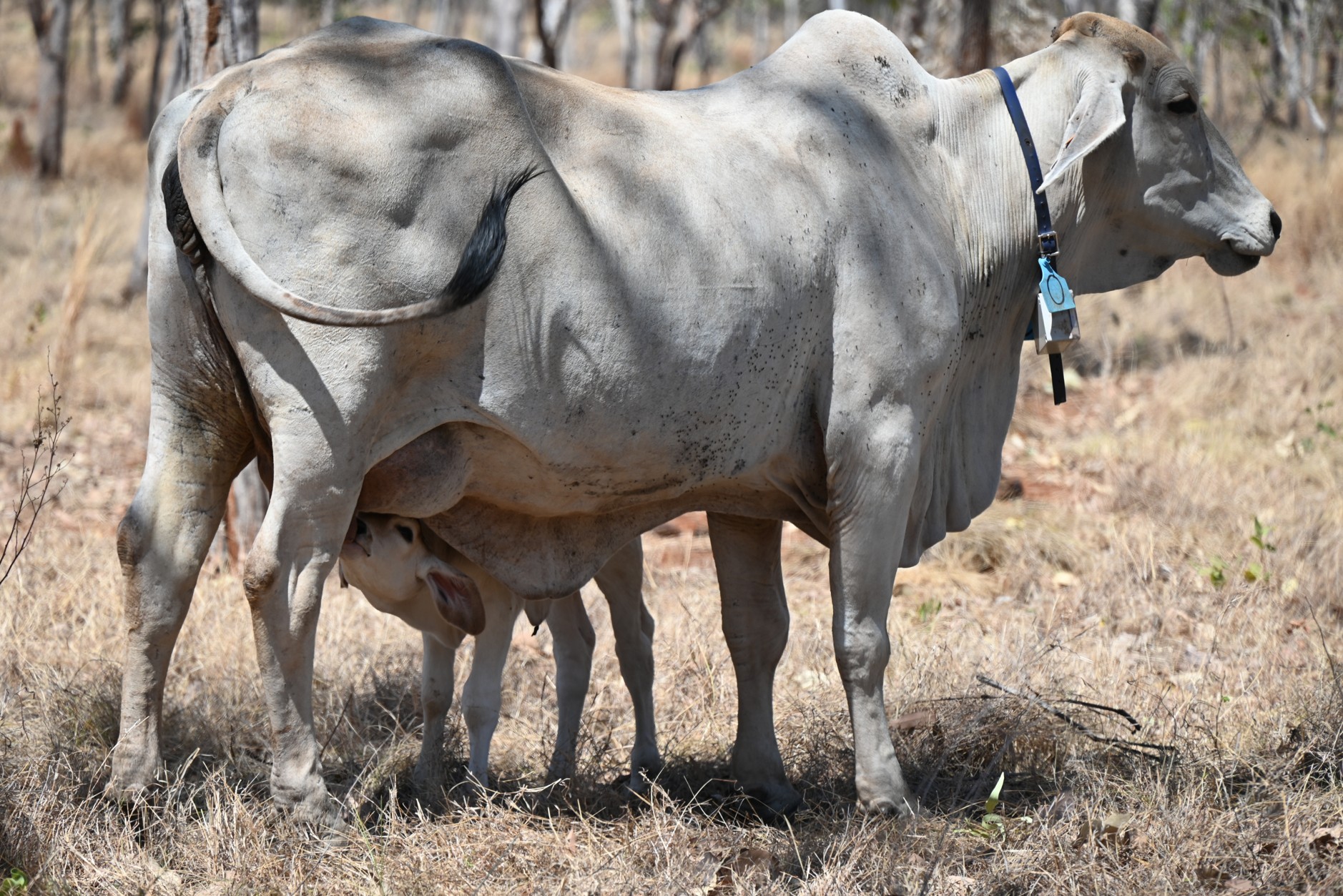
Mooternal data showed Brahman cows preferred to keep their calves with them while they grazed over leaving them in a group with other calves. Image supplied.
Uncovering the maternal advantage
Out of the 100 pregnant breeders involved in the trial, 89 successfully calved.
According to Anita, their movements following the live birth or loss of their calf has helped shaped a better understanding of what factors may drive maternal behaviours.
“With our Brahman cows at Manbulloo, we noticed the majority tended to keep their calves close to them – especially within the first week following birth,” she said.
“Later we began seeing a small group of mothers begin leaving their calves in that crèche-like setting with a single cow while the others went off and grazed.”
“Our secondary research station, ‘Belmont’ at Rockhampton, Queensland, further supported this pattern with all Brahman cows electing to keep their calf with them as they moved around the paddock to graze and access water points.
“Belmont also had some composite cows which displayed a totally different form of mothering by setting that crèche up almost immediately after birth.
“This suggests that climate, breed, and available resources may also be components driving maternal behaviour.
“But, despite the clear differences in mothering we are seeing, the data we have collected is yet to confirm if one from is better than the other.”
At Manbulloo, Anita said tracked data also led the team to theorise that cow movement compared to their pre-birth baseline is indicative of how vigorous or mobile their calf is.
“Cows that had healthy calves typically began moving with their calf a day after giving birth, with movement gradually increasing over the next few days,” she said.
“When cows were more restricted in the ground they covered, we often found it was due to an issue with her calf.”
As the project progresses, Anita said and the team will unpack which behaviours contribute most to calf survival and productivity, to build practical tools to help producers manage maternal performance.
Mooving forward
With the first stage of data collection complete, the Mooternal team is now turning its attention to the next phase of the project – expanding research beyond dedicated trial sites and onto commercial beef operations across northern Australia.
"The causes of calf loss are likely to be different between properties and even from one season to the next," Anita said.
"By working directly with producers, we'll be able to test how the technology performs in commercial herds and better understand the factors influencing calf survival under real-world conditions. And, most importantly, use those findings to drive practical changes that improve reproductive performance."