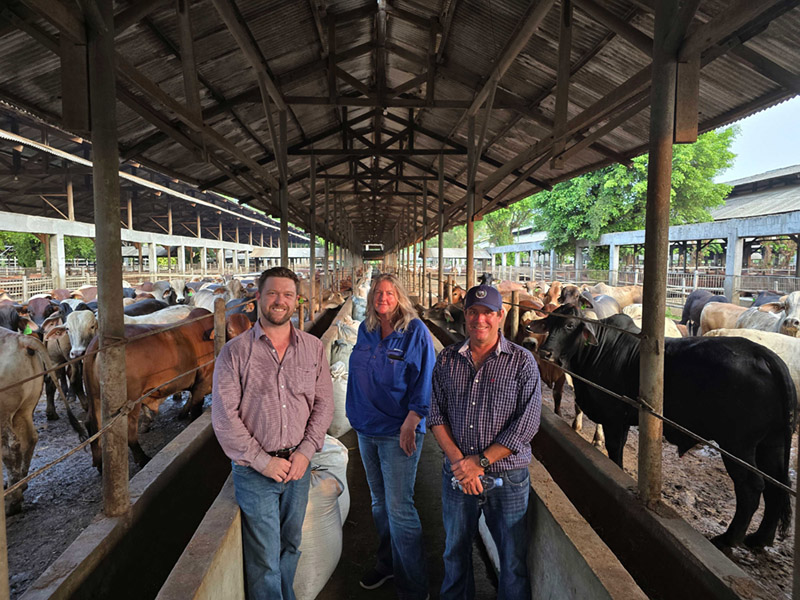
 NT producers Trudi Oxley and Sam McBean with Indonesia Livestock Operations General Manager Jack Webb at the Brahman Perkasa Sentosa Feedlot. Image supplied.
What NT producers learned inside Indonesia's cattle supply chain
The delegation, supported by MLA and the Northern Territory Cattlemen’s Association (NTCA), equipped producers with a better understanding of what happens to their cattle in Indonesia.
Producers visited feedlots and abattoirs in Lampung, Banten and West Java.
“Our Indonesian supply chain partners were very welcoming and pleased to see engagement from Australian cattle producers to help them better understand the trade,” MLA’s Indonesia and Asia Pacific Trade and Market Access manager Spencer Whitaker said.
“To fully understand Indonesia’s protein landscape there’s nothing better than seeing it with your own eyes.
“Producers on the tour were impressed with the animal welfare outcomes they saw, as well as the size, investment and professionalism of the operations.”
Important market
Indonesia is a key destination for many northern Australian beef producers, while for Indonesia – which has limited space to sustainably produce its own herds – live export provides an important supply of cattle and protein.
In 2025, about 583,000 head of cattle entered the Indonesian market from Australia through live trade export.
One of the producers on the delegation, Trudi Oxley, said Indonesia was a crucial market for her her family’s operation Oxley Grazing and accounted for nearly 100% of their business.
They supply Brahman steers to the live export market, so seeing the distribution chain in action was invaluable for Trudi.
“You think you have a reasonable understanding of how the supply chain works but it’s not until you actually get to a country that you understand how the culture and conditions shape it,” she said.
“I’ve seen how calm the animals are outside the abattoirs and can now visualise the conditions my cattle are in when they are in Indonesia.”
The delegation visited the Great Giant Livestock (GGL) and Juang Jaya Abdi Alam (JJAA) feedlots in Lampung which between them provide thousands of domestic jobs.
Trudi said seeing the feedlots firsthand helped her appreciate the socio-economic impact of the Australian-Indonesia live export trade.
“I gained an understanding of how important the live export trade is as an employer of local people,” she said.
Managing costs
One of the central messages producers heard was that some Indonesian operators faced thin profit margins due to high cattle prices, input price rises and a poor exchange rate.
Lotfeeders also shared how price caps placed on live cattle sales by Indonesia’s regulatory authority has limited their ability to pass on costs.
“We didn’t understand the impact of having a weaker local currency against the US dollar, on top of increasing Australian cattle prices,” Trudi said.
Trudi is now interested in forming a greater business-to-business relationship with Indonesian processors, to benefit all links in the supply chain.
“By understanding the customer, we can better prepare cattle for them so they have better margins and we can get more efficiency in our business by being able to better plan supply,” she said.
Building the relationship
NTCA Top End Branch chair and NT producer Sam McBean said the eagerness of Indonesian operators to meet with the delegation emphasised the value of the trade relationship.
“Ongoing dialogue between government and industry officials will help to further strengthen the trade,” he said.
“I’m really keen to send someone from our business to Indonesia each year.”
The delegation met Indonesia’s Directorate General of Livestock and Animal Health Services (DGLAHS), who reinforced Australia’s important partnership.
“There is recognition that Australian cattle are an important part of the system in Indonesia, but we can’t rest on our laurels,” Spencer said.
“We need to ensure the supply chain is profitable and running as efficiently as possible to achieve positive outcomes over the long-term.”
Opening the door to feedback
Spencer said improving the feedback loop between Australian cattle producers and Indonesian operators was a key takeaway from the tour.
“Currently, there’s limited feedback to Australian producers from Indonesia, but with data collected in feedlots, there is opportunity to grow this,” he said.
He said producers can encourage information sharing with Indonesian lotfeeders by engaging with opportunities through MLA.