What the highest cash rate in more than a decade means for producers
Key points
- The cash rate has increased to 4.60%, its highest level since 2011.
- Higher interest rates are adding to already elevated input and operating costs across livestock production systems.
- For sheep producers, increased financing costs can raise the cost of retaining females, purchasing stock and carrying animals for longer periods.
The Reserve Bank of Australia (RBA) increased the cash rate by 25 basis points to 4.60% this week. It’s the fourth-rate rise of 2026 and the highest level since 2011.
While producers have operated in interest rate environments at similar levels previously, the broader livestock production environment is markedly different.
In 2011, the cash rate remained at 4.75% for most of the year before the RBA began cutting rates later in November of the same year.
In contrast, today’s 4.60% cash rate follows a one percentage point increase since the start of 2026, with the latest decision reflecting continued inflation and cost pressures.
Higher costs build into the equation
For producers, interest is another cost within an already substantial farm operating cost base.
ABARES data highlighted sheep operations recorded average cash costs of approximately $286,000 in the 2024–25 financial year and included approximately $21,000 in interest expenses.
Interest accounted for around 7.5% of total cash costs.
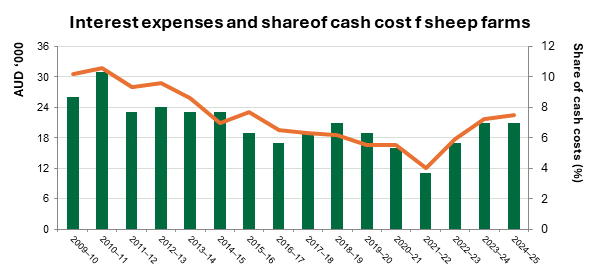
Source: ABARES Farm Data Portal; Average per sheep farm.
Higher rates affect more than repayments on existing long-term debt.
Finance is also used for working capital, livestock purchases and other operating expenses required to carry animals through to sale.
More broadly, agricultural debt supports both ongoing farm operations and longer-term investment in land, machinery and equipment.
This becomes particularly relevant when producers choose to hold more livestock.
Retaining ewe lambs or breeding females means foregoing immediate sale income while continuing to incur feed, animal health and management costs before those animals generate a return.
Purchasing additional breeding stock can increase numbers more quickly, but requires greater upfront capital. Particularly when livestock prices are strong.
Where these decisions are debt-funded, higher rates increase the cost of both holding and purchasing livestock.
A 25-basis-point increase adds approximately $2,500 in annual interest for every $1 million borrowed, if fully passed through by lenders.
Across the one percentage point increase in the cash rate during 2026 that equates to approximately $10,000 per $1 million borrowed.
A different sheep cycle than 2011
The timing is important for the sheep industry.
According to the Australian Bureau of Statistics (ABS), the national flock was at 66 million head by June 2025 following several years of difficult seasonal conditions and elevated turn-off.
More recently, widespread rainfall across southern Australia has improved pasture availability and producer confidence.
Tight supply and strong prices have supported greater retention and restocker demand.
Interest rates are unlikely to outweigh seasonal conditions, feed availability or expected livestock returns in producer decisions.
However, higher financing costs raise the hurdle for increasing numbers and may influence whether producers retain existing females, purchase additional stock or increase numbers more gradually.
The cash rate may be similar to 2011, but the cost of financing livestock has increased throughout 2026.
For producers, debt exposure, cashflow and expected returns will therefore play an increasingly important role in decisions to retain, purchase and carry livestock.
Join MLA’s Market Information team on Wednesday 7 October for the latest Sheep Industry Projections webinar.
The webinar will cover the outlook for flock numbers, slaughter, production and exports for the next three years.
Register your interest in the MLA October 2026 Sheep Projections webinar now.
Attribute content to: Emiliano Diaz, MLA Senior Market Information Analyst.
Information is correct at time of writing on 1 October 2026.