Record lamb carcase weights emerge amid tightening supply
Key points
- National cattle slaughter reached almost 9.6 million head in 2025–26, the highest financial-year total since 1978.
- Queensland, NSW and Victoria all set quarterly beef production records.
- Female slaughter reached a record 1.387 million head in the June quarter.
Nearly 9.6 million cattle were processed nationally in 2025–26, the highest financial-year total since 1978. The result highlights the scale of cattle available to processors and the capacity of the Australian supply chain to handle historically high throughput while cattle markets have remained comparatively strong.
The financial-year total has already exceeded the scale outlined in MLA’s March Cattle Industry Projections, which forecast 9.45 million head for the 2026 calendar year. At the time, that was expected to be the highest annual slaughter result in almost five decades.
Queensland leads national throughput
Queensland drove much of the June-quarter increase, processing 1.083 million head, or 43% of the national kill. This was 13.9% higher than the March quarter and 7% above the same quarter last year. It was Queensland’s strongest June quarter since 2015 and one of the state’s largest quarterly slaughter totals in more than a decade.
NSW slaughter reached 572,500 head, up 11.7% year-on-year, while Victoria processed 587,000 head, up 8.8%.
Beef production was even stronger. Queensland produced 355,529 tonnes, NSW 171,257 tonnes and Victoria 171,059 tonnes, with all three states recording their highest quarterly beef production in the available series since 1972. Each also set a new financial-year production record.
The fact that all three major eastern processing states reached records at the same time highlights how broad-based the lift in cattle supply has been.
First-half slaughter remains ahead
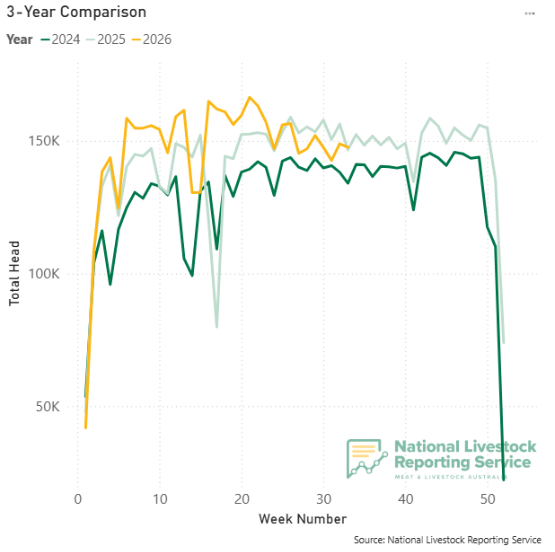
As the NLRS weekly slaughter figures have been showing, national slaughter released by ABS for the first six months of 2026 was 6.9% higher than the same period in 2025.
However, weekly slaughter has started to moderate. NLRS figures tracked above 2025 levels through much of the first half, but since the end of June national throughput has averaged around 2% below the corresponding weeks last year.
The export environment has become more complex, with safeguard quota volumes for Mainland China and Korea now filled. This is expected to redirect some Australian beef towards markets including Japan, the United States and South-East Asia rather than necessarily reduce underlying demand.
Female turn-off reaches record
The June quarter also recorded the highest number of female cattle slaughtered since 1972, at 1.387 million head. Females accounted for 55% of total cattle slaughter, the highest quarterly female slaughter rate since June 2020.
This reflects a strong seasonal element to female turn-off. With many spring-joining herds, pregnancy testing occurs through autumn, with empty, older or lower-performing cows then culled before winter. This avoids carrying unproductive females through a period of slower pasture growth and higher supplementary feed requirements, lifting female supply through May and June.
More recent NLRS weekly data suggest that trend is easing, with female slaughter gradually declining from its May peak alongside the broader moderation in national throughput.
Attribute to: Emiliano Diaz, MLA Senior Market Information Analyst.