Implementation of Objective Measurement
Overview
Overview
Meat & Livestock Australia (MLA), through its Objective Measurement (OM) and Supply Chain Implementation programmes, is driving a suite of initiatives aimed at accelerating the development, adoption, and commercialisation of OM technologies and associated data analytics systems across the red meat industry.
These programmes go beyond the initial build and early adoption phases, focusing on overcoming barriers to scaled implementation and embedding OM technologies into business-as-usual operations. This includes validating alternative business models, supporting commercialisation pathways, and ensuring that enabling systems are in place to maximise industry-wide benefits.
The initiatives represent a strategic extension of MLA’s early adoption efforts, transitioning supply chains from pilot projects to full integration of OM technologies within operational frameworks.
Core Activities
The activities under this programme support the adoption of OM-based solutions that can be applied to live animals or carcases to measure traits critical to compliance, productivity, and carcase value. These solutions underpin improved grading accuracy, enhanced feedback systems, and optimised supply chain performance.
Outcomes from this product group are primarily delivered through MLA Donor Company investments, complemented by producer levies and funding from the Australian Meat Processor Corporation (AMPC).
Key initiatives include:
- Carcase Measurement Solutions: Supporting implementation of technologies that enhance Meat Standards Australia (MSA) and AUS-MEAT grading systems. This includes exploring opportunities for hot (pre-chiller) beef grading, improving lean meat yield measurement, and enabling adoption of the cuts-based MSA sheepmeat model. Additionally, OM data is being leveraged to underpin brand-based strategies for processors and brand owners.
- Traceability Solutions: Facilitating adoption of proven traceability systems within abattoirs to deliver improved end-to-end integration and data flow from OM technologies, strengthening supply chain transparency and compliance.
- Supply Chain Feedback Systems: Supporting implementation of feedback and feed-forward mechanisms that enable processors and producers to act on OM data, improving decision-making and enabling OM-driven value propositions.
Benefits to industry
The implementation phase represents the final step in the technology development pipeline, where OM technologies transition from trial to full-scale adoption across supply chains. These investments are critical to realising the modelled economic and operational benefits of the OM programme.
According to MLA’s most recent modelling (2020), the projected net first-round benefit from widespread adoption of carcase and live animal OM technologies is substantial:
- $62.7 million annually by 2030, with the majority derived from cattle OM ($50.2 million).
- $216.9 million annually by 2045, with cattle OM contributing $174.5 million.
- $1.3 billion net benefit to the red meat industry between 2025 and 2045.
These benefits stem from improved grading accuracy, enhanced feedback loops, optimised processing decisions, and greater alignment between production and market requirements. Ultimately, OM implementation strengthens industry competitiveness, supports value-based trading models, and drives productivity gains across the supply chain.
Projects
Project Code: P.PSH.1498
Objective: The purpose of this project is to support JBS trial and validate and value propositions of IMF measures in lamb supply chains. Specifically it will use a range of IMF measurement technologies to trial and adopt the MSA sheep cuts model. Adoption of such OM technology and incorporating into grading models, such as MSA model, is expected to deliver greater consistency to brand owners which encourages greater investment as they know it will be rewarded in optimal product categorisation.
Status: In Progress
Project Code: P.PSH.1513
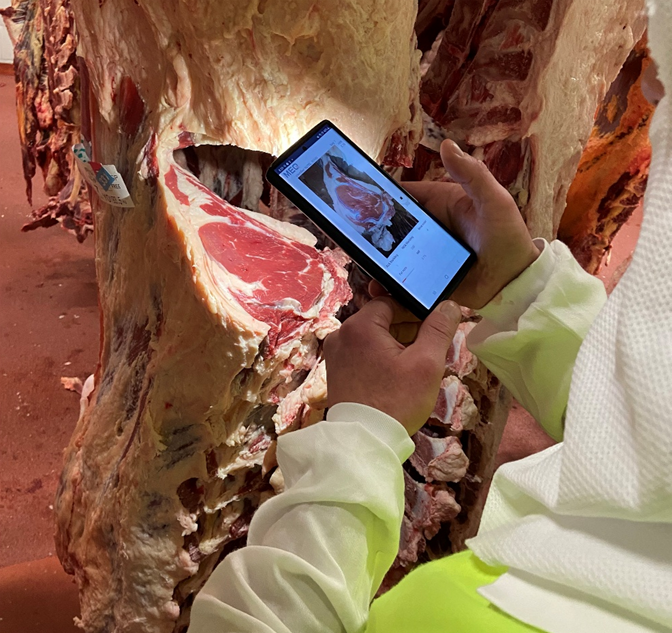
This project aims to deliver an integration and implementation of objective measurement cold carcase grading in beef processing operations. Objective measurement technology and enabling processes will be integrated into a processor's business systems to measure cold beef carcase traits to improve accuracy and consistency compared to current visual grading methods. Specifically, the project will evaluate the integration of the MEQ cold beef grading camera into a beef processor's workflows and business data management systems, including feedback to producers. This is the first OM adoption project of its kind to implement and fully integrate an OM solution at the initial pilot processing plant, and the adoption protocols developed will be used for full integration of the OM solution across all operations.
Status: In progress
Project Code: P.PSH.1554
Objective: This project involves the commercial testing of a low-cost microwave system invented by Murdoch University that has recently been accredited by AUS-MEAT for measuring intramuscular fat percentage (IMF%) and GR tissue depth in hot carcases on the slaughter floor. Murdoch University will partner with JBS to install and implement the Microwave system at two of their supply chains. Two key outcomes of the project will be: 1. Evaluation of the Microwave system to measure both GR and IMF% at chain speed, thereby unlocking JBS to evaluate the MSA model and 2. Collect a greater range of high IMF% data for the Microwave system to enable the technology to progress accrediatation for a greater IMF% range, thereby creating the potential to unlock new high value high IMF% lamb markets.
Date published: In Progress
Project Code: P.PSH.1528
Objective: This project aims to deliver an early adoption and integration of an objective measurement device and Mobile application (App) to measure cold beef carcase traits to improve accuracy and consistency compared to current visual grading methods. This project will develop operating protocols and dashboards to enable adoption of a grading solution and comparison with visual grading methods using the cold carcase traits for future adopters. The project will evaluate the integration of the MEQ cold beef grading camera and mobile application into a beef processor's workflows and business data management systems, including feedback to producers. A daily comparison of manual and device measurement results over a wide range of traits will enable change management protocols to be developed to transition and roll out a full integration and implementation of objective measurement solutions across of the company's beef processing operations.
Status: In Progress
Project Code: P.PSH.1550
Objective: This project aims to support evaluation and validation of value propositions using objective measurement in lamb supply chains. Specifically, the project will use a range of quality and yield-based measurement technologies to trial and evaluate quality processes and systems to support lamb branding strategies. The project will build on previous company evaluated quality and yield technologies to educate and develop baselines for quality and yield measures in lamb, and create awareness of typical ranges in IMF% and LMY across different carcase types. Trials will be expanded from the current application of installed DEXA and MEQ to implement and adopt a newly AUS-MEAT accredited Microwave technology. The overall objective is to implement and integrate quality and yield based measures and systems across all company lamb production sites. If successful, this will help facilitate the adoption of the objective measurement solutions and ensure it can be used as an input into quality and yield based models, and thereby support the wider industry adoption of MSA Sheepmeat cuts based model in branding strategies.
Status: In Progress
Project Code: P.PIP.0747
Objective: This project will ascertain, through a hot side production DEXA grading system, (1) The benefit of OCM to Producers when measured on hot product, (2) if the cutting data obtained in a hot carcase translated to real cut location in chilled product, (3) Identify training and support programs for processors and producers in the area of OCM feedback and use, (4) Enable MLA (and Scott) to ascertain whether future systems are better suited to the hot side in a processing facility.
Date Published: 09 October 2023
Project code: P.PIP.0755
Objective: This project will ascertain, through a hot side production DEXA grading system, (1) The benefit of OCM to Producers when measured on hot product, (2) if the cutting data obtained in a hot carcase translated to real cut location in chilled product, (3) Identify training and support programs for processors and producers in the area of OCM feedback and use, (4) Enable MLA (and Scott) to ascertain whether future systems are better suited to the hot side in a processing facility.
Date Published: 01 November 2023
Project Code: P.PIP.0754
Objective: This project will ascertain, through a hot side production DEXA grading system, (1) The benefit of OCM to Producers when measured on hot product, (2) if the cutting data obtained in a hot carcase translated to real cut location in chilled product, (3) Identify training and support programs for processors and producers in the area of OCM feedback and use, (4) Enable MLA (and Scott) to ascertain whether future systems are better suited to the hot side in a processing facility.
Date Published: 01 November 2023
Project Code: V.TEC.2025
Objective: This project will leverage an AEA grant to deliver multiple installations of the Miniprobes beef and sheep system to various commercial processing plants to assess and validate system performance and enable the supply chains to utilise the objective measurements the technology provides. Additionally, the scope includes activities aimed at fostering industry adoption of the technology through these installations.
Status: In Progress
Project Code: P.PSH.1633
Objective: This project will develop and evaluate processes to optimise carcase sortation for early adoption of objective measurement technologies in beef processing. A full carcase identification and tracking system will be implemented and validated from livestock into processing whereby multiple objective measurement technologies integrated in the plant can be linked to data capture throughout all areas of process. The outcome will be the development of a hot grading pre-sorting protocol including guidelines of how a beef processor will implement a full end-to-end tracking system from livestock to carcase monitoring using objective measurement data to enable pre-chiller sortation and allocation in saleable product markets to optimise value and returns.
Status: In Progress
Project Code: P.PSH.1504
Objective: The overall objective of the project is to evaluate the Cognex AI camera’s ability to read labels and barcodes to determine errors and misprint while also assessing its capability to recognise and identify beef and lamb cuts and primals. A successful outcome is expected to reduce costly product recalls in the primary and secondary processing industry while ensuring market access is maintained through accurate validation of all labels and product types.
Status: P.PSH.1504