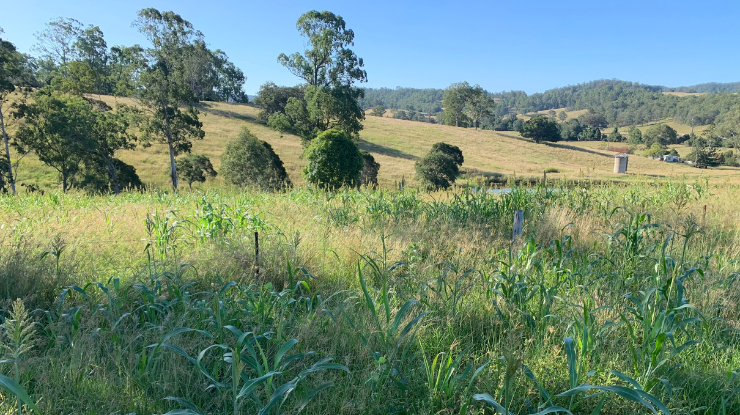
 The Botfields have increased soil and pasture productivity through the project.
Grazing changes deliver 150kg weight gains
NSW beef producers Tom and Katie Botfield’s involvement in Casino Food Company’s carbon project has delivered more kilos of beef and healthier soils at their Northern Rivers property.
The results have been impressive, with steer weights increasing from 250–300kg to 400–450kg and an average daily weight gain of 0.9–1.2kg over six to eight months.
Shifting focus
The Botfield family’s farm enterprise currently encompasses three properties, with two neighbouring blocks owned by Tom’s parents and a third recently added by Tom and Katie.
“About 10 years ago, when I started becoming more involved in the family business, I decided I wanted to try doing things differently,” said Tom, a former electrician.
“I mustered my parents’ cattle in with mine to form one single mob and started completing a holistic land management course.
“It was a very different approach to what we’d previously done and definitely ruffled a few feathers at home, but I think when you’re looking to get the best out of your land and improve your profitability, you need to be willing to look at all the options available to you.”
Tom sold off his breeder herd and transitioned to a steer backgrounding operation in 2024.
He saw this as an opportunity to mix things up and investigate how focusing on soil health and carbon sequestration could improve market opportunities and his on-farm productivity. As a producer shareholder of Casino Food Company, Tom jumped at the chance to get on board the organisation’s carbon project.
A good fit
The carbon project worked seamlessly into what he was already doing to improve land condition and soil health.
“An increase in organic matter will aid in sequestering carbon from the atmosphere,” he said.
“I was already working to do that because increased organic matter also allows for humus to form in the soil, which then almost becomes a battery that releases moisture and minerals that charge your pastures.
“Throughout the course of the project we’ve watched our lighter soils transform from a grey rocky sand to a smooth dark chocolate.
“Our pastures are growing in thickets and are supplying our cattle for longer.”
While the broader project aimed to measure carbon sequestration, variability in soil types across the region made consistent testing difficult – for Tom, this challenge became a turning point.
“We couldn’t get reliable carbon data because the soils were so different from paddock to paddock and year to year,” he said.
“But what we could see – plain as day – was that the land was improving.
“Pastures were stronger, cattle were healthier, and erosion was down.
“At the end of the day, we weren’t trying to tick boxes, we were trying to improve our land – if accurately measuring carbon sequestration was volatile across paddocks and years, then we felt we couldn’t commit to carbon accreditation without financial risk.
“There was so much value in simply undertaking these steps as part of improved grazing land management that I felt more than happy to reduce carbon without the badge of honour.”
|
Five steps for healthy soils These strategies are delivering benefits for Tom’s cattle, land and bottom line.
|