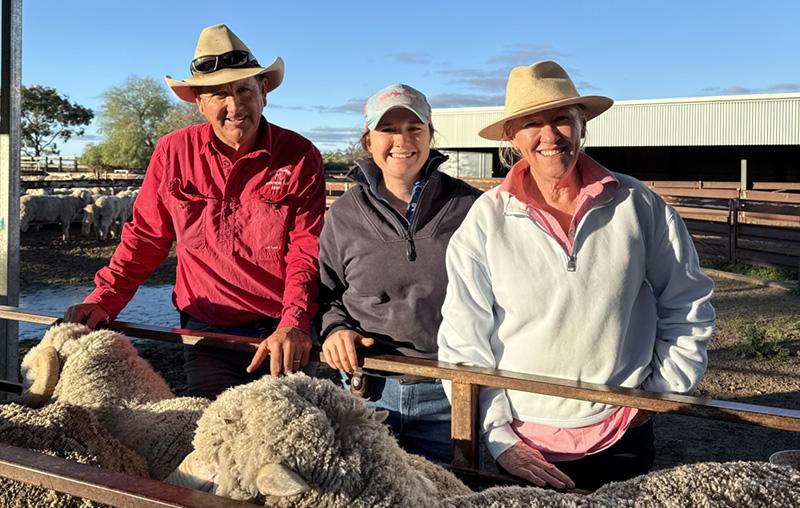
 Peter, Emma and Lisa McCrabb run a self-replacing Merino flock on the saltbush-dominant Hay Plains.
Every measurement has a purpose
Today’s sheep producers have access to more information than ever before, from electronic identification and pregnancy scanning to fleece weighing and carcase feedback. Here’s a look at how south-west NSW producer Emma McCrabb is turning data and measurements into practical improvements on-farm.
Emma and her parents Peter and Lisa run their commercial self-replacing Merino flock near Booroorban, on the Hay Plains.
The saltbush-dominated landscape has a highly variable environment where annual rainfall averages around 300mm, making feed one of the property’s most valuable resources.
Rather than relying on improved pastures, the family manages native country through rotational grazing and strategic supplementary feeding, meaning every management decision carries weight.
It’s one of the reasons Emma places such a strong emphasis on measuring flock performance.
“When you start objectively measuring some traits, you realise you need to get onto others as well,” Emma said.
“We’ve just gradually increased what we’re measuring.”
That mindset has shaped the way her family selects ewes and rams, manages pregnancy and uses technology to make everyday jobs more efficient.
FARM SNAPSHOT
-
Name:PETER, LISA AND EMMA McCRABB
-
Location:Booroorban, NSW
-
Area in hectares:16,000ha
-
Enterprise:Merinos (4,500 ewes)
-
Pastures:Native dryland pastures, saltbush-dominant
-
Soils:Variable – sandy red loams to heavier clays
-
Rainfall300mm
Taking industry knowledge home
Although Emma always intended to return to the family business, she wanted to gain experience beyond the farm gate first.
Working in MLA’s Sheep Genetics team exposed Emma to seedstock producers across Australia and demonstrated how objective measurement could improve breeding and management decisions.
Rather than seeing those tools as something reserved for stud breeders, Emma saw opportunities for commercial producers to benefit too.
“I saw my time at MLA as an opportunity to build off-farm skills and understand how the wider industry works, particularly the ram breeding side,” she said.
“It really opened my eyes to the possibilities that objective measurement can bring to a commercial business.”
Returning home four years ago, Emma began applying many of those principles in the family flock.
Today, the McCrabbs record breech wrinkle scores at lamb marking and again as yearlings, capture birth type information through pregnancy scanning, and individually weigh the fleece of every ewe hogget.
Those measurements complement their breeding objectives, providing objective information to support selection and identify animals that are performing across the traits that matter most to the business.
Measuring what matters
“Weaning rate is one of the key profit drivers in our business, and it’s something we can readily monitor and select for through pregnancy scanning, and wet and dry assessments at marking,” Emma said.
“Breech wrinkle was another obvious trait for us to measure because we don’t mulese.
“At the same time, we wanted to measure fleece weight because of the unfavourable relationship between those two traits.
“Wool is another important profit driver for our business, particularly because we shear every six months.”
More recently, the family has begun benchmarking the eating quality of its lamb through objective carcase assessment.
Entering lambs in a local hook competition where MLA’s Meat Standards Australia team collected carcase measurements gave Emma her first opportunity to see how the flock was performing for eating quality.
“We’ve always eaten our own lamb and thought it was pretty good,” she said.
“It’s great to actually get that objective feedback and benchmark how we might perform in a future value-based market.”
Turning information into action
Pregnancy scanning has become one of the most valuable management tools on the property. Separating twin- and single-bearing ewes allows feed to be directed where it delivers the greatest return, improving both ewe management and lamb survival.
“What we found when we started scanning for multiples and managing them separately was we were able to better allocate feed to the ewes that needed it most, “Emma said.
“Programs like Lifetime Ewe Management taught us how to better manage those twin-bearing ewes by tailoring feed to condition score and that’s made a huge difference to our reproduction.”
That thinking also drove the family’s investment in electronic identification (eID).
The family began electronically identifying and recording individual animals in 2022 before purchasing an auto-drafter with the support of government funding in 2024.
Since then, Emma says the biggest gains have come through both improved data collection and labour efficiency.
“The labour savings have been pretty exciting,” Emma said.
“We can now weigh every individual sheep easily, rather than relying on mob-based samples. And I can do that by running them through on my own with just a few dogs.
“In a family business, that’s a big deal.”
As family labour changes over time, finding smarter ways to complete everyday jobs is becoming increasingly important.
“What Dad’s been able to do forever, I hate to admit, I can’t always physically do myself,” Emma said.
“Finding more efficient ways to get those jobs done is really important for the sustainability of the business.”
Staying curious
Emma sees curiosity as one of the most valuable tools producers can have.
“If you’re introducing new technology, prepare everyone who’s going to be in the yards with you to be patient on day one,” she said.
“I’ve had everything go wrong with eID. My biggest takeaway is, just be patient”.
Her advice to young people entering agriculture is equally simple: take every opportunity. Emma credits university programs like Intercollegiate Meat Judging (ICMJ) and attending industry events like LambEx as experiences that shaped both her career and the way she thinks about the sheep industry.
“I’d just take every opportunity,” she said. “You don’t know where it’ll lead.”
Emma, who was on the 2026 LambEx Taskforce, said she hoped producers left this year’s event with practical ideas they could implement as soon as they returned home.
“My hope is everyone went home with at least one thing to try on-farm and one new person to call,” she said.
“LambEx is an incredible opportunity to meet people. You never know whether it’s the person on stage or the person sitting next to you that’s going to change the way you think.”
For Emma and her family, that’s exactly how progress happens, by staying curious, measuring what matters and using every piece of information to make the next decision a better one.