Getting ahead of non-replacement calf challenge with beef from dairy strategy
|
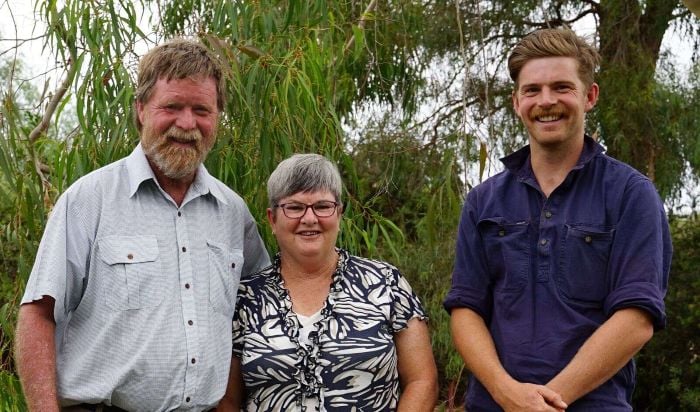
FARM SNAPSHOT Name: Jacob, Mark and Ann Gardiner Location: Bamawm, Murray region, Victoria Area: 520 hectares (fully irrigated) Herd size: 1100 head – 85 per cent Holsteins Calving pattern: 60 per cent spring, 40 per cent autumn Homegrown feedbase: perennial ryegrass, annual ryegrass, corn, lucerne Irrigation: Permanent – 1,000 megalitres; temporary - as needed up to 4,000 megalitres annually Farm system: Hybrid, grazing in winter, total mixed ration on dirt feedpad in summer Milk production: 700,000 kilograms milk solids Feed ration: Winter hay plus grazed ryegrass, summer corn, vetch, canola mixes |
Concern about the future of the bobby calf market prompted northern Victorian dairy farmers the Gardiner family to take a different approach to non-replacement calves in their business five years ago.
Mark and Ann Gardiner and their son Jacob are one-third partners in the 1100-cow dairy farm business at Bamawm, which leases the 520-hectare farm from Mark and Ann.
The farm operates a hybrid system, with cows grazing ryegrass in the winter and fed a total mixed ration on a feedpad in the summer.
“We identified that the bobby calf game was going to come to an end at some stage, and we thought it would be an abrupt ending,” Jacob said.
“So we decided to get in front of that and stop calving down any bobby calves.”
The business had been using sexed semen over its heifers and conventional semen over its cows. It has now eliminated the conventional dairy semen altogether.
The number of replacements required is used to calculate how many heifers and cows are joined to sexed semen in a fixed-time artificial insemination program.
Beef semen is used over the remainder and for all subsequent joinings during that breeding period.
A bonus from this change on the dairy side has been a tighter calving period for the replacements because they all come from the initial fixed-time AI program.
“They're all within a month of each other, and so you don't have a dozen out the back that are six or eight weeks younger that just never catch up,” Jacob said.
The beef semen is all Angus, sourced from Semex, with its national key accounts manager, Joseph Holloway, providing advice.
“Semex has done a lot of work to get bulls that cross well with dairy cattle, producing high-quality meat, and producing the frame, size and growth rates required,” Jacob said.
The Gardiners aim to raise all their beef calves to six months of age, but if a bottleneck emerges and they have insufficient capacity, they will sell some to nearby specialised calf-rearing operation CalfLink.
The beef calves are raised separately from the dairy replacements but are managed in the same way.
All calves are tube-fed colostrum, dosed with Halocur, fed six litres of milk per day and disbudded under sedation.
They are housed in sheds for four weeks, before being moved into paddocks and fed on a milk cart.
The dairy beef calves are weaned at about eight weeks at 95-100 kilograms and then run in groups of 40. They are fed ad lib grain, with hay available if required.
At six months of age, when they weigh 270-320kg, the calves are sold. The Gardiners target the feedlot market, where the animals are initially backgrounded, before being finished.
They have also sold some calves to a nearby dairy farmer, who is raising beef animals.
The lack of a clear supply chain has been a frustration for the Gardiners.
“We have been exploring a number of different methods to find consistent homes for these calves,” he said.
“We want a supply chain where we can do the same thing year after year, and we want a price that isn’t going to jump up and down.”
Jacob said developing relationships with those further along the supply chain, including feedlots, was critical.
Consistency from dairy farms was also vital, as feedlots were looking for larger volumes than many individual dairy farms could produce.
Jacob welcomed the CalfWays program, a collaboration between Dairy Australia and Meat and Livestock Australia, which aims to ensure all dairy calves not required for herd replacement enter valued market chains by 2035.
The CalfWays Initiative aims to bring the dairy and beef sectors together to create value for non-replacement dairy calves, support sustainability goals and societal expectations whilst improving returns across the supply chain.
“I think it’s important to get the industry on the same page and pulling in the same direction,” Jacob said.
The beef calves are an ancillary part of the Gardiner business, but Jacob said they were profitable and could provide a revenue stream when other parts of the business faced tougher years.
“From our perspective, there hasn't been any cost – only benefits – from these Angus calves,” he said.
“They're largely paying for themselves.”