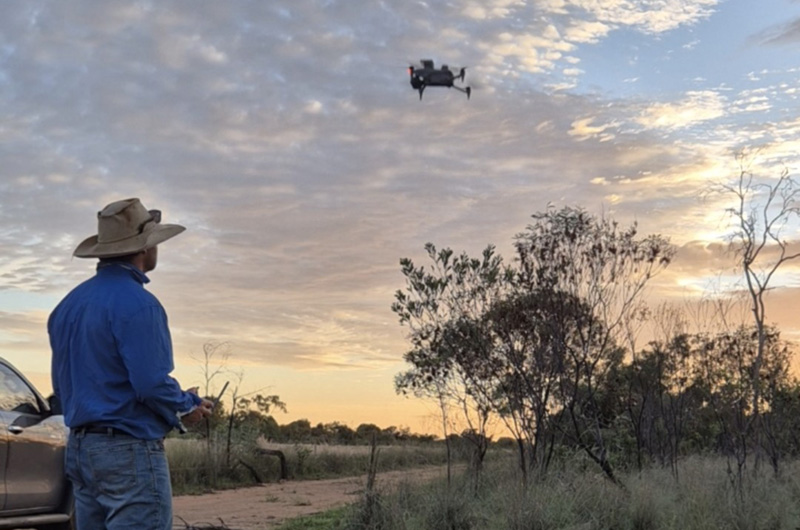
 Sam Fryer sends up a drone to muster cattle on his Hughenden property.
How drone mustering delivered a 110% return in its first year
For North West Queensland cattle producer Sam Fryer, making the shift to drone mustering has delivered an immediate return on his investment and been a gamechanger for his business.
Sam estimates his $12,000 investment in a DJI Matrice 4 thermal drone from SkyKelpie has returned around $20,000 in savings during its first year alone.
Farm snapshot
-
NameSam Fryer
-
Location‘Ellington’, Hughenden, Queensland
-
Area in hectares6,000ha
-
Enterprise300 Brangus/Droughtmaster-cross breeders, 100 trade cattle
-
PasturesPredominantly Buffalo, Flinders and Mitchell grasses
-
SoilsBlack soil and red country
-
Rainfall (annual average)600mm
Saving time and money
With a significant portion of his herd agisted across several leased paddocks, mustering previously required hiring a helicopter for three hours (costing $500/hour) as well as two people on bikes ($350–$400/day each).
“We muster two to three times a year and I was spending around $2,000 for each muster, so it quickly adds up,” Sam said.
“I can now do the muster on my own in two hours, using the drone to move the herd towards the water before getting on my bike for the closer handling work.”
On top of reduced mustering costs and labour requirements, he’s reduced vehicle and bike repair costs as well as the time and cost of regular water, cattle and infrastructure checks by ground.
With the value of drones now proven, Sam is seeing a real shift in how people are thinking about the technology – including his dad, who is now a convert to drone mustering.
“Recently, my old man told me that instead of spending $13,000 on a new bike, he’s going to buy a drone instead,” Sam said.
Enhanced tracking with thermal imaging
Sam is saving more than just time and money using the drone.
He’s up at 4.30am to start the muster, and done by 9am, with the cooler early morning conditions enabling his drone’s thermal camera to easily identify any lost or concealed animals.
As a result, Sam said he hasn’t missed a single cow since introducing the drone, compared with previously missing five to 10 head per muster.
“The other day, I was up early mustering a paddock and one of the cows wandered off so I just zoomed up higher to follow her back to find her calf,” he said.
The thermal cameral also allows Sam to locate pests such as dingoes, which is helping him work out where to put baits and traps.
He’s also been able to use it to locate and monitor livestock at night, quickly checking on the safety of fresh weaners when dingoes are nearby, and even tracking dingo movements around the property.
|
Tips for getting started
|
Beyond mustering
The drone has also had a huge impact on efficiency, but Sam acknowledges he’s probably only just scratching the surface of the drone’s potential, particularly in his region’s wet conditions.
While the wet can be really challenging, Sam’s strategy is to drive to the highest point of the property and send the drone from there.
“You can basically track the whole place and check things like your fences or floodgates without risking the unnecessary and all too common damage to vehicles,” he said.
Looking ahead, he anticipates drones will become a major asset in fencing operations, helping to map and plan new fence lines with greater efficiency – even just checking fence lines has become so much easier.
“So, there’s two parts to it: the return on investment coupled with the improved efficiency has been an absolute game changer for us,” he said.
|
Return on investment (ROI) Sam estimates he’s seen a 110% ROI in the first year of using the drone, equating to annual savings of approximately $20,000. With a conservative lifespan of five years, Sam expects his investment in drone technology to deliver a 950% ROI – returning the equivalent of $9.50 in value for every $1 invested. |
Creating opportunities for young producers
Sam is passionate about bringing more young producers into the industry. His podcast, ‘A place to call home’, is all about helping the next generation move into land ownership.
“We need to be looking at ways to bring young people back into the industry and the economics and convenience of drone technology is opening a door for them to come back,” Sam said.
Like other young producers, Sam doesn’t have the cash to hire additional people.
“A lot of the time it’s just me in my Hilux with a bike and a drone on the back,” he said.
“Having the drone is like having an extra employee and I don’t think we’d be able to do what we’re doing without it.”
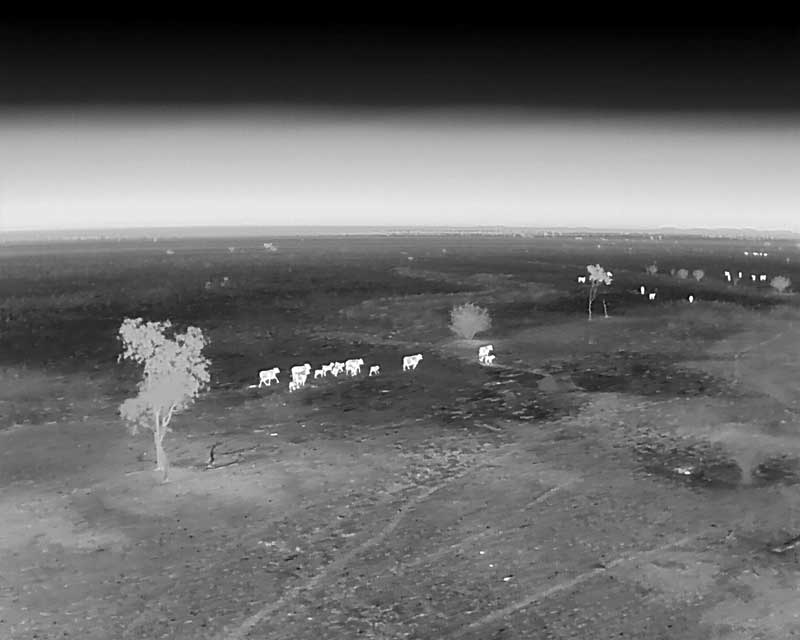
The drone’s thermal camera lets Sam easily identify any lost or concealed animals.
Stockmanship more important than ever
While the drone is a ‘godsend’, Sam said it couldn’t replace the essential stockmanship skills of an experienced livestock producer.
“Even if you’re using a drone, you still need the basic animal handling and husbandry skills needed to work livestock and move your cattle effectively,” he said.
“Young or inexperienced operators can run into trouble pretty quickly if they don’t know what they are doing, so having those skills is critical to reducing stress in the animals and calf losses.
“My old man would say that for every day you spend breaking in your weaners properly, you’ll save yourself months of pain down the track because you won’t have panicking animals.”
Taking that on board, Sam spends five days breaking in his weaners so that all his cattle are used to the drone.
“We’ll spend time getting them used to being handled in the yard before taking them out into the paddock using a bike one day, then a horse another day,” he said.
Once they’re in the paddock, he starts introducing them to the drone, moving them from one end to the other and working in small mobs first to get to know the animals.
“You can’t just take them out of the yard and start chasing them around with the drone on the first day, you’ve got to socialise them properly,” he said.