How has fuel price volatility affected cattle markets in 2026?
Key points
- Diesel price volatility has added cost pressure across the cattle supply chain in 2026.
- Higher fuel costs may influence buying activity in the short term, but they are not a major driver of cattle prices over the long term.
Since disruptions to the Strait of Hormuz began in late February 2026, global diesel prices have been highly volatile, increasing costs for producers, lot feeders, processors and transport operators.
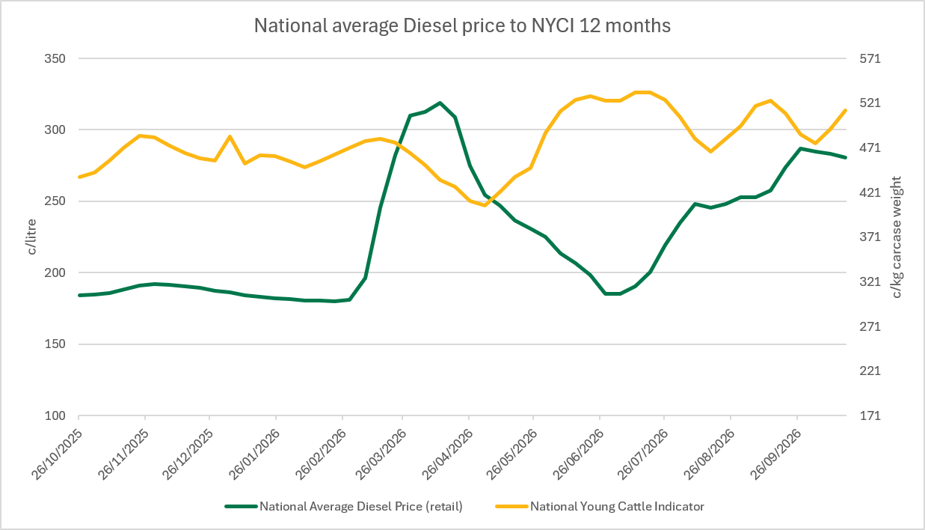
Over the past 12 months, national retail diesel prices ranged from 180¢/litre in the week ending 22 February 2026 to a peak of 319¢/litre in the week ending 12 April 2026, an increase of 77%.
For the young cattle market, the initial fuel price shock coincided with a period of strong cattle turn-off across southern Queensland and northern New South Wales.
March and April recorded the year’s two highest monthly throughput figures, at 409,000 and 367,000 head respectively. With such large numbers of cattle entering the market, it is difficult to separate the impact of diesel prices from broader supply-driven market pressures.
Source: MLA, Australian Institute of Petroleum
A second, more sustained rise in diesel prices from July 2026 showed a stronger relationship with the National Young Cattle Indicator (NYCI).
Diesel prices increased from 185.5¢/litre in the week ending 5 July to 286.7¢/litre in the week ending 27 September. Over the same period, the NYCI fell by 7%.
While this suggests higher fuel prices may have weighed on buying confidence and bidding activity, they were not the only factor influencing the market. Seasonal conditions, cattle supply and demand continued to play a significant role.
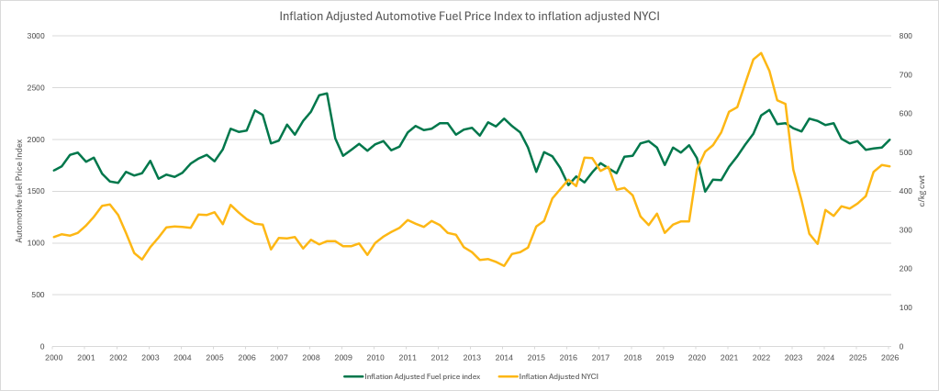
Looking over a longer time frame, the relationship between fuel and cattle prices remains relatively weak. Comparing inflation-adjusted fuel prices with the inflation-adjusted NYCI from 2000 to the March 2026 quarter shows little consistent connection between the two.
For example, real fuel prices reached a peaked in 2008 when young cattle prices were relatively subdued. Conversely, the inflation-adjusted NYCI reached a record 757¢/kg liveweight in early 2022 despite rising fuel costs. Similarly, cattle prices fell sharply during 2023 while fuel prices remained comparatively stable.
Source: MLA, ABS
Overall, fuel is one of many factors that can influence short-term market sentiment and purchasing capacity. However, seasonal conditions, feed availability and the herd cycle remain the primary driver of cattle prices.
For producers, lot feeders and processors, the main impact of fuel price volatility in 2026 has been increased operating costs and further pressure on already tight margins across the supply chain.
Attribute content to Alex Fry, MLA Market Information Analyst.
Information is correct at time of publication on 23 October 2026.