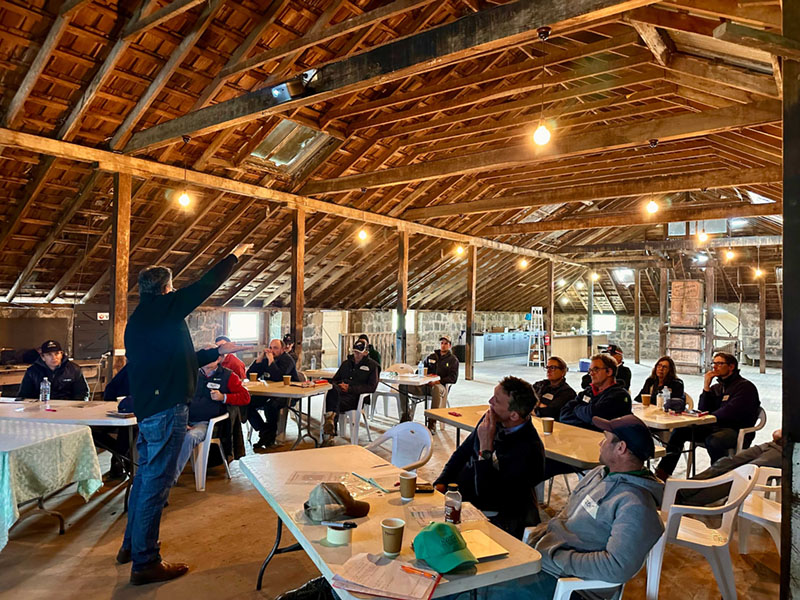
 More Beef from Pastures 2.0 brings local producers together to interpret their own farm data, compare experiences and explore different management options. Image supplied by Dr Penny Schulz.
Local group, practical insights, better outcomes
Southern producers with self-replacing beef systems are invited to join a new cohort of local learning groups to help improve maternal productivity, pasture utilisation and whole-farm profitability.
More Beef from Pastures 2.0 brings together producers navigating rainfall variability and diverse livestock enterprises to strengthen resilience in variable seasons, improve heifer development and make more confident, data-informed farm decisions.
Supporting wider industry development, the program is a modern update of the original initiative, which first supported producers 22 years ago.
Adelaide University is leading MLA’s flagship beef extension project alongside a range of institutional partners.
Learning groups are underway across South Australia, Tasmania, Victoria, New South Wales and southern Western Australia.
The program is midway through its first round with recruitment for the second cohort now open.
What to expect
Producer groups involve up to 10 beef operations working with a trained facilitator over a two-year period.
Participants will have access to practical tools, resources and technical specialists across a range of areas, including maternal productivity, pasture utilisation, nutrition, genetics, weaner management, herd health, market specifications and business decision-making.
On farm, participants will tailor the program to their enterprise by collecting a core set of data, including:
- Body weights and condition scores (heifers and mature cows)
- Key management and reproductive events (joining, scanning, calving and weaning)
- Pasture growth and feedbase quality data
- Basic economic information (not financial benchmarking)
The data will help underpin decision-making, inform management strategies and contribute to broader, long-term industry learnings.
The project team will support the collection process to ensure it is practical, relevant and valuable.
Adelaide University’s Southern Beef Project Lead, Dr Penny Schulz, said the program shouldn’t be misconstrued as a “classroom-style program.”
“The technical content is important, but equally important is producers being able to learn from each other, look at their own data and work through what different management options might mean for their business,” she said.
Producer feedback is already informing improvements to the program, including how local groups are matched with facilitators.
The aim is to create an open environment where producers can interpret their data and discuss shared successes and challenges.
Eligibility
Participants must be able to follow and monitor at least 20 heifers and be willing to commit to the two-year program, with the group meeting four to six times a year.
A participation fee applies but will be reimbursed following the collection and submission of program data, resulting in no overall cost to producers.
New groups are being established across southern Australia, with opportunities available in New South Wales, Victoria, Tasmania, South Australia and Western Australia.
How to apply
Places are limited and producers are encouraged to express their interest early.
Complete the expression of interest form to apply. For more information, contact Dr Penny Schulz at: penny.schulz@adelaide.edu.au