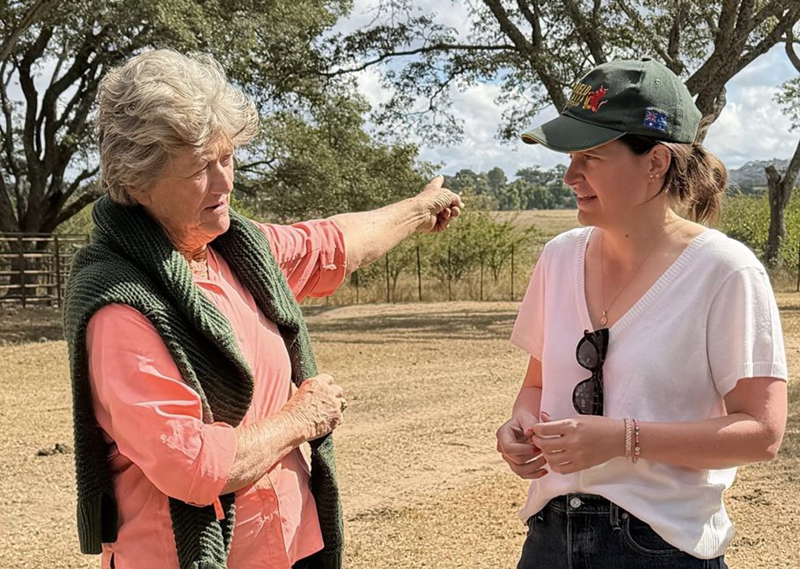
 Kate Watts (right) with Helen Locke, Zimbabwe’s first female Nuffield scholar, whilst on a visit to her farm.
Practical ways to make better on-farm decisions
Growing up on a sheep and cattle property near Quilpie in western Queensland, Kate Watts has spent enough time in cattle yards to know livestock systems are only useful if they work when producers need them.
Now based in Toowoomba, Kate works with the Australian Agricultural Company (AACo), managing livestock record systems and supporting cattle forecasting across the company's operations. It's this producer-first perspective that underpins her Nuffield Scholarship, which is exploring how producers can use livestock records and traceability tools to make faster, more informed decisions.
"If something doesn't work, a farmer will throw it against the wall and never use it again," she said.
"You want to be in the yards and have everything go smoothly. As soon as it doesn't, people won't use it."
Rather than focusing on collecting more information, Kate wants to understand how producers can make better use of the records they already have to improve day-to-day decision making.
From the Territory to traceability
A gap year in the Northern Territory turned into more than a decade working on stations and in the live export industry. It was there that Kate's fascination with livestock data and traceability began.
“I just loved all the data. Being able to trace animal health back through the supply chain really interested me,” she said.
“Watching weight gains and performance data showed me how powerful good information could be.”
Focus on the records that matter
For Kate, collecting better livestock data isn’t about creating more records. It’s about helping producers make decisions while they still have time to act.
"We already have a huge amount of data in agriculture, there's just a real gap between what we've got and how the decisions are made," Kate said.
Through her role with AACo, Kate has seen firsthand how better data collection can improve everyday management. Trials using UHF tags have increased scan accuracy and made mob-based processing more efficient, demonstrating the value of practical, reliable systems.
Those experiences reinforced a simple lesson: collecting more data isn't the goal. Using the right data to make better decisions is.
Kate points out that good data management starts with focusing on the information that genuinely supports management decisions.
"You don't need to capture everything," she said.
“You just need to focus on the information that actually drives decisions.”
For most producers, she says that means focusing on:
- weights and weight gain
- pregnancies and fertility
- treatments and animal health records
- livestock movements.
Learning from countries starting fresh
Kate's Nuffield travels will take her to countries including Brazil and Scotland, where new livestock traceability systems are being introduced.
Rather than studying the technology itself, she's interested in how better data is translated into practical on-farm decisions and how producers are supported to adopt new systems.
"They're building new systems now, so there's a real opportunity to learn how they're doing it differently to how we did it 20 years ago," she said.
She also wants to understand how countries are managing the transition between different tagging technologies while maintaining confidence in their traceability systems.
For Kate, technology is only valuable if it helps producers make better decisions without adding complexity.
"You only get one or two chances with producers," she said.
"If a system drops out in the yards or slows people down, they'll go straight back to pen and paper."
Kate hopes her travels will identify practical ways to help producers get more value from the information they're already collecting.
After years working with livestock data and traceability systems, she believes every new tool should be judged by one simple question.
"Does the technology support producers and work for them, or is it the other way round?
"That's the real challenge,” she said.