Why seasonal conditions drive the price gap between trade and heavy lambs
Key points
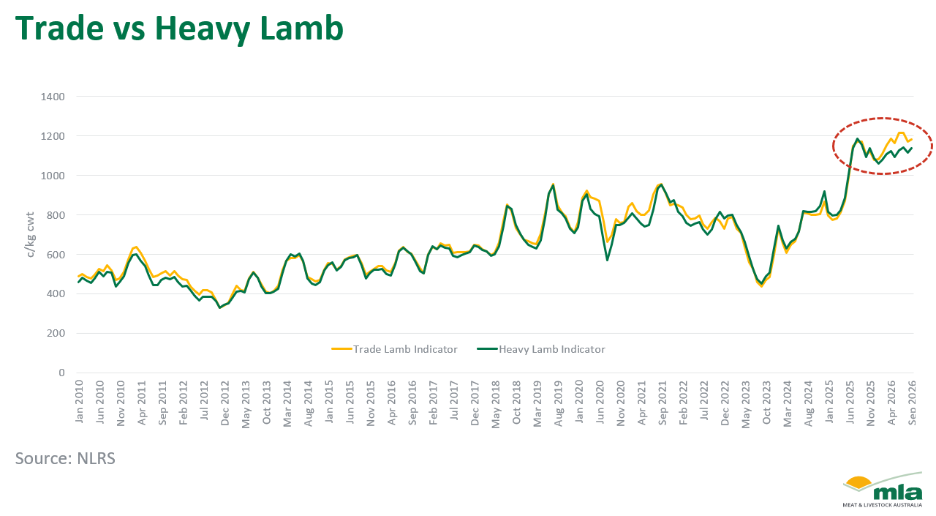
- Heavy lambs traded at a 58¢/kg cwt discount to trade lambs for the month of August 2026, well below the long-term average premium.
- Mutton slaughter is a reliable indicator of the direction and magnitude of heavy-versus-trade lamb premiums.
- Rising cost pressures are increasing the incentive for processors to enforce tighter carcase specifications.
The relationship between lamb prices and seasonal conditions is well understood. What is less obvious is how seasonal conditions can significantly influence the difference between trade and heavy lamb prices – and the dramatic swing it can create year-on-year.
The same applies to the premium prices that trade and heavy lambs attract relative to restocker lamb prices.
Two types of lamb, two types of market
Trade lambs are lighter animals and suited to domestic retail. Heavy lambs are larger and finished for export markets.
Processors compete for both categories to service these markets, but their value shifts depending on both seasonal conditions and product demand.
When conditions are tough
In a poor season, pasture is scarce and weight gain is harder to achieve. Producers struggle to finish lambs at heavier weights, which means fewer export-ready animals are available.
With heavy lambs in short supply, processors pay a premium to fill export orders.
Producers simultaneously sell off breeding ewes they can no longer afford to carry, which drives higher mutton slaughter.
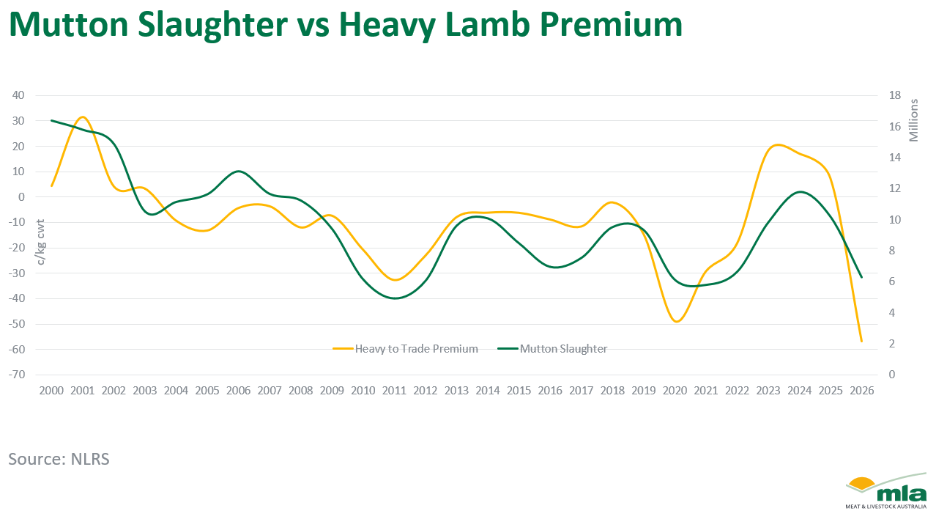
As a result, mutton kill provides a reliable signal of seasonal conditions (refer to second graph).
When conditions are good
When rainfall returns and pasture conditions improve, producers chase weight gain to maximise return per head. As more lambs reach export weights, heavy lamb supply increases and the premium shifts.
Trade lambs become relatively scarce, prompting competition among processors. As a result, the traditional premium relationship can reverse as trade lambs attract a higher price over heavy lambs.
This relationship is currently taking place within the market. In June 2026, heavy lambs traded at an 80¢/kg cwt discount to trade lambs – the second largest monthly discount on record behind August 2020.
The discount has since narrowed to 58¢/kg in August 2026 in comparison to the long-term average discount of 13¢/kg since 2010. This reflects a market responding to improving seasonal conditions as supply shifts from lighter trade lambs towards heavier export-weight lambs.
Mutton slaughter as a predictor of premiums
Mutton slaughter numbers are both a seasonal indicator and meaningful predictor of where heavy lamb premiums are heading.
Over the past 16 years, the correlation between mutton kill and the heavy-lamb premium has been 0.81. Across the full 26-year dataset, the relationship remained at 0.73. A value above 0.7 is typically considered a strong and reliable relationship over time.
When mutton slaughter rises, it typically signals deteriorating seasonal conditions and increased destocking trends. Producers are less able to carry lambs to heavier weights, which tightens heavy-lamb supply and supports premiums for export-ready animals.
When mutton slaughter falls and producers shift into flock-rebuilding mode, improved pasture availability encourages weight gain. As more lambs reach heavier weights, the premium shifts back towards trade lambs.
The timing and magnitude of the swing can be anticipated with reasonable confidence by tracking the mutton kill indicator.
Volatility amplifies everything
The more extreme the seasonal shift, the wider the price divergence between trade and heavy lambs. If seasonal volatility continues, both producers and processors should expect these swings to grow larger and more frequent in both directions.
The mounting pressure on processors
Already grappling with high livestock prices and lower throughput, processors are finding it increasingly difficult to absorb the cost of out-of-specification carcases.
With fewer animals moving through the supply chain, fixed overheads are spread across a smaller processing volume and place further pressure on margins.
The typical response may prompt tighter grid specifications and steeper penalties for carcases that fall outside target weights and fat scores. However, the extreme low levels of supply and competition from processors to maintain operations, despite reducing capacity, shifts the degree in which that can occur.
Looking ahead
If favourable seasonal conditions persist, trade lambs are likely to maintain their premium over heavier lambs.
A deterioration in conditions would expect to reduce that premium, and in very prolonged dry periods, flip in the other direction in favour of heavy lambs.
The extent of these premium and discount swings is closely linked to the rebuilding or destocking of a breeding flock.
As weather patterns become more volatile, these cyclical movements may become larger and more pronounced – creating greater opportunities and risk for both producers and processors alike.
Attribute content to: Stuart Bull, MLA Market Information Manager
Information is correct at time of publication on 18 September 2026