Beef sector surges into 2026 with a new production record
Key points
- Australia produced 730,077 tonnes of beef in the March quarter, the largest first quarter beef production result on record.
- Cattle slaughter reached 2.30 million head, up 6% year-on-year.
- Victoria registered the highest beef production in a quarter.
According to new Australian Bureau of Statistics data, the first quarter of 2026 has been the strongest start to the year on record for the beef sector, with production, slaughter and transaction values all lifting.
Australia produced 730,077 tonnes of beef in the March quarter, up 2% on the December 2025 quarter and 8% higher year-on-year. This marks the largest first-quarter beef production result on record and reinforces the scale of cattle supply moving through the system.
The result follows record production levels in 2025 and shows the sector has carried strong throughput into the new year. High processing volumes were driven by an intense global demand, sustained by a continuation of favourable seasonal conditions across northern Australia.
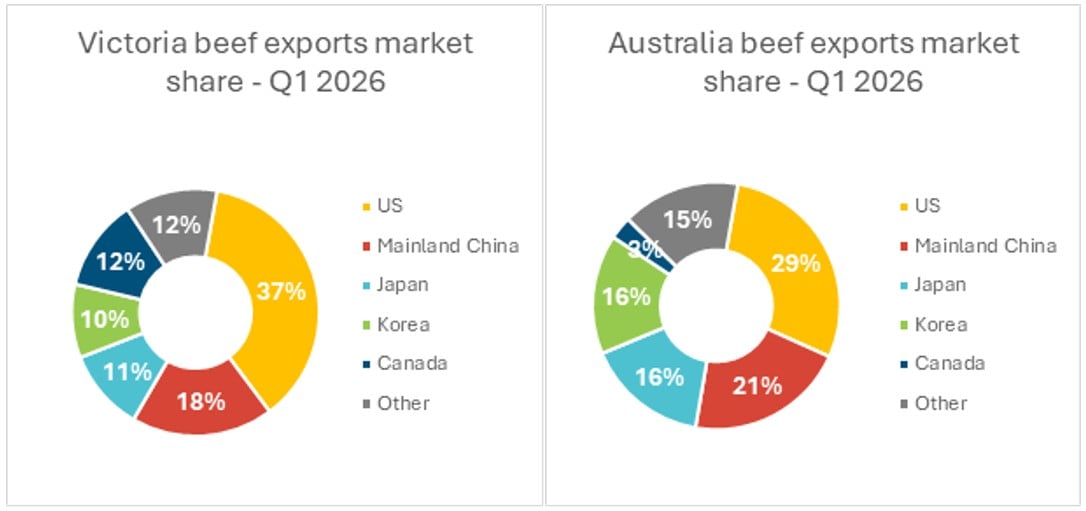
Queensland led the volumes, accounting for 43% of the total production. Victoria led the growth, with a 4% increase quarter-on-quarter (QoQ) and a 10% lift on Q1 2025, achieving the highest production quarter ever recorded at 167,401 tonnes cwt. This volume was achieved after five consecutive quarters in the top five volumes. With Victorian exports skewed towards North America, this shows the strength on the demand from this market, while Mainland China has also grown this quarter.
Source: DAFF
Slaughter supports production growth
Cattle slaughter reached 2.30 million head for the March quarter, a 6% increase on the March 2025 quarter. The lift confirms a strong supply pipeline, with cattle availability remaining high across key producing regions.
The dry conditions in northern NSW have also contributed, at the end of the quarter, to higher yardings and turn-off in that region.
While slaughter numbers increased 0.2% QoQ, the 2% lift in beef production was underpinned by the lift in carcase weights that continued to trend higher, reaching 317kg in the March quarter. Sustained favourable seasonal conditions and a high level of grainfed turn-off (which achieved a record of one million during the March quarter) supported this result.
State slaughter trends mixed
State-by-state slaughter trends were mixed during the quarter, reflecting different seasonal and supply conditions across the country.
- Queensland slaughter lifted 1% to 951,000 head, maintaining its position as the largest processing state.
- Victoria rose 2% to 552,900 head.
- NSW eased slightly, down 1% to 539,000 head.
- WA recorded the largest fall, down 8% to 112,200 head.
- SA eased 1% to 85,800 head.
- Tasmania moved against the broader southern trend, lifting 5% to 61,000 head.
These movements show that while national cattle slaughter remains elevated, supply is not moving evenly across all states. Regional conditions continue to shape turn-off patterns and processor access to stock.
The March quarter results build on the strong momentum seen throughout 2025, placing the beef sector on solid footing at the start of 2026. Production levels are aligning with MLA’s 2026 Cattle Industry Projections. However, uncertainty is building for the second half of the year, with less favourable weather forecasts and changing trade dynamics following Australia’s use of China’s safeguard quota.
Attribute content to: Emiliano Diaz, MLA Senior Market Information Analyst.
Information is correct at time of writing on 21 May 2026.