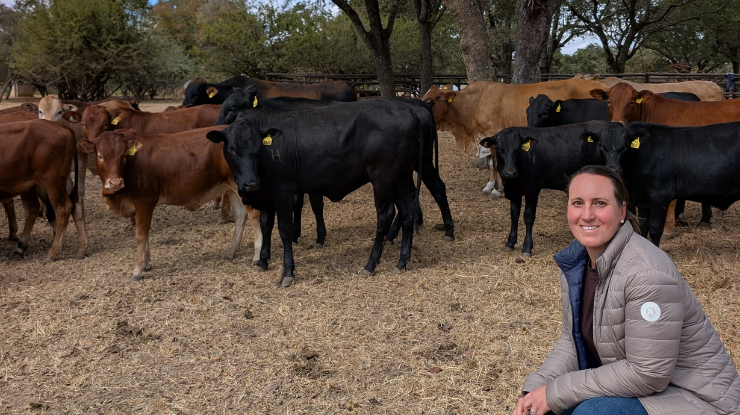
 Mashona cross cattle and livestock handling facilities in Zimbabwe, visited as part of Jessica Fedorow's Nuffield Scholarship research into the return on investment of farm infrastructure.
Is your farm layout costing you?
Most Australian farms are still operating around infrastructure layouts designed decades ago. According to NSW contractor and producer Jessica Fedorow, that poses a simple but important question: “Are we building for the business we have now – or the one we want in the future?”
It’s a question she asks producers every day and now underpins her Nuffield Scholarship research into return on investment (ROI) in on-farm infrastructure.
Supported by Nuveen Natural Capital and the NSW Nuffield Alumni, Jess’ research will explore how infrastructure investment can improve profitability, labour efficiency and long-term resilience across livestock businesses.
Measure before you commit
Based between Orange and Bathurst, NSW, Jess and her husband Ross run a cattle trading enterprise alongside their contracting business, Copper Creek Contracting, which services producers across a range of livestock systems across NSW and Queensland.
Their work has evolved well beyond traditional fencing contracting and now centres on whole-farm planning.
“How stock move and labour moves, how infrastructure supports grazing management and handling systems – it all has to connect,” Jess said.
A broader systems view grew from years spent working directly with producers and seeing both successful and unsuccessful investments play out in real time.
“People would often say, ‘I hope this works’ after they’d already spent the money,” she said.
“That got us thinking, how do we help producers measure whether an investment is going to improve their business before they commit?”
Jess thinks infrastructure decisions often shape a business for decades, which is why she believes producers need to think beyond upfront cost.
“Most farms are still set up the way they were in the 1950s or 60s – but labour availability, grazing systems, technology, and consumer expectations around animal welfare have changed since then,” she said.
Jess believes every infrastructure upgrade presents an opportunity to rethink how the business functions operationally.
“Every time you replace a fence or redesign yards, there should be a conversation around whether the layout still makes sense.”
Welfare by design
Jess highlighted that one of the biggest improvement opportunities is designing infrastructure that works with livestock behaviour rather than against it.
Jess said common infrastructure issues include:
- awkward entry points
- inefficient drafting systems
- poor stock flow through handling facilities.
She believes better infrastructure design can improve animal welfare while also lifting labour efficiency, workplace safety and productivity.
“When stock can flow naturally, and staff aren’t fighting the infrastructure, everything improves.”
Designing for efficiency
A stand-out project for Jess involved redesigning a client’s cattle handling system.
Rather than rebuilding the entire yard complex, the project focused on improving cattle flow and adding flexible, multi-purpose pens that could be used for containment feeding, yard weaning and sale preparation.
A six-way draft system was also introduced to improve labour efficiency and simplify cattle handling.
“It completely changed how they worked cattle through the yards,” Jess said.
“Saving time, reducing labour pressure and improving flow adds up over time.”
After years of working across livestock enterprises, Jess said her top tip is surprisingly simple: don’t just keep using what’s already there without asking whether it still works.
In Jess’ experience, producers often become so familiar with existing layouts that they stop questioning whether there’s a more efficient option.
“Sometimes the biggest improvements come from stepping back and evaluating the efficiency of the systems already in place.”
Searching for measurable results
Through her Nuffield travels, Jess plans to investigate infrastructure systems and ROI measurement frameworks in other countries, including Ireland, New Zealand and Canada.
Ireland, in particular, has attracted her attention due to its government-supported infrastructure rebate programs and strong focus on measuring ROI.
She’s also interested in how emerging technologies, particularly virtual fencing and intensive grazing systems, are changing the way farms are designed internationally.
“There’s no silver bullet, but there are a lot of ideas and perspectives that can help us make better decisions,” she said.
The value of practical knowledge
For Jess, one of the greatest strengths of Nuffield is the opportunity to connect directly with producers around the world and see systems operating firsthand.
“You can’t put a price on those conversations,” she said.
“You realise pretty quickly that producers everywhere are dealing with many of the same challenges – we just describe them differently.”