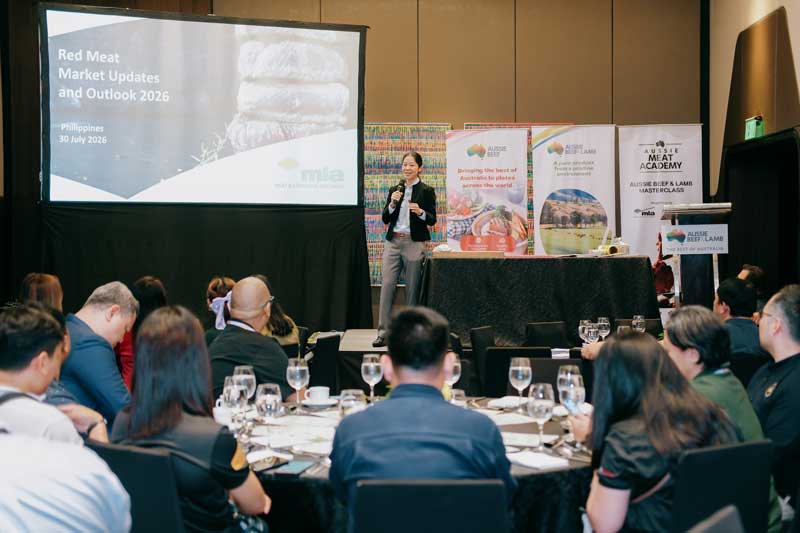
 MLA Regional Manager for Southeast Asia Valeska presents a red meat market update during industry engagement activities in the Philippines.
Southeast Asia opportunities grow as competition intensifies
From bustling trade show floors in Manila to running activations in Bangkok and growing demand in Vietnam, MLA's Regional Manager for Southeast Asia, Valeska, says the region continues to offer significant opportunities for Australian beef and lamb exporters.
On the latest On the Ground podcast episode, Valeska checked in from the Philippines, where MLA was supporting industry engagement at the World Food Expo (WOFEX), one of the country's largest food trade events.
Manila in focus
While Australia did not exhibit directly at WOFEX, MLA maintained a strong presence through trade seminars and customer engagement activities.
"We had about 50 people at the seminar and the show was huge. Each time I've been back, you can see the quality and calibre of the exhibitors improving" Valeska commented.
The event primarily attracts local businesses, with around 90 per cent of exhibitors coming from the Philippines. However, the international presence is growing, with major global competitors actively targeting the market.
"The Europeans, Brazilians, US and Canada are all there," she said. "The Philippines is one of those markets where we're really trying to strengthen Australia's position beyond manufacturing beef."
Australian exporters were represented through both company exhibits and importer displays, highlighting the growing importance of the market for premium Australian products.
A market with two distinct opportunities
The Philippines has traditionally been a strong market for manufacturing beef, supplying products used in burger chains, sausage production and the country's sizeable corned beef sector.
"I've learned a lot about corned beef in the Philippines," Valeska joked.
However, she believes a second wave of opportunity is emerging as consumer preferences evolve.
"We are seeing a higher appreciation for quality products. Grainfed and grassfed beef, Angus and Wagyu are increasingly finding their place in hotels and fine dining restaurants."
The trend is not limited to Manila. Demand for premium products is gradually spreading throughout the country alongside broader retail modernisation.
"We're seeing larger retail players entering the market and that's going to be a game changer. It could help disrupt the market and create new opportunities for premium Australian products" Valeska said.
While Manila remains the primary import destination, Cebu is also developing as an important manufacturing and distribution hub. Improving cold chain capability remains a key focus area, particularly for chilled beef.
To support this growth, MLA has increased investment in-market, including placing a business development representative on the ground to increase customer knowledge around Australian red meat.
Southeast Asia attracts global attention
As global trade patterns continue to shift, Southeast Asia has become an increasingly important battleground for international suppliers.
Recent market movements have seen Australian beef volumes redirecting from China into Southeast Asia. At the same time, exporters from South America and elsewhere are actively pursuing new opportunities across the region.
Valeska said competition is intensifying.
"The South Americans are really active and quite aggressive. At the show yesterday we spoke with Brazilian packers who indicated they're looking at alternative markets."
Brazilian exporters are now appearing at virtually every trade event across the region, while Argentina has recently gained access to Indonesia and is also pursuing expansion opportunities.
However, Valeska believes Australia's long-term investment in Southeast Asia positions the industry well to maintain its competitive edge.
"We're not resting on our laurels. Australian beef is definitely ramping up activities across Southeast Asia, and I think it's an opportunity to really secure the premium segment while continuing to grow demand through other channels."
MLA made a decision several years ago to invest in local teams across markets such as Thailand, Vietnam and the Philippines, who are a great regional resource for Australian exporters to leverage.
Health, wellness and the rise of protein
One emerging trend attracting significant attention across Southeast Asia is the growing consumer focus on health and wellness.
MLA recently tested a new activation in Thailand called the ‘Aussie Meat You Run’, combining fitness, retail partnerships and consumer sampling.
"We're seeing everyone getting into marathons, Hyrox events and other fitness activities," Valeska said.
The initiative was developed in partnership with Makro, one of Thailand's largest retail groups, and aimed to connect Australian beef with active lifestyle consumers.
Participants completed the run before enjoying Australian beef samples, creating a direct link between protein consumption and healthy living.
"The health and wellness trend isn't going away. We're looking at how we can use this template and potentially roll it out across the region” Valeska said.
The activation also complements MLA's broader ASEAN football partnership, which provides opportunities to connect Australian beef with sports fans across multiple markets.
Thailand's growth story
Thailand remains one of the region's most exciting opportunities.
According to Valeska, rising incomes, younger consumers and changing eating habits are all contributing to growing beef demand.
"We're really only at the beginning," she said.
Many younger Thai consumers are embracing beef despite previous generations consuming less of the protein. At the same time, imported beef volumes remain relatively modest, creating significant room for growth.
Australia currently dominates Thailand's imported beef sector and is well positioned to benefit from increasing consumer demand for premium, safe and high-quality products.
"We are seeing real interest in putting Australian beef and lamb on restaurant menus and retail shelves," Valeska said.
Vietnam continues to build momentum
Vietnam remains another priority market, supported by strong economic growth, tourism recovery and a deep-rooted food culture that embraces meat consumption.
"The food culture in Vietnam has always had a strong focus on meat," Valeska said.
Growing affluence is driving demand for higher-quality protein options, while investment across the hospitality sector is creating additional opportunities for Australian exporters.
MLA recently partnered with a major shabu shabu and yakiniku restaurant chain with ambitious expansion plans, highlighting growing confidence in consumer demand.
"We see growth opportunities across both live cattle and boxed beef," she said.
While trading conditions have been mixed at times this year, feedback from industry suggests momentum is building again.
Education remains central
Looking ahead, Valeska said education will continue to underpin MLA's Southeast Asian strategy.
The Aussie Meat Academy program remains a core pillar of market development, helping train customers, build product knowledge and strengthen industry relationships.
Alongside education initiatives, MLA is also leveraging its ASEAN football partnership through fan engagement activities in stadiums across the region.
From trade shows in Manila to stadium activations across ASEAN and premium growth opportunities in Thailand and Vietnam, Southeast Asia continues to demonstrate why it's become one of the most important growth regions for Australian red meat exporters. As competition heats up, MLA's on-the-ground presence and long-term investment in the region are proving more valuable than ever.