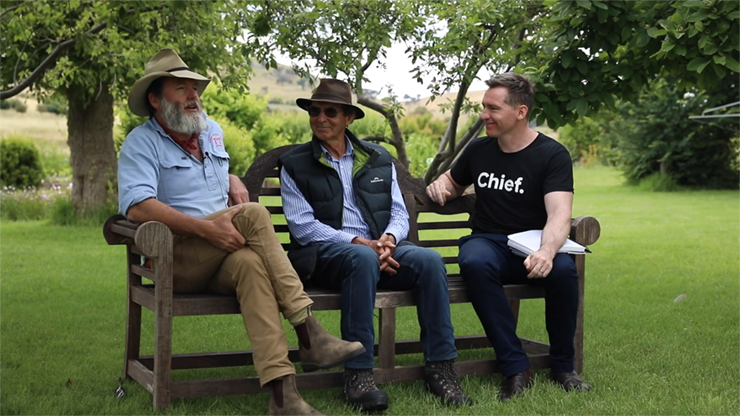
 Chief Nutrition co-founder Brock Hatton (right) chats with producers Charlie Arnott (left) and David Marsh about beef supply chain systems.
From secondary cuts to global shelves
Meet the innovators turning secondary red meat cuts into on-the-go nutrition.
You can find them on the shelves of an international pharmacy, in the health food aisle of major supermarkets and inside the backpacks of fitness influencers: a new generation of Australian beef products. Derived from secondary meat cuts, hides and offal, they are taking over the world’s fastest-growing nutrition categories.
With a focus on health, sustainability and the key ingredient of high-quality Australian beef, the MLA Donor Company-supported brand Chief Nutrition has expanded far beyond its humble beginnings in a handful of independent NSW health food stores.
Now, a decade after the development of their first Australian beef protein bar, Co-founder and CEO Brock Hatton shares insights on the growing demand for Chief Nutrition products, and the pivotal role Australian red meat plays in powering it.
High-protein, natural and sustainable
Chief Nutrition was born from the goal of Co-founder and Head Nutritionist, Veronika Larisova, to develop an on-the-go, high-protein product that was low in carbs and sugar, and made from whole-food ingredients instead of synthetic isolates.
“Coming from a background of working within the health food sector, I knew the easiest answer to achieving that goal was to use red meat,” Brock said.
“When we looked at what the market already had on offer, we found that on-the-go red meat was really only offered as jerky.
“There was a clear gap in the market, we just needed to figure out how to fill it.”
The Chief Nutrition co-founding team created their first savoury protein bars in 2015, using secondary cuts of beef and lamb. They harnessed freeze-drying technology to create a product which had a longer shelf life and could be transported and stored ambiently, but was still made from natural ingredients.
“We released a beef, cranberry and chilli bar, and a lamb, rosemary and currant bar,” Brock said.
“Our bars were stocked on the shelves of Ampol Service Stations across Australia, and stood out amongst the sea of dessert-flavoured protein bars. Demand grew quicker than we expected.”
Consumer input
Based on consumer surveys after their initial product release, the Chief Nutrition team found consumer expectations stretched beyond convenience and health to include a desire for sustainably sourced ingredients.
“We decided we needed to lean more into those points of interest, grow our knowledge on the Australian red meat industry and broaden our product range to build full carcase utilisation opportunities,” Brock said.
“So, around the same time we began looking at the possibility of a bovine collagen bar, we reached out to MLA’s Food Innovation Program manager, John Marten.
“With his support, we gained a better understanding of the supply chain, and insights on the challenges and value in commercialising a collagen product made from Australian red meat.”
John connected Chief Nutrition with domestic and international retailers, which highlighted that a lot of bovine collagen products in the market – including in Australia – were largely from South American countries and China. John also connected the team with processors, who highlighted a lack of domestic demand for offal.
“These insights made clear to us just how much untapped potential there was in parts of the carcase that traditionally left Australia with little to no value attached,” Brock said.
“Once we understood the supply chain gaps, we realised we could do far more than just innovate a single product.”
Armed with this knowledge, the Chief Nutrition team pushed beyond bovine collagen and began exploring the rising global demand for whole-food nutraceuticals – products that deliver micronutrients in their natural, bioavailable form rather than synthetic isolates.
“We started developing organ-based supplements – beef liver, heart and kidney –formulated with vitamin C to aid iron absorption,” Brock said.
“This didn’t just come about as a way to help reduce offal waste, but as a solution to a real problem.
“Synthetic iron can be really tough on the gut microbiome, but for individuals who suffer from malabsorption, experience heavy menstrual periods or are pregnant, iron supplements are often unavoidable.
“Today, we’ve got an average of 1,500 consumers per month who have essentially been prescribed our beef liver capsules by their health practitioner as a natural and more gut-friendly solution to increasing their iron levels – which is a really great form of feedback to receive.”
Made with Australian beef
With product now on shelves across the globe, Brock said their most effective marketing strategy has been their simple package labelling of ‘made with Australian beef’.
“No matter the country our product is being sold in, that line alone is a major trust cue for consumers,” he said.
This trust from consumers is something Brock attributes entirely to what Australian producers and processors are doing right.
“The Australian red meat industry is known by international consumers for its high animal welfare standards, strong traceability systems, sustainable practices and consistent quality.
“Where it differs slightly between regions is how consumers prioritise those values.
“Within the US market, many consumers feel a lot of distrust towards ‘big food’ and large-scale manufacturing, so calling out that our collagen, biltong and nutraceuticals are made from Australian beef is a massive drawcard.
“US consumers also value Australia’s ability to deliver consistent, grass-fed or grass-finished beef – something that’s difficult to produce year-round in most American regions.”
In markets such as Japan, Brock said a message from consumers has been to not localise packaging.
“Keeping it in English and clearly identifying it as Australian created a stronger value perception because it’s seen as a premium imported product,” he said.
Regardless of the market, Brock said it’s what Australian producers are doing on-farm that underpins the brand’s appeal, with product format and accessibility becoming secondary considerations to that consumer trust the Australian red meat has already globally established.
Growing demand
Today, Chief Nutrition’s red meat-based snacks and supplements are available in 12 international markets.
Within Australia, the brand has expanded well beyond its service station roots and can now be found nationwide through retailers including:
- Ampol
- Coles
- Woolworths
- 7-Eleven
- Harris Farm
- Elite Supplements
- Go Vita
- Market Organics
- independent pharmacies and specialty health stores.
Behind that retail presence sits a significant and consistent demand for Australian red meat and red-meat-derived ingredients.
On a monthly basis, Brock said Chief Nutrition sources approximately:
- 20 tonnes of secondary cuts
- 12 tonnes of bovine collagen
- 170kg of offal powder.
“For us, it’s not just about optimising carcase utilisation to deliver greater off-farm productivity and profitability for the industry,” Brock said.
“It’s also about highlighting the value of those once lesser-used components through premium products that reflect the high health, integrity and sustainability standards behind Australian red meat.”