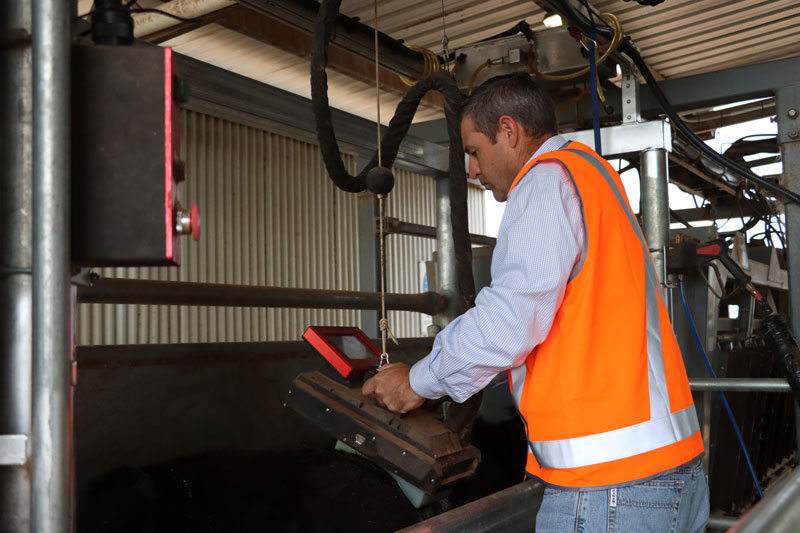
 Kevin Jenkinson helping scan mid-program Wagyu cattle at Prime City.
New measurement tech cuts the guesswork from feedlot sorting
At JBS’s 46,000 head licence capacity Riverina Feedlot in Leeton, NSW, a few extra minutes in the crush is anticipated to improve efficiency at the other end of the supply chain.
According to JBS Feedlot Continuous Improvement Manager Kevin Jenkinson, the anticipated improvement is linked to a new objective measurement tool being trialled through an MLA-funded project with MEQ Solutions.
Known as MEQ Live, the handheld device is enabling cattle to be grouped more accurately in the feedlot based on objective marbling score.
This information is giving JBS greater confidence and flexibility when making feeding decisions, with the aim of delivering more consistent lines of cattle and supporting operationally viable carcase sorting at processing.
Removing variation
MEQ Live has been built into Riverina’s induction for their short and mid-fed Angus cattle programs, with scanning fitting within their existing safe animal commercial handling practices.
The scan provides staff with an objective snapshot of the animals’ marbling status at that point in time – which fits into one of three ranges determined by JBS.
“In the past, we were sorting cattle that came in based on weight and what learned experience told us about physical composition,” Kevin said.
“But that sorting process still left a lot of variation in marbling outcomes in each feeding program.”
That variation has flow-on effects across the integrated system, highlighting the opportunity for more targeted feeding decisions in the feedlot and greater consistency through to processing.
MEQ Live has been operating at Riverina for 18 months. The first phase of the trial focused on data collection and validation.
“Now in phase two, we’re examining the outcomes of using that data to inform business decisions, and to assess whether the expected efficiencies can be realised on a commercially viable basis,” Kevin said.
“Because animals are grouped into similar marble score ranges well before they arrive at the plant, there is less variability between carcases on the chain.”
Kevin is quick to point out that MEQ Live is not a prediction tool.
“We’re not scanning cattle to say what marble score they’ll finish on,” he said.
“It’s an objective measurement of where an animal is at on the day.
“Those point-in-time scores are used to rank cattle at induction and draft them into groups accordingly, shifting some of the sorting task upstream and easing pressure at processing.”
Second scanner introduced
On 26 March this year, JBS introduced a second MEQ Live scanner at their 34,000-head licence capacity Prime City Feedlot near Griffith, NSW, beginning scans on Wagyu cattle.
However, unlike the Angus cattle scanned at induction at Riverina, JBS is scanning the Prime City Wagyu midway through the feeding program.
With their Wagyu typically fed for about 400 days, Kevin said timing was critical.
“For a longer feeding program, scanning later provides a greater accuracy in high-value Wagyu,” he said.
“But leaving it too close to slaughter can disrupt social hierarchy, which can change animals’ short-term behaviour and in turn can affect meat quality.
“Scanning at the midpoint allows us to gather objective marbling differences to be captured once they are clearer, while minimising disruption to cattle.”
As with Riverina, MEQ Live is not being used to predict final outcomes.
Instead, the mid-program scan provides a point-in-time marbling score that allows cattle to be ranked and managed more deliberately through the remainder of the feeding program.
The first Prime City scan was supported on site by MEQ Solutions, who assisted with installation and staff training, with MLA also involved in observing the technology’s performance in a commercial setting.
Kevin said JBS values the ongoing development of technology that can lift productivity across the supply chain.
“We’re always looking for ways to do things better – for the cattle, our staff and our customers,” he said.
“If a tool strengthens productivity and profitability anywhere in the system, it’s worth exploring.”