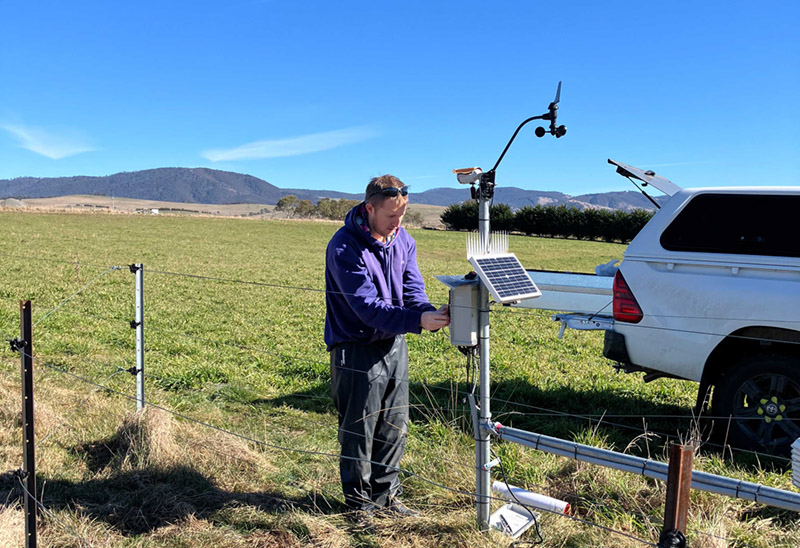
 James Paulet performs maintenance on a soil moisture probe at Omeo.
How better grazing timing almost doubled pasture growth
Gippsland livestock producers are digging deep to make better pasture management decisions based on soil moisture and temperature data.
An MLA Producer Demonstration Site (PDS) run by Agriculture Victoria is overcoming regional challenges of unpredictable rainfall, late autumn breaks and cold winter soils, which can quickly turn pasture planning into costly guesswork.
Agriculture Victoria’s James Paulet said producers worked together to test how soil moisture probes and temperature data could improve seasonal preparedness across Gippsland grazing systems and guide decisions about sowing, fertiliser application and grazing.
“The main issue is seasonal variability,” James said. “A lot of our rainfall comes from east coast low systems, which aren’t always reliable or predictable.”
Over two years, demonstration sites at Bairnsdale, Buchan South and Omeo gave producers the opportunity to see how seasonal conditions and management decisions interact, to apply this understanding within their own systems.
The project reinforced that seasonal conditions alone do not determine pasture performance.
Instead, producers observed first-hand how management decisions – including grazing timing, pasture species and sowing date – influenced how effectively available soil moisture is converted into feed.
Turning data into practical decisions
James said soil probes provide producers with practical 'trigger points' to guide this seasonal decision making.
"Whenever you need to start predicting growth rates, soil moisture can be a key indicator of what kind of growth rates to expect." he said.
"Adequate soil moisture and temperature at sowing in autumn is probably the first trigger point producers should start tracking.”
He said it was important to interpret probe data carefully.
"Differences in pasture or crop type can mean soil moisture varies across a paddock compared to what a nearby probe is showing," he said.
Rather than checking data daily, he recommended monitoring trends weekly to better understand how quickly stored moisture is being used and whether conditions are likely to support future growth.
Management drives production
Some of the largest gains seen across the demonstration sites came from management changes, reinforcing the value of timing decisions based on seasonal conditions rather than calendar dates.
At the Bairnsdale site, earlier autumn sowing produced substantially more feed than traditional later sowing, despite later rainfall appearing more favourable. Cooler soil temperatures reduced establishment and total production compared to those sown earlier.
In this case, soil probes assisted producers to understand that reaching optimal stages can vary depending on:
- how much moisture is available for regrowth
- whether conditions are likely to support strong pasture growth
- when recovery rates slow due to moisture or temperature limitations.
The Buchan South site simulated rotational grazing based on ryegrass leaf stage, reinforcing the impact grazing timing can have. Compared to grazing every 30 days, this approach almost doubled pasture production. Over 26 months, the leaf-stage approach produced an additional 18.2 tonnes of dry matter per hectare.
"It was really good to see confirmation of how much extra feed you can grow by grazing to leaf stage," James said.
Extension activities build confidence
As part of the PDS, producers in the region had access to live data from 17 soil moisture probes. The data was supported by regular analysis connecting it to pasture growth and management decisions, so producers could relate the information back to their own systems.
Field days, paddock walks and workshops gave producers the opportunity to build confidence interpreting probe data in practical farm situations.
By the end of the project, all core participants and 73% of observer producers reported using soil moisture data to guide decisions around grazing, sowing and fertiliser timing.