New quarterly turn-off record for Australian feedlots
Key points
- National feedlot turn-off reaches a record of over 1 million head.
- National utilisation rate remains high.
- National feedlot capacity has lifted to over 1.7 million head.
This week, Australian Lot Feeders’ Association (ALFA) and Meat & Livestock Australia (MLA) released results from the March quarter National Feedlot Survey. Conducted quarterly across NFAS-accredited feedlots, the survey captures key data on capacity, turn-off and number of cattle on feed. The findings are published alongside ALFA’s media release, the lot feeding brief report will be published and available shortly on the MLA website.
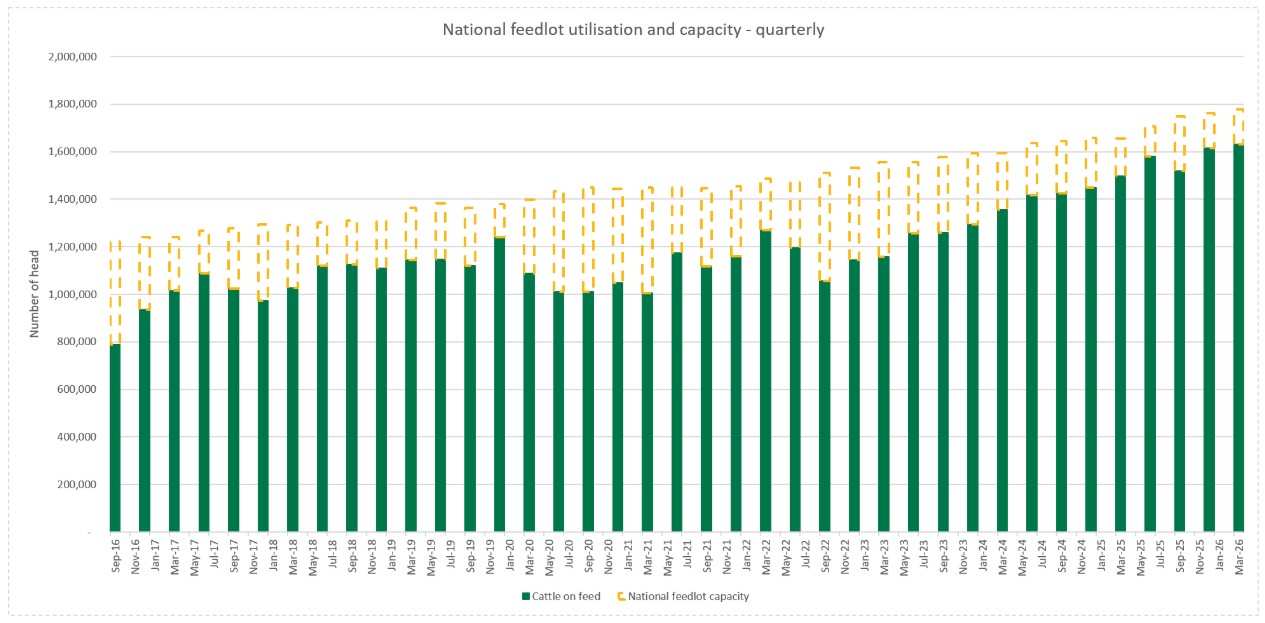
The National Feedlot Survey has confirmed a new record turn-off from Australian feedlots of over 1 million head. In total, feedlots contributed 1,046,717 head of cattle to the supply chain – an 11% increase in turn-off from the December 2025 quarter. The impressive figure gives insight into the growing importance of feedlots for the beef supply chain, establishing feedlots as a channel that underpins the consistency of supply for Australian processors and exporters.
Despite the significant increase in turn-off from feedlots, the national utilisation rate remains unchanged since last quarter at 92%. The unchanged figure signals a huge level of demand for Australian beef and the efficiency required to meet that demand.
Source: DAFF, MLA
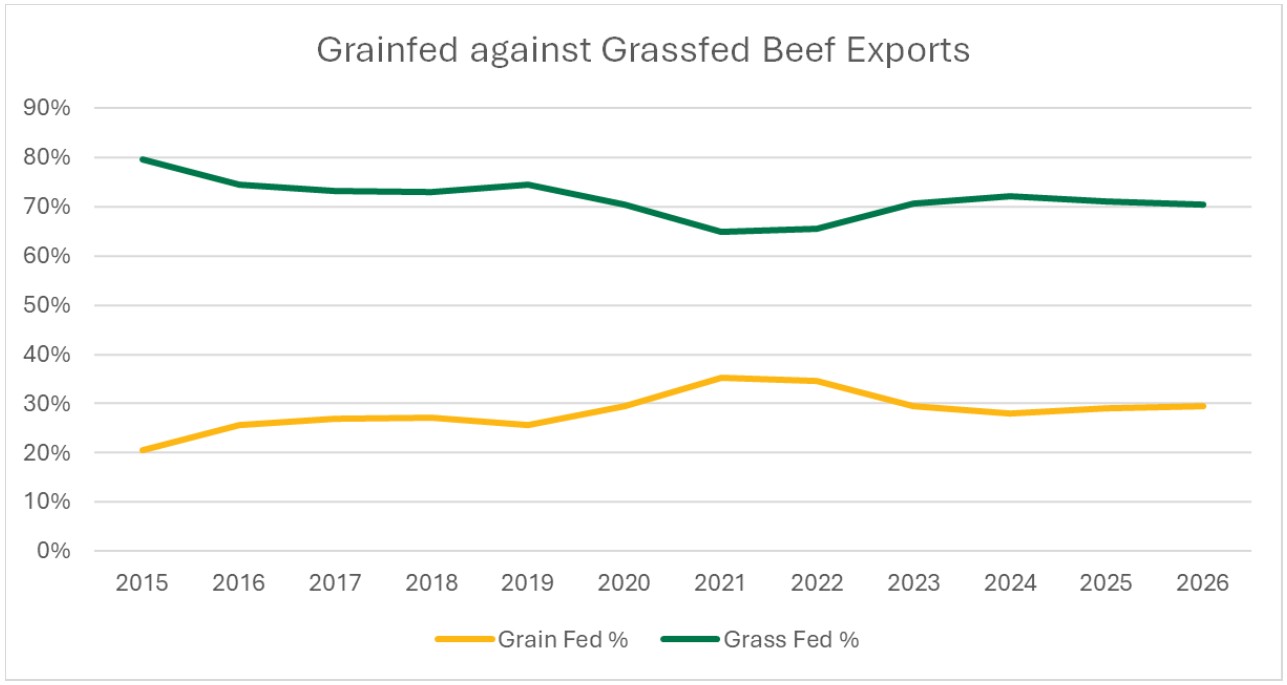
According to export data released by the Department of Agriculture, Fisheries and Forestry (DAFF), 506,138 tonnes of beef were exported, with 30% being grainfed (149,653 tonnes) from the start of 2026 to the end of April. In 2015, the proportion of grainfed beef was 21%.
The long-term investment in the lot feeding sector has caused this lift in the proportion of grainfed cattle exports against grassfed, allowing for a more consistent supply, even in tougher seasonal conditions.
Source: DAFF, MLA
The recent survey also confirmed an increase in the national capacity of feedlots to 1,777,893 head, a 1% increase over the December 2025 quarter, highlighting continued investment and expansion in the sector.
Attribute content to Alex Fry, MLA Market Information Analyst.
Information is correct at time of writing on 21 April 2026.