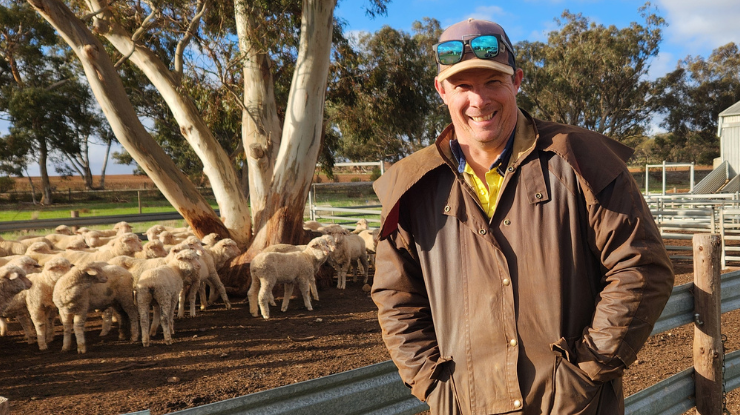
 Mid North SA sheep producer David Clarke at ‘Clarisglen’.
How simple eID decisions lifted lambing by 20%
Mid North SA sheep producers, the Clarke family, have scaled up their use of electronic identification (eID) from a simple start to make sure it met their key needs first – such as flexibility in managing sheep around their cropping program.
The Clarkes run a self-replacing Merino flock on five properties, spread across approximately 50km between Wirrabara and Hammond.
Ian and Susan Clarke have been farm managers since 1988, with their son David coming into the business full-time in 2013.
Their cropping program accounts for more than three-quarters of their farm income, with the remainder from the sheep.
|
FARM SNAPSHOT Name: David, Chloe, Ian and Susan Clarke – ‘Clarisglen’, Wirrabara and Hammond, SA Area: 1,600ha Enterprise: Self-replacing Merino flock based on 500–650 ewes and a cropping program of 1,100ha with cereals, legumes and canola Pastures: Sown barley and vetch Soils: Variable – heavy red clays to loams Rainfall: 290–450mm |
Flock management
Their sheep are managed to fit around the cropping program. The flock is run as two big mobs for most of the year, then managed as smaller mobs for lambing.
Mob size is reduced to fewer than 100 for ewes bearing multiples, while single-bearing ewes are generally run as a single mob of up to 300.
Ewes are typically mated in March and April and are pregnancy scanned 80–100 days post-joining.
The Clarkes began tagging ewe lambs with eID in 2021, after attending an information day organised by the Upper North Farming Systems group.
They approached eID adoption from the perspective of starting simply, then slowly adding improvement goals and associated data collection over a few years.
Why eID was introduced
The Clarkes had a list of improvements which have been supported by data from eID. These included:
- higher scanning and lambing rates (in particular, getting dries to below 5%)
- reliable individual animal identification, to enable boxing/splitting mobs at different times
- reliable tracking of individual ewes’ breeding performance across multiple years
- fast growth rates in lambs
- best use of available feed.
Although they first applied eID tags to ewe lambs in 2021, basic data collection didn’t commence until 2022, when the Clarkes purchased a stick reader and began pregnancy scanning ewes.
After they purchased weighing equipment in 2023, they began collecting weight data for ewes, followed by wether lambs in late 2024.
They collect data on:
- pregnancy scanning results (multiple/single/dry)
- birth status of ewe lambs (twin/single)
- ewe lamb weights at weaning and opportunistically at other times
- occurrence of flystrike and high dag scores
- paddock of birth.
eID equipment
Data is collected using a Gallagher HR4 stick reader and a set of wireless load bars installed on a Combi Clamp handler.
Data is sent via Bluetooth to a Gallagher animal performance application installed on a smart phone. The app has similar functionality to a scale indicator without the upfront cost, however there is a monthly subscription fee for the app.
The equipment they purchased was chosen based on:
- the desired functionality
- mid-range price
- simple set-up that gets the job done
- lower upfront cost.
David recommends assessing different brands before purchasing equipment.
“It’s worthwhile considering the merits of all the components of the system you intend to use as it can be difficult to integrate components from different brands,” he said.
Data collection tips
Data collection outside of pregnancy scanning is arranged around other activities. Birth status of ewes is collected at marking, by reading eID tags of singles and twins in their separate mobs. Weight data is collected at weaning and shearing.
Collecting data has not created any additional labour requirements. Data is transferred into excel spreadsheets on a ‘year of birth’ basis, creating sets of data for different age groups for ewes.
Data in the form of drafting lists is also stored and retrieved from the Gallagher app in the yards as needed, to guide manual drafting.
David said his experience of initially setting up and using the eID equipment was pretty good and he received good after-sales support from his local reseller.
A major limitation with collecting weight data has been the distances between the Clarkes’ grazing properties, as the weigh equipment is fixed at the main yards at the shearing shed.
Easier flock management
eID streamlines livestock management around the demands of their cropping program.
Prior to implementing eID, groups had to be kept separate from scanning through to lambing.
This made livestock management tasks, such as shearing or moving between paddocks, more complicated and time consuming.
Now that they use eID to identify ewes as twin or single bearing at scanning, all ewes can be boxed together into one big mob immediately following scanning for greater ease of management.
They can then be reliably separated three-to-six weeks prior to lambing into twin and single mobs for better lambing outcomes.
Increasing lambing percentage
A key driver for introducing pregnancy scanning in 2019 was to increase lambing percentage.
eID subsequently enabled dry maiden ewes to be easily identified and potentially kept for a further year before being sold if they scan dry a second time, as opposed to older ewes which are sold off following being identified as dry.
Implementing pregnancy scanning also revealed a 40% loss between scanning rate and lambing percentage.
Using eID to simplify the management of ewes based on their pregnancy status is closing this gap.
Twin-bearing ewes are given supplementary feeding where possible, from the time they are separated from singles up until lambs are 10–12 weeks old.
Keeping records of individual pregnancy status has enabled David to build up a lifetime reproductive performance profile for each ewe – which aids keep/cull decisions.
Ewes that have twinned are retained to an older age than singles, while dries (apart from maiden ewes) are immediately removed.
Ewes that have only born singles have a higher culling pressure applied at all age stages.
Lambing percentage has improved by about 20% over the past five years. This has been achieved by removing unproductive dry ewes, as well as retaining and breeding from twin-bearing ewes for longer and managing the nutrition of twin-bearing ewes to improve foetal survival rate.
Monitoring weight gain
David began recording average daily weight gain to provide data to identify poorer performing ewe lambs for earlier removal as lambs rather than hoggets.
Since 2024, all lambs have been eID tagged and monitored for weight gain.
Data collected is used to identify which animals in the Clarkes’ containment yards, especially in difficult dry times, can be pushed to finishing weight quickly and sold, versus those that will be put onto maintenance and finished later in the year when better feed is likely to be available.
David is also using weight data to monitor for the prevalence of oversized animals – which can pose a management issue, such as at shearing.
Using the eID data to make these decisions allows him to allocate feed resources effectively, maximising profit and simplifying management.
He also uses the wand reader whenever sheep are in the yards to identify ewes with high dag scores or which are being treated for flystrike and these go on a list for subsequent culling. This ensures decisions are based on data, not just visual classing or age.
This has particular significance in difficult seasons when efficient management of feed becomes critical for profitability.
Future plans
David has done two rounds of flock profile DNA testing and, based on the results, has begun to apply selection pressure for eye muscle depth and fat to improve stock resilience.
Recording weaning weight and post-weaning weights against birth status may also be undertaken in future to better assess feed conversion efficiency.
|
Lessons learnt
|
This case study was developed as an initiative of eID Advantage Program from the Government of South Australia, supported by MLA and AWI Extension SA.