Turning carcase data into better livestock decisions
A new decision-supporting platform known as Meat Logic has been developed with the support of Adelaide University – combining production planning, profitability analysis, carcase performance information and traceability tools into a single system.
Building on MLA’s ALMTech projects (ALMTech I and ALMtech II) – which have focused for almost a decade on advancing objective measurement technologies that give processors a better understanding of carcase lean meat yield, eating quality and value – the platform aims to improve how objective measurement data is stored, analysed and utilised to inform decision-making.
Cutting the fat
Professor Wayne Pitchford, from Adelaide University’s School of Animal and Veterinary Sciences, said that the development of Meat Logic initially began when they were asked to help lamb and sheepmeat processors understand the costs of excess fat in their systems.
“Producers invest a lot of resources into feeding animals to meet market specifications,” he said.
“But if animals are carrying excess fat, processors then have to invest additional labour and resources to remove it.”
While that fat is trimmed to maximise the value of the cut, accurately determining fat depth manually can be difficult, creating the risk of either too much or too little being removed.
For processors, the challenge was therefore not only accessing objective measurement technologies, but finding a way to better use the data they generate to inform processing decisions and provide meaningful feedback to producers.
Meat Logic was developed to bridge that gap, bringing objective measurement data and information that can otherwise sit across an array of spreadsheets into a single, dashboard-driven platform.

Meat Logic is designed to serve as a one stop shop - consolidating and analysing objective measurement data to give processors key decision-making insights.
Bridging the gap
As the platform moved from concept to development, the Adelaide University contracted Dale Flanigan, a commercial boning room manager with a long career in red meat processing.
Dale brought experience spanning the slaughter floor to the boardroom and played a key role in developing the coding behind Meat Logic.
That practical processing experience helped shape the logic and integration needed to bring information into a single user interface – replacing multiple spreadsheets and giving processors one place to manage and interrogate information across the supply chain.
According to Adelaide University Researcher and Innovation Broker, Dr Sean Miller, the platform works by linking carcase data from the suite of objective measurement devices within a processing plant into a single location.
The platform then analyses the data to create a reporting on:
- carcase yield and eating quality
- carcase weight
- production efficiency
- labour utilisation
- processing profitability
- carcase-to-carton tracking.
This includes a web-based production planning dashboard, protected by the same cybersecurity systems used to store human medical records, which brings operational information together in a single view. The platform can also calculate revenue captured across carcases.
Sean said the platform's ability to connect and analyse multiple datasets has already demonstrated significant potential through optimisation work that examined how different groups of carcases could be sorted to increase profit.
“Through analysing inventory from across a four-day period at one of our processor trial sites, Meat Logic was able to help them determine a way to allocate carcases to an ideal boning room cutting plan.”
“Then, through that simple introduction of a specified carcase sortation strategy and improved efficiency, they were able to gain an additional profit of $1.50-$2.00 per head.”
“In the long term, the hope is that the greater value extracted from carcases will then enable the development of a reverse engineered price grid – delivering a fairer and more transparent payment system for producers.”
Delivering value on-farm
In alignment with MLA’s Strategic Plan 2030’s bold ambition of delivering value-based marketing, the platform’s analysis of objective measurement data will also be utilised by processors to provide carcase feedback to producers.
“Helping producers breed, feed and finish livestock with the end market in mind is critical to the long-term productivity and profitability of the industry across the supply chain,” Sean said.
“By translating objective measurement data into meaningful carcase feedback, Meat Logic creates an opportunity for producers to gain a clearer understanding of the traits that are driving value within processing systems and premium markets.”
“Rather than receiving feedback focused solely on weight and fat score, future applications of the platform could enable producers to better understand how characteristics such as lean meat yield, eating quality and carcase composition contribute to overall carcase value.”
“This information can then be used to support both day-to-day management decisions and longer-term genetic improvement strategies,” he said.
“The addition of a clear payment system will also offer further signals producers that guide them of which characteristics to target for that premium price.”
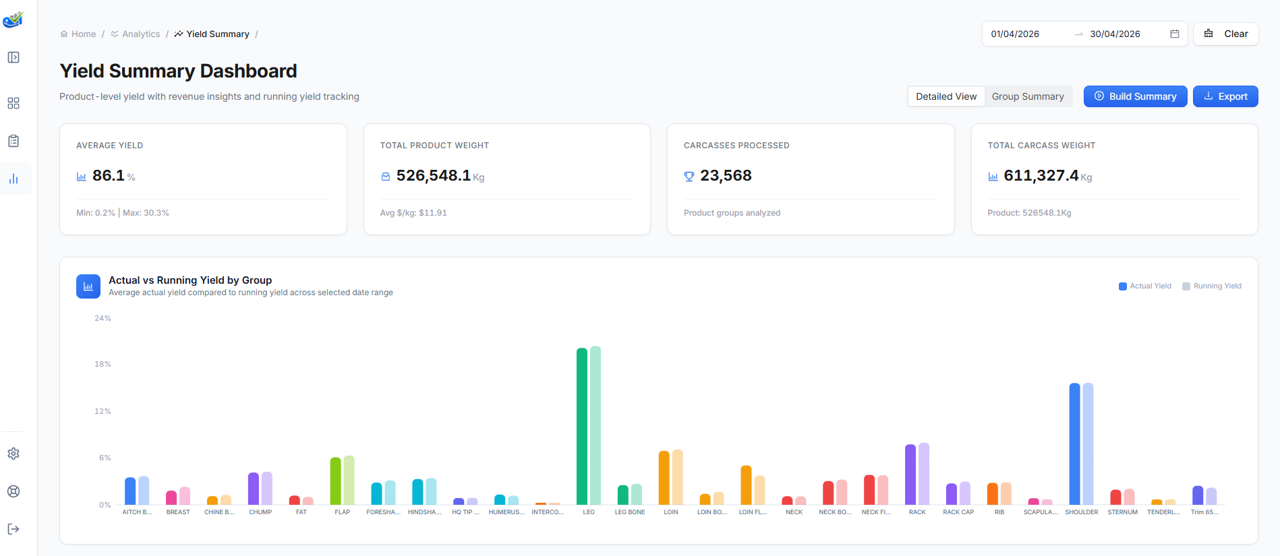
The Yield Summary Dashboard compares actual and running yield performance, providing processors with insights to maximise carcase value.
Taking the next steps
While initially developed for lamb and sheepmeat processing, Wayne said the platform has been designed with future expansion into beef processing in mind.
“What we've built is a framework that can continue to evolve alongside industry needs,” he said.
“The exciting part is that we're now working with actual commercial data rather than estimates.”
“And as more processors come on board, the platform will continue to improve and provide an increasingly accurate picture of where value is being created within our red meat industry.”
To read more about Meat Logic and the benefits it’s delivering, access the final report here.