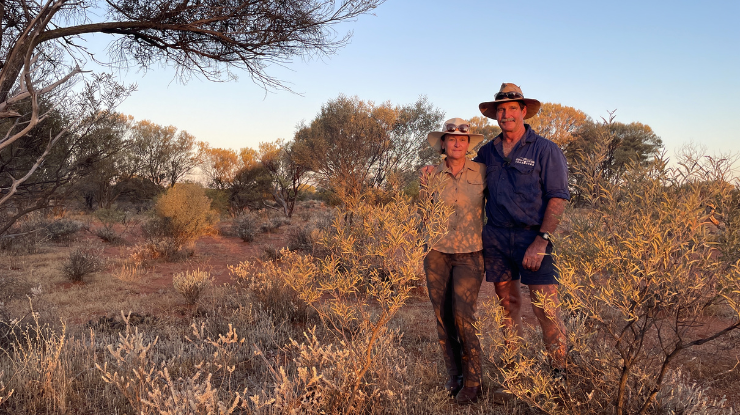
 WA Southern Rangeland producers Debbie and Ash Dowden.
Why 1,000 breeders beat 3,500 in tough rangelands
WA beef producers Ashley and Debbie Dowden may run less than a third of the region’s recommended stocking rate, but it’s proving to be a more sustainable approach on the 200,000ha they call home.
“We’re located in the southern rangelands of WA. It’s some of the most challenging agricultural country and we run about 1,000 breeders,” Debbie said.
“If we did run the recommended 3,500 animals on our property, the land condition would deteriorate until the property isn’t capable of supporting any livestock.”
The Dowdens participated in a recent MLA-supported project, where modelling of their property found their stocking rate was, in fact, more sustainable than the traditional approach.
|
FARM SNAPSHOT Debbie and Ashley Dowden – East Murchinson, WA Area: 200,000 ha Enterprise: 1,000 breeders Pastures: Native pastures – mulga forest and saltbush flats Soils: Red sandy clay/loam, calcrete soils, stony flats Rainfall: 220mm |
Reducing emissions
The project looked at interventions suitable for reducing emissions in rangelands, without compromising profit and productivity.
“Our land is already marginal, so we understand how incredibly important it is to be environmentally sustainable,” Debbie said.
“We’re looking at interventions to lower emissions, but unless there’s a market for those interventions or a possible return on investment, they’re too expensive in a rangelands environment.”
Interventions that are common in higher rainfall zones – such as planting trees – are not viable in rangelands. Instead, they are focusing on creating an efficient and high quality herd, and regenerating existing native vegetation.
“We’re really specific with our heifer selection and culling. That way we run an efficient herd that fetches a premium price,” Debbie said.
“We want to make sure every one of our cows has a calf and sell those calves as young bulls or cull heifers, and cull old or non-productive cows every year to keep the herd as efficient as possible.”
Putting figures behind the farm
The Dowdens have always focused on running a sustainable beef operation and Debbie said the modelling undertaken in the project validated the work they’ve been doing for years. It also provided direction on where to go next.
The data revealed that the Dowdens’ emissions intensity (the kilograms of carbon produced per kilogram of liveweight) was -42kg with sequestration, making their beef production carbon negative.
The emissions intensity excluding sequestration was 13.6 kg CO2e/kg of liveweight.
“We knew we would be carbon negative because we only have 1,000 cattle on 200,000ha, but it’s useful to know the figure and have confirmation that what we’re doing works,” Debbie said.
Data-backed decisions
Going forward, the Dowdens will use the data they received from the project – including ecological condition, net station emissions, habitat condition and biodiversity modelling – as a baseline to introduce natural capital improvements.
“This is the most robust baseline data we’ve ever had,” Debbie said.
“Quite often the southern rangelands are overlooked because their variability and unpredictability mean they’re quite difficult to study and model. It’s some really important research for the region to move forward sustainably.”
|
The International Year of Rangelands and Pastoralists (IYRP 2026) celebrates Australia’s iconic outback and the people who live there. For further information, including resources, visit the IYRP website. |