Establishing a biodiversity baseline for the Australian goat industry
BioBrowser will develop a comprehensive biodiversity snapshot for participating goat businesses. By combining a systematic review of the literature, on-farm pilot data and a cost benefit analysis, a biodiversity profile for participating goat businesses will be developed,with expert advice sought from a skills-based Technical Reference Group.
Biodiversity measures identified will be used to outline areas of priority for goat producers and provide a blueprint for undertaking objective biodiversity profiling throughout the broader red meat industry.
Overview
The project seeks to achieve the following objectives:
1. Prepare a detailed literature review and desktop research to understand the biodiversity
footprint of goats in the Australian landscape.
2. Identify repeatable, reliable and accurate measures of biodiversity applicable to a range of
environments and explore the relationship between biodiversity outcomes and total grazing
pressure of goats.
3. Using six (6) case studies, provide a benefit-cost of wild harvesting rangeland goats and
production of farmed goats on landscape biodiversity, including an evaluation of the value of
the industry (economic and social) to the environment, industry, the supply chain and
consumers.
4. Develop an engagement and communications plan to share the project outcomes with
industry stakeholders (including producers). This will include developing extension resources
and connecting with locally based industry support staff to support uptake of biodiversity
measurement.
5. Develop a short-term communications campaign to promote the project outcomes to a
broader audience
Technical reference group
- John Falkenhagen – President, GICA
Bec Brayley – Queensland Department of Primary Industries - Brian Allport – Grassland Goats
- Ron Hacker – Ron Hacker Rangeland Consulting Services
- Jessica Mitchell – Greenham
- Hafiz Stewart – Climate Friendly
- Matt Taylor – Ecotec Environmental
Literature review
A systematic review of the academic and ‘grey’ literature was undertaken, targeting research and resources centred around the biodiversity footprint of goats in the Australian landscape. In conjunction with the Technical Reference Group, the biodiversity measures to be used in the on-farm pilot were identified in the review below.
Find out more
Pilot properties
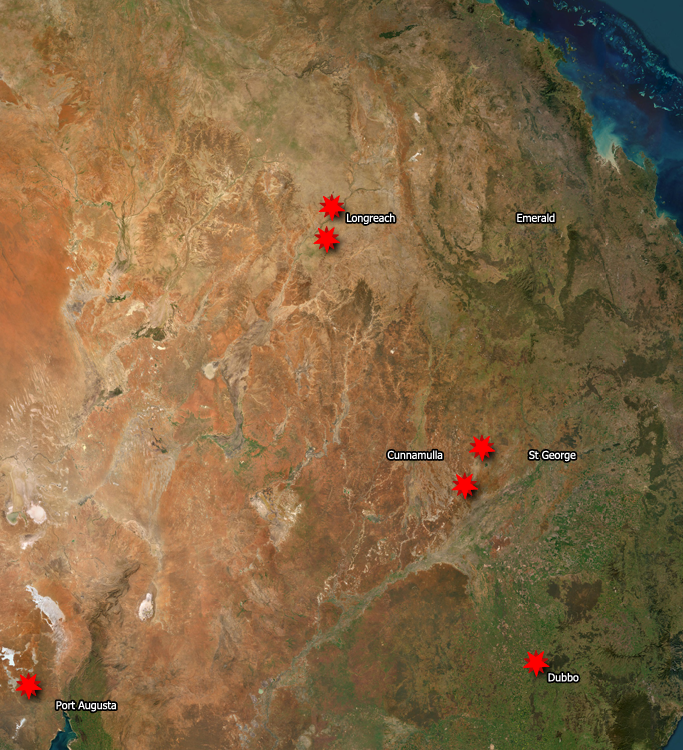
Goat businesses (n = 6) that were involved as pilot sites in the BioBrowser project. Most sites are based in the semi-arid rangelands, an extensive bioregion encompassing the majority of goatmeat production in Australia.