April beef exports above year-ago levels
Key points
-
Australian beef exports reached 140,943 tonnes in April, 11% above April 2025.
-
North America remained the largest market, with exports up 12% YoY.
-
Mainland China recorded strong growth, with both grassfed and specially grainfed exports lifting sharply.
Australian beef exports eased from March to April but remained well above year-ago levels. Total exports reached 140,943 tonnes, 6% lower than March but 11% higher than April 2025.
For the first four months of 2026, Australia exported 506,138 tonnes of beef, 16% more than the same period in 2025. Chilled and frozen exports both lifted 11% year-on-year (YoY) in April, while grassfed exports rose 12% and grainfed exports increased 8%.
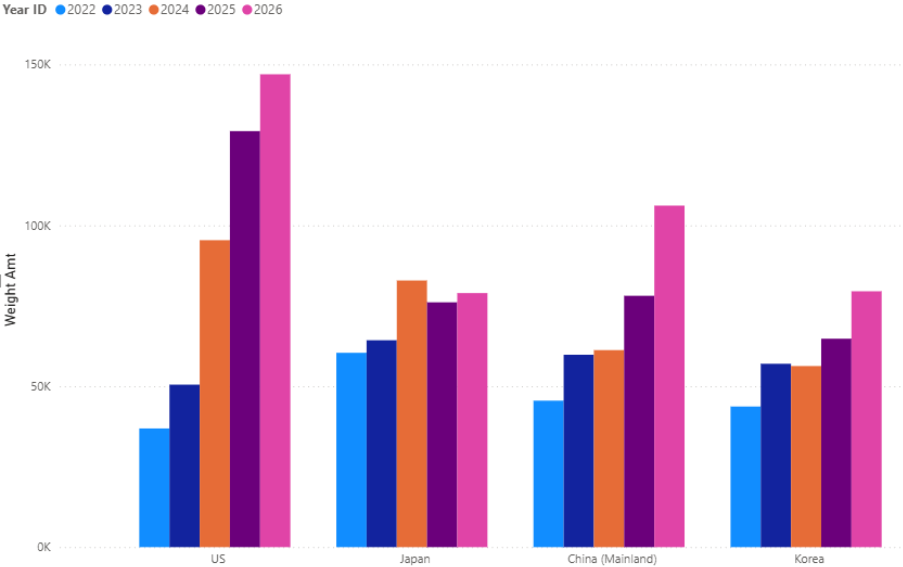
Top four beef export markets (January to April)
Source: DAFF
North America
North America was Australia’s largest beef export market in April, receiving 45,992 tonnes. This was 2% lower than March but 12% higher than April 2025.
The United States accounted for most of the volume, with exports reaching 41,173 tonnes, 11% above April last year. For the year-to-date (YTD), exports to the US surpassed 2015 (144,270 tonnes shipped weight (swt)) with a total export of 146,951 tonnes swt.
Chilled exports to North America increased 25% YoY to 13,645 tonnes, while frozen exports rose 8% to 32,347 tonnes. Grassfed beef continued to dominate the trade, lifting 14% YoY to 44,220 tonnes. Grainfed exports fell 21% to 1,771 tonnes.
For the YTD, exports to North America totalled 163,132 tonnes, 16% above the first four months of 2025.
Greater China
Mainland China recorded the strongest YoY growth among the major markets listed, and the strongest starting year. Australia exported 32,347 tonnes of beef to the region in April, 8% lower than March but 32% higher than April 2025.
The strong start to 2026 has been supported by exporters moving product into China before the safeguard quota is filled. This has contributed to higher early-year shipments and lifted YTD exports to Greater China to 116,201 tonnes, 30% above the first four months of 2025.
Mainland China accounted for the majority of the April volume, receiving 29,572 tonnes. This was 38% higher than April 2025 and was the main driver of growth across the region. By contrast, exports to Taiwan fell 15% YoY to 2,136 tonnes.
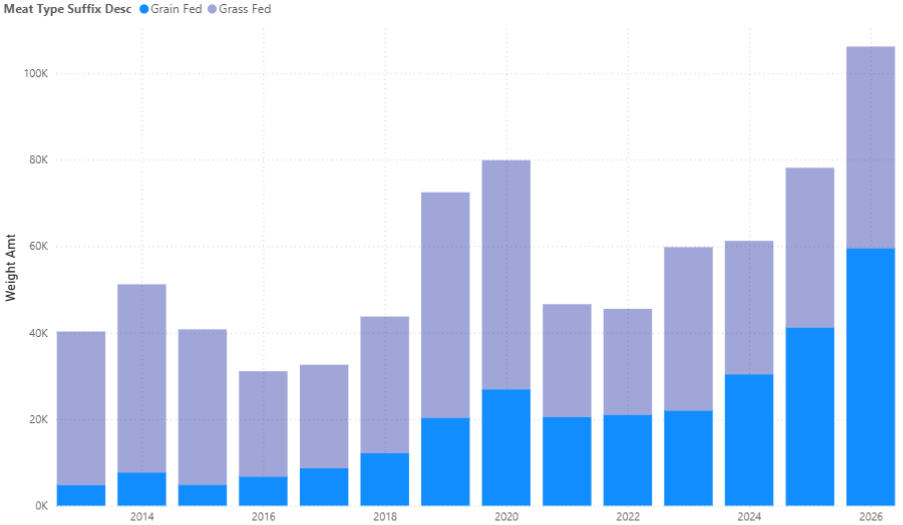
Beef exports to Mainland China by fed (January to April)
Source: DAFF
Growth was broad across product categories, with both grassfed and grainfed beef recording strong increases. Grassfed exports to Mainland China rose 26% YoY to 46,616 tonnes, while grainfed exports experienced the largest increase, lifting 45% to 59,530 tonnes.
Grainfed beef accounted for slightly more than half of total exports to Mainland China in in the first four months of 2026, reflecting the strength of demand across that category and underpinning the overall beef export volume growth over the last three years with at 171%. Grassfed volumes also remained significant, with both production systems contributing to the region’s YoY growth.
Japan and South Korea
Exports to Japan were softer in April, totalling 20,504 tonnes. This was 14% lower than March and 4% below April 2025. Both grassfed and grainfed exports eased YoY, down 4% and 5% respectively. Despite the April decline, YTD exports to Japan remained 4% above the first four months of 2025 at 78,956 tonnes.
South Korea received 22,365 tonnes of Australian beef in April, 12% lower than March but 11% higher than April 2025. The YoY increase was led by frozen and grassfed beef, with frozen exports up 14% and grassfed exports up 24%. YTD exports to South Korea reached 79,518 tonnes, 23% above the same period in 2025.
Overall, April beef exports were lower than March but remained ahead of year-ago levels and on track for a record year. North America continued to account for the largest share of exports, while Greater China’s strong start to the year.
Attribute content to: Emiliano Diaz – MLA Senior Market Information Analyst.
Information is correct at time of writing on 7 May 2026.