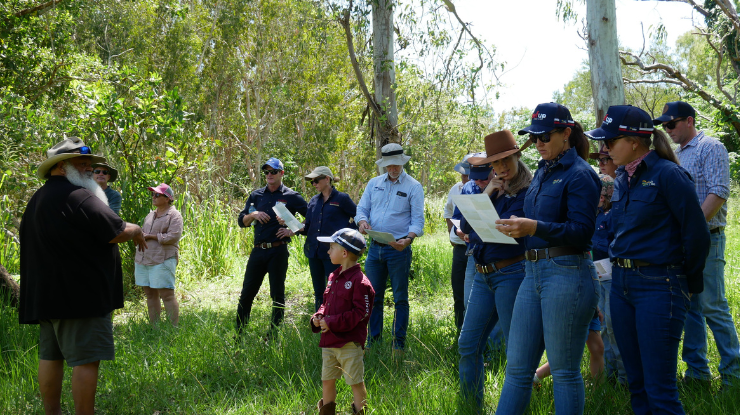
 Hosting 20 fellow NB2 participants on-farm earlier this year, Jacob shared insights on the new Blue Carbon project the station is beginning to embark on – explaining how they will incorporate their extensive water systems into the trials.
Lifting land capability and herd performance on Country
Located on the floodplains and wetlands of North Queensland, ‘Mungalla Station’ has been cared for by the Nywaigi peoples of countless generations.
It was founded as a cattle station in 1882 by Irishman James Cassady and put on the map in 1957 by Monty Aktinson as birthplace of the Droughtmaster breed. The station hit another key milestone in 1999, when ownership returned to its Traditional Custodians.
Farm Snapshot
-
Jacob Cassady‘Mungalla Station’, Ingham, Queensland
-
Area880ha
-
EnterpriseBetween 400 (dry season) and 1,000 (wet season) agisted Brahman cattle
-
PasturesNative pastures, pangola, variable introduced species
-
SoilsVariable – ranges from clays in wetlands to sandy soils
-
Rainfall2,120mm
Today, it’s managed by Jacob Cassady – one of the land’s Traditional Custodians – who plays an integral role in shaping the future of the station.
Here’s a look at how he’s balancing ancient cultural responsibility with modern industry research developments to rebuild land capability and improve herd management.
“Like many producers working and living on the land, Mungalla is not just a beef cattle business but our home, our history and our responsibility to the future generations,” Jacob said.
“I have been actively involved in managing and developing Mungalla for many years now, working across governance, tourism, environmental restoration, and more recently, improved herd performance.”
All in on country
Mungalla Aboriginal Business Corporation was established in 2002 to help bring the Nywaigi peoples back onto Country in a meaningful and economically sustainable way.
“Currently, we operate as an agistment enterprise. Over the past decade, we have developed a strong tourism operation – sharing Nywaigi culture, history and land management practices with visitors from around the world,” Jacob said.
“This has allowed us to maintain income and employment opportunities on-farm while we rebuild our land and business capacity, with the long-term goal of fattening our own cattle on Country.”
Forging links with NB2
As part of their business improvement plan, the Mungalla team connected with Livestock Management Consultant and Northern Breeding Business (NB2) Group Facilitator, Ian Perkins.
“Over the years, we’ve completed workshops with Ian through the Indigenous Land and Sea Corporation (ILSC) – where we also connected with other skilled and knowledgeable producers,” Jacob said.
“We got involved in the NB2 program under Ian’s guidance in 2021 with the goal of improving our business management strategies on and off-farm, and building confidence and capability within our team.”
NB2 is a peer-driven business improvement program that supports producers to lift productivity, sustainability and profitability through better decision-making and data use.
While NB2 is open to all northern cattle producers, a dedicated Indigenous group was established during the program’s pilot phase to better reflect the governance, cultural and operational realities of Indigenous-owned enterprises.
Today, the program brings together 12 Indigenous-owned properties across more than three million hectares – placing strong emphasis on creating culturally appropriate learning environments, supporting employment and training pathways, and strengthening connections between Indigenous and non-Indigenous producers.
Reading the country, responding with confidence
Intense wet seasons – often with flooding – followed by unpredictable dry periods mean the team at Mungalla deals with significant climate variability.
Growing industry expectations around sustainability and traceability also bring their own separate challenges.
“A lot of Indigenous-owned enterprises have little historical access to industry extension or peer networks,” Jacob said.
“We saw NB2 as an opportunity to overcome these challenges and improve on-farm productivity and profitability in a way that incorporates our cultural values.”
Through NB2, Jacob and his team assessed their current operation to identify gaps in knowledge, skills, capacity and/or capabilities.
They determined four focus areas:
- Review paddock condition and grazing pressure
The team assessed paddock condition across the property to gain a clearer understanding of how different areas respond to seasonal conditions, flooding and grazing pressure.
- Introduce more structured planning around stocking and livestock movement
They began planning stocking rates and cattle movement more deliberately, with the aim of better matching stock numbers to carrying capacity and seasonal conditions.
- Improve monitoring and record-keeping systems
Greater focus was placed on monitoring pasture condition, water points and overall land condition, alongside improving record-keeping to support more consistent, data-informed decision-making.
- Strengthen governance and reporting processes
For the community-owned corporation, this included clarifying roles, strengthening internal reporting and improving accountability for more effective operational and business decisions.
While still early in the process, these changes have already delivered tangible outcomes.
“The biggest value of NB2 has been the practical, on-ground learning,” Jacob said.
“Being able to work directly with experienced industry mentors and apply what we’re learning straight back into our own operation has made a real difference.
“We have a far better understanding of our land’s carrying capacity and how different parts of the station respond.
“It’s improved our planning capabilities and given our staff and leadership more confidence in the decisions we’re making.”
Governance support has been a particularly valuable component of the NB2 program for the community-owned enterprise.
“The decisions we make need to reflect both cultural authority and business responsibility, and NB2 has helped us strengthen systems that are transparent, sustainable and aligned with our long-term vision.”
Think tradition, think technology
For centuries, storytelling has been central to how knowledge is shared within Indigenous communities.
This traditional teaching approach was reflected with the rollout last year of virtual and augmented reality tools as part of phase two of the NB2 program. These were designed to deliver practical, on-farm learning for Indigenous cattle producers in a culturally relevant and accessible way.
Developed by immersive technology provider Think Digital, the tools use virtual farm tours, ‘campfire’ style discussions and interactive simulations to support learning around herd health, biosecurity and decision-making.
Training can be accessed via mobile phones, laptops or virtual reality headsets, enabling producers to engage no matter the distance.
Working together
Jacob said peer-to-peer learning was one of the most powerful parts of the program.
“And NB2 did an amazing job at enabling that with the creation of a culturally safe space where we could speak openly about our current challenges and future aspirations,” he said.
“Building a network of producers from different places facing similar challenges has also been incredibly valuable in helping us realise that we’re not working through these issues alone.
“We learned practical grazing and business strategies from others, but also different approaches to managing land in challenging environments.
“In return, we shared our perspective on cultural land management, holistic thinking, and the importance of long-term stewardship over short-term gain.”
Connection is culture
Earlier this year, Jacob hosted 20 NB2 participants at Mungalla – bringing together Indigenous and non-Indigenous cattle producers.
Producers toured the station and its surrounding wetlands, gaining insights into Mungalla’s land management, tourism and cultural programs, and strategic direction.
“It was a proud moment for us to have everyone on Country and share the work we have done – not just as a cattle operation, but as a cultural and community-driven enterprise,” Jacob said.
“It was also a great opportunity for Indigenous and non-Indigenous producers to connect and learn from each other – something I see as essential if we’re going to continue to lift land management standards across the industry.”
Building the future
For Jacob, education, land conservation and strong community connection are central to good stockmanship and a sustainable future for the land.
Through initiatives such as the Silver Lining School, Mungalla is supporting rural secondary students – particularity Aboriginal and Torres Strait Islander – by reconnecting learning to Country, culture and real-world opportunities.
Alongside this, the station is building pathways for young Indigenous adults to develop practical stockmanship skills and land management knowledge, with training designed to lead directly to meaningful employment.
The goal, Jacob says, is to enable young people to live and work on Country in ways that are both culturally grounded and economically viable – strengthening communities while building the next generation of skilled land managers.
“Beyond productivity and profitability, producers – Indigenous and non-Indigenous – have a shared responsibility to care for the land in ways that sustain it for future generations.
“We also have a responsibility to teach and empower our next generation of landowners, ensuring the hands that carry our industry forward are both competent and caring.”