What do safeguards mean for Australia’s grainfed sector?
Key points
- Feedlot capacity reached a record high in the June 2026 quarter, totalling 1,794,806 head.
- July export data demonstrated that grainfed beef exports were down 15% year-on-year despite feedlot utilisation and capacity rates remaining at record highs.
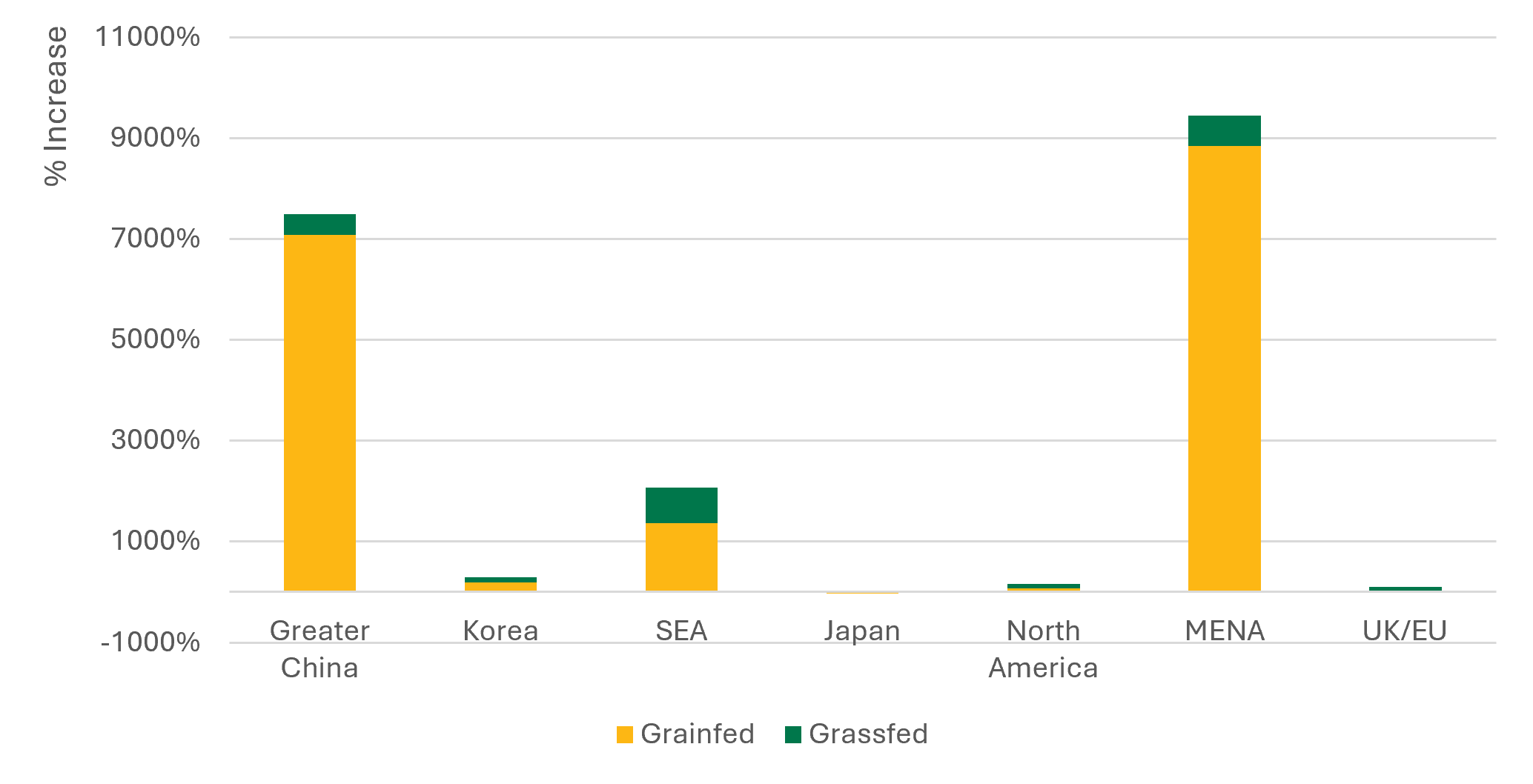
- Between FY06 and FY26, grainfed exports recorded the strongest percentage increase, reflecting sustained global demand.
Following the safeguard triggers for Mainland China and Korean beef exports on 18 June and 21 July respectively, it is still too early to fully understand the long-term implications for Australia's red meat export markets. However, current indicators show that feedlot utilisation and cattle turn-off appear to be holding relatively firm.
Feedlot capacity reached a record high, totalling 1,794,806 head in the June 2026 quarter, up from 1,777,893 head in March 2026 and 1,706,272 head in June 2025. Cattle turn-off has softened across most states, which may reflect Mainland China's safeguard quota getting close to capacity. Queensland was the exception, recording a 3.2% increase in turn-off during the quarter of June. Victoria experienced the largest decline, with turn-off numbers falling 6.9% compared to March 2026 quarter.
July export data demonstrated that grainfed beef exports were down 15% year-on-year despite feedlot utilisation and capacity rates remaining at record highs. In March 2026, cattle on feed in the 200–299 day-on-feed (DOF) category increased by 71% compared with the previous quarter. Similarly, the 300+ DOF category recorded an increase of 33%. This suggests the grainfed sector is well positioned to respond once quota allocations reset in January next year.
Looking beyond the immediate impact of the safeguard triggers, the longer-term outlook for grainfed beef remains an important consideration. A 20-year analysis of exports across Australia’s major overseas markets shows that grainfed beef has significantly developed. FY06 and FY26, grainfed exports were compared and recorded the strongest percentage increase, reflecting sustained global demand and reinforcing the importance to Australia’s export portfolio.
Percentage increase in Australian beef exports by key region and production system (FY06 vs FY26)
The longer-term export analysis also highlights the importance of maintaining a diverse export market portfolio, particularly as access conditions change in individual markets. Recent export growth across several destinations provides alternative opportunities for Australian beef
- Japan: In July, Australia exported 24,744 tonnes of beef to Japan. This is up 3% compared to June and 7% higher than July 2025.
- South-East Asia: In July, Australia exported 21,063 tonnes of beef to South-East Asia, 35% more than June and 50% more than July 2025.
- MENA: In July, Australia exported 6,501 tonnes of beef to MENA, 14% more than June and 89% more than July 2025.